Enhanced Glycaemic Control in Type 2 Diabetes: Digital Therapeutic Glucura Combined with CGM Shows Superior 6-Month Outcomes
Highlight
- Integration of the digital therapeutic glucura with intermittent continuous glucose monitoring (CGM) led to a significantly greater HbA1c reduction compared to CGM alone in non-insulin-treated type 2 diabetes.
- The intervention group achieved more frequent glycaemic targets (<7.0% and <6.5% HbA1c) and greater weight loss over 6 months.
- Improvements extended beyond glycaemic control, including better mental health and reduced diabetes-related distress, with consistent effects across subgroups.
- No device-related serious adverse events were reported, demonstrating safety in routine clinical use.
Study Background
Type 2 diabetes mellitus (T2DM) represents a major global health burden characterized by chronic hyperglycaemia and associated microvascular and macrovascular complications. Optimal glycaemic control reduces complications but remains challenging, particularly in patients managed without insulin. The American Diabetes Association (ADA) Standards of Care 2026 have expanded recommendations for intermittent use of continuous glucose monitoring (CGM) in non-insulin-treated T2DM to improve self-management and glycaemic outcomes. However, the incremental benefit of CGM alone in the context of high-quality standard care remains modest.
Digital therapeutics represent a promising adjunct, delivering personalized lifestyle interventions and structured self-management support through app-based platforms. The digital therapeutic glucura is designed to integrate CGM data with behavior modification strategies to enhance diabetes management. This randomized controlled trial (RCT) evaluates whether combining glucura with intermittent CGM and standard care improves glycaemic control and patient-centered outcomes more effectively than CGM and standard care alone over 6 months.
Study Design
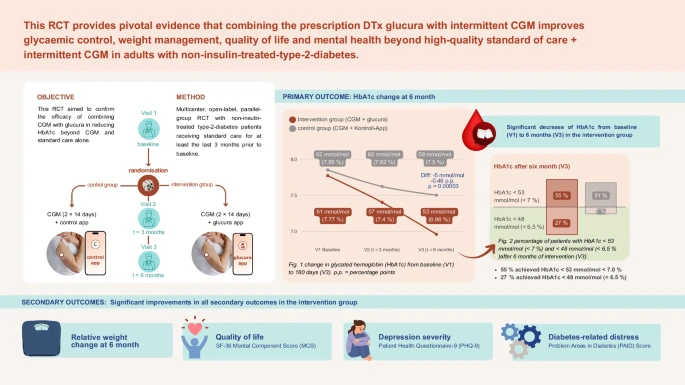
The study was a multicenter, open-label, randomized controlled trial (RCT) conducted across 24 sites in Germany (Trial ID DRKS00032537). Adults aged 18 years and older with non-insulin-treated T2DM were enrolled if they had an HbA1c between 53 and 97 mmol/mol (7.0%–11.0%) and a body mass index (BMI) ≥25 kg/m2. All participants received high-quality standard clinical care per guidelines.
Participants were randomized in a 1:1 ratio to either the intervention group, which received the glucura digital therapeutic alongside intermittent CGM, or to the control group, which used a control app plus intermittent CGM. CGM sensors were provided every 3 months throughout the 6-month study and had not been used by participants prior to enrollment. Randomization employed centralized, stratified block methods to ensure balance across groups. Neither participants nor clinical personnel were blinded due to the nature of the intervention.
The primary endpoint was the change in HbA1c from baseline to 6 months. Secondary endpoints included changes in body weight, attainment of HbA1c targets (<7.0% and <6.5%), and patient-reported outcomes such as mental health and diabetes-related distress. Safety assessments focused on device-related adverse events.
Key Findings
Among 327 randomized participants (165 intervention, 162 control), 320 were included in the intention-to-treat (ITT) analysis. Baseline characteristics were balanced regarding age, sex, duration of diabetes, BMI, and HbA1c.
The control group, using intermittent CGM and standard care, achieved a modest mean HbA1c reduction of 3.3 mmol/mol (0.30 percentage points) over 6 months. By contrast, the intervention group showed a substantially greater mean HbA1c reduction of 8.7 mmol/mol (0.80 percentage points), corresponding to an adjusted between-group difference of -5.0 mmol/mol (-0.46 percentage points; 95% CI, -7 to -3 mmol/mol; p=0.00003).
More patients in the intervention arm reached glycaemic targets: 55% versus 31% achieved HbA1c <53 mmol/mol (7.0%) (odds ratio [OR] 3.38, exploratory p=0.0002), and 27% versus 7% achieved HbA1c <48 mmol/mol (6.5%) (OR 6.63, exploratory p=0.0001). Mean weight loss at 6 months was significantly greater in the glucura group (4.11% vs. 1.79%; p<0.0001).
Additionally, improvements were observed in patient-centric outcomes. Measures of mental health and diabetes-related distress significantly improved in the intervention cohort, indicating psychosocial benefits. These improvements were consistent across subgroups stratified by age, sex, diabetes duration, and baseline HbA1c.
Importantly, no device-related serious adverse events were reported, supporting the safety of integrating glucura with CGM in routine practice.
Expert Commentary
This trial provides compelling evidence supporting the additive benefit of a digital therapeutic incorporating personalized lifestyle and self-management interventions alongside intermittent CGM in adults with non-insulin-treated T2DM. The magnitude of HbA1c reduction (-0.46 percentage points beyond CGM alone) is clinically meaningful and compares favorably to many pharmacologic treatments.
The improvement in weight and mental health outcomes highlights the multidimensional advantages of behaviorally focused digital therapeutics, addressing the complex challenges of diabetes management beyond glucose metrics. The consistent benefits across subpopulations suggest broad applicability.
Study limitations include the open-label design, which could introduce performance bias, and a follow-up limited to 6 months, precluding long-term efficacy and sustainability assessment. Furthermore, the trial was funded by the manufacturer of glucura (Perfood Laboratories GmbH), calling for independent replication.
Nevertheless, the findings align with a growing body of evidence endorsing digital tools as complementary therapies in chronic disease care. Future research should evaluate cost-effectiveness, implementation strategies, and integration with existing healthcare infrastructures.
Conclusion
In adults with non-insulin-treated type 2 diabetes receiving high-quality standard care, combining the digital therapeutic glucura with intermittent CGM offers significant improvements in glycaemic control, weight management, and mental health over 6 months compared with CGM usage alone. This approach may represent an impactful, scalable adjunct to current diabetes care paradigms, enhancing holistic patient outcomes.
Funding and Trial Registration
This study was funded by Perfood Laboratories GmbH. The trial is registered with the German Clinical Trials Register under ID DRKS00032537.
References
1. American Diabetes Association. Standards of Medical Care in Diabetes—2026. Diabetes Care. 2026;49(Supplement 1):S1–S200.
2. Freckmann G, König IR, Grube H, et al. Efficacy of the digital therapeutic glucura combined with CGM in the treatment of type 2 diabetes: a randomised controlled trial over 6 months. Diabetologia. 2026-10-01; PMID: 42820970.
3. Peters AL, Ahmann A, Battelino T, et al. Advances in continuous glucose monitoring and hybrid closed-loop systems in type 1 and type 2 diabetes. Diabetes Care. 2022;45(2):277-288.
4. Greenwood DA, Gee PM, Fatkin KJ, Peeples M. A systematic review of reviews evaluating technology-enabled diabetes self-management education and support. J Diabetes Sci Technol. 2017 Nov;11(5):1015-1027.
This article was created using several editorial tools, including AI, as part of the process. Human editors reviewed this content before publication.