We use cookies

Our website uses essential cookies and, with your consent, additional cookies to measure performance and improve our services. Cookie Policy.

You can change your choice at any time.

MMedXYNews
HomeVideos
MedXY AI/MedXY News/Section: Critical Care

Optimizing Antibiotic Duration in Neonatal Early-Onset Sepsis: Evidence from the DURATION Trial
MedXY Editorial Team•Sep 4, 2026•Critical Care
early-onset sepsisindividualized treatmentneonatesantibiotic stewardship

Highlight

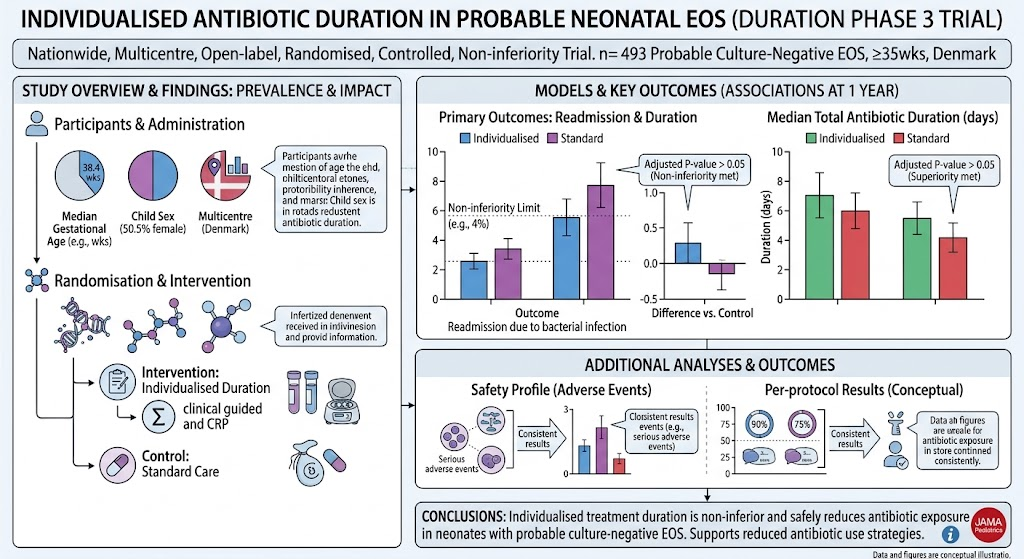
  • Individualised antibiotic treatment shortening therapy to median 3 days is safe and effective in culture-negative early-onset sepsis (EOS) among late-preterm and term neonates.
  • The approach significantly reduces antibiotic exposure compared to standard 5-7 days, potentially limiting antibiotic resistance and other adverse outcomes.
  • Non-inferiority was demonstrated for infection-related readmissions, supporting a clinically guided, biomarker-informed strategy.
  • The multicentre Danish DURATION trial provides robust evidence supporting antibiotic stewardship in neonatal EOS management.

Study Background: Clinical Context and Unmet Need

MedXY registered readers

Sign in free to continue reading

Create or use your MedXY account to unlock the complete article.

This article was created using several editorial tools, including AI, as part of the process. Human editors reviewed this content before publication.

Related articles

Open language-specific specialty feeds and department pages.

Rapid Respiratory Point-of-Care Testing and Antibiotic Use in Primary Care: A Randomized Clinical TrialA randomized trial found that rapid respiratory point-of-care testing did not reduce same-day antibiotic prescribing in primary care, though it was safe and may help when a virus is detected.May 26, 2026Institutional Policy Shifts on Penicillin Allergy Labels Dramatically Increase Cefuroxime Use in Cataract SurgeryA large-scale quality improvement study reveals that reclassifying penicillin allergies and providing pharmacy support can increase the use of intracameral cefuroxime from 2% to over 70%, significantly improving evidence-based prophylaxis iMar 13, 2026Beyond the Hospital Walls: Can Prospective Audit and Feedback Solve the Discharge Antibiotic Dilemma?A multicenter stepped-wedge trial reveals that while prospective audit and feedback by stewardship teams improves the quality of discharge antibiotic prescribing, it fails to reduce the overall volume or duration of therapy, highlighting thJan 16, 2026Combined Multiplex PCR and Procalcitonin Strategy Fails to Increase Antibiotic-Free Days in Critically Ill Patients with CAP: Insights from the MULTI-CAP Trial
Loading comments...
MedXY briefing

Get the free newsletter

Evidence-led clinical news, trends, and analysis—delivered to your inbox.

Ask MedXY AI

Most popular

Intimate Health
Five Benefits for Women Continuing Sexual Activity After Menopause
Intimate Health
Why Some Women Have a Strong Sex Drive—And Why Men Shouldn't Worry About It
Nursing & care
How often should a couple have sex?
Intimate Health
Classic Intimacy Recommendations: How to Help Women Reach Orgasm and Enjoy Mutual Pleasure
Intimate Health
What Makes a Woman "Physiologically Addicted" Is Never Money, But These Two Relationship Qualities
© 2026 MedXY
Contact usAbout usPrivacy PolicyMedXY story
The MULTI-CAP trial demonstrated that combining multiplex PCR and procalcitonin did not significantly increase the number of antibiotic-free days by Day 28 in ICU patients with pneumonia, although it did successfully reduce the cumulative d
Dec 31, 2025
Safe Stewardship: Antibiotic De-escalation by Day 4 Reduces Hospitalization Length Without Increasing Mortality in Community-Onset SepsisA large-scale target trial emulation demonstrates that de-escalating anti-MRSA and anti-pseudomonal therapy on day 4 of sepsis treatment is safe, associated with fewer antibiotic days, and leads to shorter hospital stays compared to continuDec 24, 2025
Shorter Is Safe: Adjusted Analyses of BALANCE Confirm Non‑Inferiority of 7‑Day Antibiotic Courses for Uncomplicated Bloodstream InfectionA post-hoc analysis of the BALANCE randomized trial shows that after accounting for treatment non-adherence using causal inference methods, 7 days of antibiotics for uncomplicated non‑Staphylococcus aureus bloodstream infection remains non‑Nov 23, 2025