Highlight
Airway occlusion maneuvers are feasible and effective during noninvasive ventilation (NIV) for assessing inspiratory effort and lung mechanics in hypoxemic patients after extubation.
Expiratory occlusion pressure (Pocc)-derived estimates correlate well with esophageal pressure measurements, providing reliable noninvasive markers of inspiratory effort and lung stress.
Ventilator-derived 100-ms airway pressure drop (P0.1) and plateau pressure during NIV show limited reliability in quantifying respiratory drive and lung mechanics.
Noninvasive measurements of predicted inspiratory effort and lung compliance were associated with risk of reintubation, carrying important prognostic implications.
Study Background
Noninvasive ventilation (NIV) is a cornerstone therapy for hypoxemic respiratory failure, frequently applied after extubation to support lung function and reduce reintubation rates. Assessing patients’ inspiratory effort, respiratory drive, and lung mechanics during NIV is critical to optimize ventilator settings, monitor treatment response, and identify patients at risk for deterioration.
Traditionally, invasive esophageal manometry is the reference standard for measuring inspiratory effort and transpulmonary pressure, but it is technically demanding and less practical outside intensive care units. Airway occlusion maneuvers—transiently blocking airflow at end-inspiration or expiration—have been validated in intubated patients as a noninvasive surrogate to estimate inspiratory effort (via esophageal pressure swing) and lung mechanics. However, the utility and reliability of occlusion maneuvers during NIV remain insufficiently characterized.
This study addresses the unmet clinical need for reliable, bedside-applicable, noninvasive tools to monitor respiratory mechanics and drive during NIV to improve patient safety and ventilator management.
Study Design
This multicenter, randomized crossover trial included 60 hypoxemic patients who underwent two distinct 1-hour NIV sessions using oronasal and full-face masks consecutively after planned extubation. Patients were assessed within a short post-extubation timeframe.
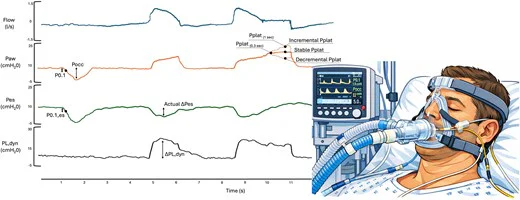
The protocol involved performing end-expiratory and end-inspiratory airway occlusion maneuvers during NIV to measure:
– Expiratory occlusion pressure (Pocc)
– 100-ms airway pressure drop (P0.1), an index commonly used to evaluate respiratory drive
– Plateau airway pressure
A calibrated esophageal manometer placed before extubation served as the reference standard, measuring esophageal pressure swing (ΔPes) representing inspiratory effort and dynamic transpulmonary driving pressure (ΔPL,dyn). Interface-specific conversion factors (K) were developed to translate Pocc into predicted ΔPes and corresponding transpulmonary pressures. The dataset was divided into derivation (20 patients) and validation cohorts (40 patients) using a cross-validation approach.
The study also analyzed associations between the noninvasive measurements and clinical outcomes, including reintubation rates.
Key Findings
Feasibility and Measurement Accuracy
Pocc was successfully measurable in all enrolled patients regardless of mask type, demonstrating the maneuver’s general feasibility during NIV.
Conversion factors were mask-specific: 0.71 (oronasal mask) and 0.80 (full-face mask), reflecting differences in mask leak and interface mechanics. Applying these factors, the predicted inspiratory effort (ΔPes) from Pocc closely agreed with esophageal-derived ΔPes, revealing small biases and tight 95% limits of agreement:
– Oronasal mask: bias -0.41 cm H2O; limits of agreement -2.3 to 1.5 cm H2O
– Full-face mask: bias 0.09 cm H2O; limits of agreement -2.9 to 3.1 cm H2O
Similarly, predicted dynamic transpulmonary driving pressure agreed with measured values with minimal bias.
Diagnostic Performance and Respiratory Drive Assessment
Predicted ΔPes demonstrated excellent accuracy in identifying patients with clinically significant inspiratory effort (ΔPes ≤ -10 cm H2O), yielding areas under the receiver operating characteristic curve of 0.98 for oronasal and 0.97 for full-face masks, indicating outstanding discrimination.
Ventilator-derived P0.1 did not reliably quantify respiratory drive precisely. However, threshold values (>2.7 cm H2O for oronasal, >3 cm H2O for full-face) were highly specific (>90%) for detecting high respiratory drive.
Plateau pressure, traditionally informative in invasive ventilation, proved unstable in the vast majority of patients (78% with oronasal, 90% with full-face masks), limiting its clinical utility during NIV.
Clinical Associations and Prognostic Value
More negative predicted ΔPes (greater inspiratory effort), higher predicted transpulmonary driving pressure, and lower predicted lung compliance (defined as expiratory tidal volume divided by transpulmonary pressure) were significantly associated with subsequent need for reintubation. These findings highlight the potential clinical relevance of noninvasive occlusion-derived parameters for risk stratification and ventilator management decisions.
Expert Commentary
This well-powered, meticulously designed study contributes valuable translational insights by validating airway occlusion maneuvers as practical, noninvasive tools to quantify inspiratory effort and lung mechanics during NIV, filling a critical gap in respiratory monitoring post-extubation. Its multicenter design and inclusion of different NIV interfaces enhance external validity.
The use of calibrated esophageal manometry as a gold standard strengthens the rigor of findings. The interface-dependent calibration factors underscore the need to consider mask effects on airway pressure dynamics when applying occlusion data.
Previous work highlighted the challenges of assessing lung mechanics noninvasively during NIV due to interface leaks and patient variability; this study provides evidence that Pocc maneuvers can overcome these limitations more effectively than ventilator-derived metrics like P0.1 or plateau pressure.
Limitations include the short observation window (two 1-hour sessions) and specific patient population limited to hypoxemic post-extubation cases, which may affect generalizability to broader NIV populations such as hypercapnic respiratory failure or more heterogeneous lung pathology.
Future research should address the longitudinal application of occlusion maneuvers, explore automated real-time analytics, and integrate noninvasive mechanical assessment into clinical decision algorithms for NIV titration and early detection of deterioration.
Conclusion
Airway occlusion maneuvers during NIV provide clinically applicable, noninvasive estimates of inspiratory effort, respiratory drive, and lung mechanics with accuracy approaching invasive esophageal pressure measurement. Predicted inspiratory effort and transpulmonary driving pressures derived from Pocc effectively identify patients with heightened respiratory effort and correlate with the risk of reintubation.
In contrast, traditional ventilator parameters such as P0.1 and plateau pressure show limited utility during NIV. Incorporating occlusion-derived indices into clinical practice could enhance respiratory monitoring and ventilator management in hypoxemic patients receiving NIV, improving individualization of care and potentially outcomes.
Funding and ClinicalTrials.gov
The study received funding support from institutional and research grants as disclosed by the authors. No clinical trial registration number was reported in the publication.
References
1. Murgolo F, et al. Airway occlusions to measure inspiratory effort, respiratory drive, and lung mechanics during noninvasive ventilation. Am J Respir Crit Care Med. 2026;212(11):2756-2768. doi:10.1164/rccm.202605-0847OC.
2. Tonelli R, et al. Inspiratory effort assessment during mechanical ventilation: a clinical perspective. Intensive Care Med. 2020;46(10):1993-2004. doi:10.1007/s00134-020-06192-x.
3. Brochard L, et al. Ventilatory drive and respiratory muscle effort during NIV. Semin Respir Crit Care Med. 2018;39(3):279-289. doi:10.1055/s-0038-1641226.