Patient Information
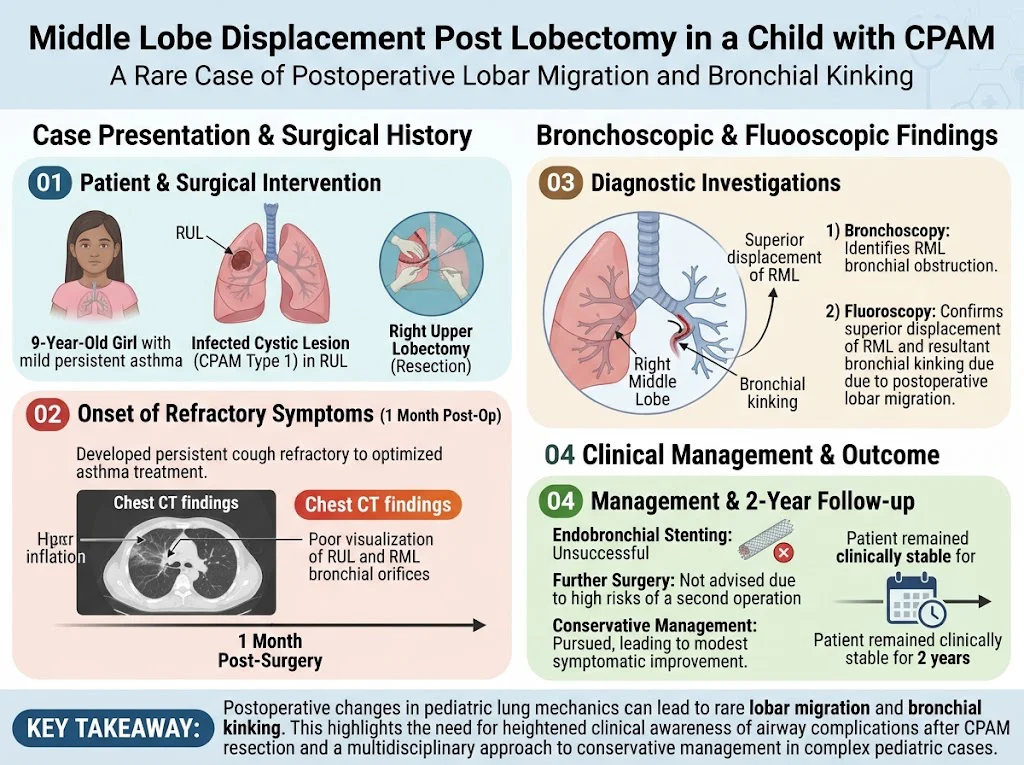
A 9-year-old female with a history of mild persistent asthma presented to the pediatric pulmonology clinic for evaluation of a cystic lung lesion. The patient was otherwise well, with no history of recurrent severe respiratory infections or significant hospitalizations. She exhibited intermittent cough and occasional wheezing consistent with her asthma diagnosis but no acute distress at presentation. There was no familial history of congenital lung disease or cystic lung lesions.
Diagnosis
Initial evaluation including chest radiography and computed tomography (CT) of the chest revealed an infected cystic lesion localized to the right upper lobe, suspicious for congenital pulmonary airway malformation (CPAM). The CT scans showed multiple cystic spaces with surrounding inflammation in the right upper lobe consistent with a type 1 CPAM morphology. Bronchoscopy and microbiological cultures excluded active bronchial infection beyond the lesion. After completion of antimicrobial therapy targeting secondary infection, elective surgical resection was planned.
The patient underwent a right upper lobectomy. Histopathological examination of the resected tissue confirmed type 1 CPAM characterized by large cystic spaces lined by ciliated pseudostratified columnar epithelium without malignant transformation.
Differential Diagnosis
Differential diagnoses considered included bronchogenic cyst, pulmonary sequestration, cystic fibrosis-associated bronchiectasis, and post-infectious bronchiectatic changes. However, imaging findings and surgical pathology confirmed CPAM. The post-operative persistent cough prompted consideration of asthma exacerbation, bronchial obstruction from postoperative scarring or stenosis, and rarer causes such as airway kinking or lobar displacement.
Treatment and Management
Following lobectomy, the patient’s antibiotic course was completed with clinical improvement. However, one month postoperatively, she developed a persistent dry cough that did not respond to optimized asthma therapy including inhaled corticosteroids and bronchodilators.
Repeat chest CT demonstrated hyperinflation of the right middle lobe (RML) and poor visualization of the right upper and middle lobe bronchial orifices. Given the suspicion of airway obstruction, a diagnostic bronchoscopy was performed, revealing obstruction at the RML bronchus.
Fluoroscopy-guided bronchoscopy further identified superior displacement of the middle lobe, causing kinking and functional obstruction at the bronchial level. This mechanical obstruction was attributed to postoperative lobar migration after upper lobectomy.
Endobronchial stenting was attempted to relieve obstruction but failed to achieve sustained airway patency, likely due to the mechanical nature of displacement and persistent kinking. The multidisciplinary team, including pediatric pulmonologists and thoracic surgeons, recommended against redo surgery owing to the high risk associated with reoperation and potential for further complications.
Conservative management comprising surveillance, symptomatic treatment, and monitoring was pursued. The patient’s asthma regimen was maintained, and supportive care was provided for cough and airway clearance.
Outcome and Prognosis
Over a two-year follow-up period, the patient exhibited modest symptomatic improvement, with a persistent but less frequent cough. She remained clinically stable without recurrent infections or significant respiratory distress. Pulmonary function tests revealed no significant decline in lung volumes or airflow obstruction. Imaging follow-up showed stable position of the RML without progressive atelectasis or consolidation.
The patient continues on regular pulmonology follow-up with supportive respiratory care and monitoring for potential late sequelae.
Discussion
Congenital pulmonary airway malformations (CPAM) represent a common subset of congenital cystic lung lesions detected in children, often requiring surgical resection when symptomatic. Lobectomy for localized CPAM is the standard treatment to remove diseased tissue and prevent infection or malignant transformation.
While immediate postoperative outcomes are generally favorable, long-term anatomical and functional consequences in pediatric patients after lobectomy remain incompletely characterized. Changes in pulmonary mechanics and lobar anatomy can provoke uncommon complications such as lobar displacement and subsequent bronchial obstruction.
Obstruction of the right middle lobe bronchus secondary to postoperative lobar migration is a rarely reported complication, predominantly described in adult surgical cohorts. This case presents one of the few pediatric reports highlighting this complication after CPAM resection.
Anatomically, the right middle lobe is predisposed to airway obstruction due to its narrow bronchus and angulated orientation. Post-lobectomy, disruption of normal lobar attachments can permit abnormal lobar movement and bronchial kinking. This mechanical obstruction manifests clinically as persistent cough, air trapping, and hyperinflation, which may mimic asthma exacerbation or infection.
Diagnosis requires high clinical suspicion and multimodal imaging including CT and bronchoscopy, often enhanced by fluoroscopy to assess dynamic airway changes. Therapeutic options are limited; endobronchial stenting is challenging and may be insufficient to correct mechanical kinking. Surgical re-intervention carries significant risks and is generally discouraged unless severe compromise occurs.
Conservative management with symptom control and vigilant follow-up is a pragmatic approach, balancing risks and benefits in pediatric patients.
This case underscores the importance of awareness of rare postoperative sequelae in children undergoing lobectomy for CPAM. Multidisciplinary collaboration is essential to optimize diagnosis and tailor management. Further pediatric-focused studies are needed to elucidate risk factors and preventive strategies for lobar displacement and airway obstruction post-lobectomy.
References
1. Stocker JT. Congenital pulmonary airway malformation: Results of surgical and nonsurgical management. Pediatr Pulmonol. 2002;33(1):20-26.
2. Felker RE, Ratner LE. Right middle lobe syndrome: causes and treatment. Thorac Surg Clin. 2008;18(4):333-339.
3. Tsang V, Bissett B, McLean A, et al. Long-term lung function and imaging follow-up after lung resection in children with congenital cystic lung malformations. Eur J Pediatr Surg. 2013;23(3):238-244.
4. Fernández-Pineda I, Becker JA, Gudinchet F, et al. Complications after lobectomy in children with congenital lung malformations. Eur J Cardiothorac Surg. 2016;50(5):940-946.
5. Martinez C, Wang HL. Adult middle lobe bronchial obstruction after lobectomy: diagnosis and management. J Thorac Dis. 2018;10(3):1781-1786.
(Article based on case report: Zahra MA, Patel N, Mansour A, Rastogi D. Middle Lobe Displacement Post Lobectomy in a Child With Congenital Pulmonary Airway Malformation. Pediatrics. 2026-11-04. PMID: 42976939.)