Rising Burden of Non-Cystic Fibrosis Bronchiectasis in U.S. Primary Care: A Decade of Prevalence Trends and Demographic Insights (2015–2025)
Highlight
- Prevalence of non-cystic fibrosis bronchiectasis (NCFB) in U.S. adults rose by 133% from 2015 to 2025.
- In 2025, age-adjusted prevalence reached 270.3 per 100,000 in a large primary care population studied.
- NCFB disproportionately affects older adults, females, and white individuals, with Medicare coverage being more common among cases.
- Large-scale EHR data provides valuable epidemiologic insights to inform clinical awareness and health policy.
Study Background
Non-cystic fibrosis bronchiectasis (NCFB) is a chronic respiratory condition characterized by irreversible bronchial dilation, leading to recurrent infections, inflammation, and impaired mucociliary clearance. Although recognized increasingly in clinical practice, contemporary epidemiological data on its burden in the general U.S. population remain limited. Historically considered a relatively rare condition, recent studies suggest its prevalence is rising, partly due to improved recognition and diagnostic availability such as chest computed tomography (CT). Understanding the prevalence trends and demographic distribution of NCFB is essential to optimize clinical management strategies, allocate healthcare resources, and identify potential risk groups requiring targeted interventions.
Study Design and Methods
This study conducted a retrospective, repeated cross-sectional analysis of the Epic Cosmos electronic health record database, one of the largest de-identified clinical data repositories, containing records of over 307 million U.S. patients. The primary care (PC) population consisted of adults aged 18 years or older who had at least one visit to an internal medicine, family medicine, geriatrics, or gynecology provider between January 1, 2015, and December 31, 2025.
Bronchiectasis cases were defined by a comprehensive algorithm involving ICD-10 and CPT codes with the following criteria: either a documented discharge diagnosis, two clinic encounters billed for bronchiectasis, or a single clinic visit with a bronchiectasis diagnosis preceded by a chest CT scan. This stringent case definition aimed to improve specificity by minimizing false positives. Annual age-adjusted prevalence rates were calculated per 100,000 PC population with 95% confidence intervals (CI). Multivariable regression analyses adjusted for demographic factors and insurance status were performed to examine associations.
Key Findings
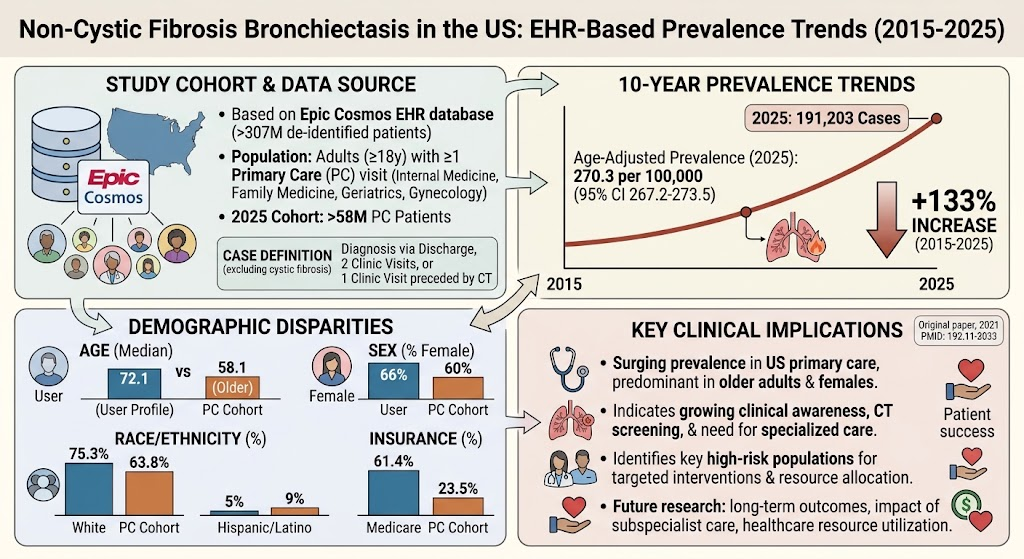
In 2025, the PC cohort encompassed over 58 million adult patients, among whom 191,203 fulfilled the bronchiectasis case definition, resulting in an age-adjusted prevalence of 270.3 per 100,000 (95% CI, 267.2–273.5). This represents a 133% increase from 2015, highlighting a striking upward trend over the decade.
Demographic comparisons revealed key distinctions between patients with bronchiectasis and the general PC population. Those with NCFB were on average older (mean age 72.1 vs. 58.1 years), predominantly female (66% vs. 60%), and more frequently identified as white (75.3% vs. 63.8%). Conversely, bronchiectasis patients were less likely to identify as Hispanic or Latino (5.0% vs. 9.0%). Furthermore, a higher proportion of bronchiectasis cases were covered by Medicare insurance (61.4% vs. 23.5%), consistent with the older age profile.
The results underscore that NCFB disproportionately burdens older adults and females, groups known to carry a higher risk for chronic respiratory disorders. The increased diagnosis rate may reflect growing clinician awareness, better access to diagnostic CT imaging, or a true increase in disease incidence possibly related to aging demographics and comorbid conditions.
Expert Commentary
This study leverages one of the largest EHR databases to provide robust, population-based prevalence estimates of NCFB in the United States, a valuable advancement considering previous data limitations. The methodology’s reliance on objective diagnostic codes combined with imaging criteria enhances diagnostic accuracy.
Notwithstanding its strengths, the study faces inherent limitations related to EHR data, including potential undercoding and missing demographic data. Selection bias could arise as patients who engage with primary care or undergo CT scans are more likely captured. Also, the study excludes cystic fibrosis bronchiectasis but lacks granular clinical data to explore disease severity or etiology.
Future research should focus on longitudinal incidence trends, explore regional and socioeconomic disparities in depth, and assess healthcare utilization and outcomes among bronchiectasis patients. Integration with clinical registries may enrich phenotypic characterization to guide personalized management.
Conclusion
The burden of non-cystic fibrosis bronchiectasis in U.S. adults has markedly increased over the decade from 2015 to 2025, reaching a prevalence of approximately 270 per 100,000 primary care patients. The condition disproportionately affects older adults, females, and white populations, with Medicare coverage predominating among cases. These findings highlight the need for enhanced clinical vigilance, resource planning, and targeted care pathways in aging populations. Electronic health record databases represent powerful tools for ongoing epidemiologic surveillance of bronchiectasis and related chronic respiratory diseases.
Funding and Trial Registration
This study was conducted using data from Epic Systems Corporation’s Epic Cosmos database. Specific funding sources were not reported. No clinical trial registration applies.
References
1. Jung F, MacRae S. Non-Cystic Fibrosis Bronchiectasis in the United States: Prevalence Trends in a Large Electronic Health Record Population, 2015-2025. Chest. 2026 Sep 19. PMID: 42762985.
2. King PT. The Pathophysiology of Bronchiectasis. Int J Chron Obstruct Pulmon Dis. 2009;4:411-419.
3. Chalmers JD et al. Bronchiectasis: Prevalence and Mortality in the United States: Analysis Using National Inpatient Sample Database. Chest. 2018;153(4):979-985.
4. Pasteur MC et al. British Thoracic Society Guideline for Non-CF Bronchiectasis. Thorax. 2010;65 Suppl 1:i1–58.
This article was created using several editorial tools, including AI, as part of the process. Human editors reviewed this content before publication.