We use cookies

Our website uses essential cookies and, with your consent, additional cookies to measure performance and improve our services. Cookie Policy.

You can change your choice at any time.

MMedXYNews
HomeVideos
MedXY AI/MedXY News/Section: Diabetes & Endocrinology

New 2026 EASD Guideline: Practical, Evidence-Based Care for Diabetes Distress in Adults with Type 1 and Type 2 Diabetes
MedXY Editorial Team•Sep 19, 2026•Diabetes & Endocrinology
psychosocial careDiabetes DistressEASD 2026diabetes management

Introduction and Context

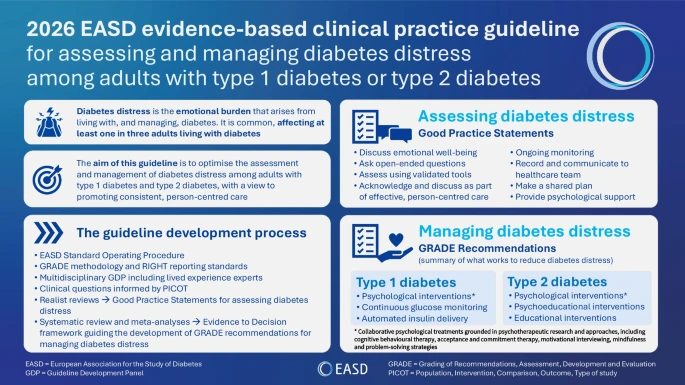
Diabetes distress — the emotional burden and worries arising from living with and managing diabetes — is common and strongly linked to self-care, quality of life and glycaemic outcomes. The European Association for the Study of Diabetes (EASD) has published a focused, evidence-based clinical practice guideline (Speight et al., 2026) on assessing and managing diabetes distress among adults with type 1 diabetes (T1D) and type 2 diabetes (T2D). This guideline responds to growing recognition that routine medical care must include systematic attention to emotional well‑being and that interventions — psychological, educational and technology-based — can reduce distress.

The 2026 EASD guideline was developed with rigorous methods (EASD Standard Operating Procedure, GRADE methodology and RIGHT reporting standards), a multidisciplinary panel that included people with lived experience, and a commissioned systematic review and meta-analysis of randomized controlled trials (RCTs). It issues Good Practice Statements on assessment and GRADE-based recommendations on management, tailored to T1D and T2D.

MedXY registered readers

Sign in free to continue reading

Create or use your MedXY account to unlock the complete article.

This article was created using several editorial tools, including AI, as part of the process. Human editors reviewed this content before publication.

Related articles

Open language-specific specialty feeds and department pages.

Glucose-Derived Personalized HbA1c Correction (GDAC) Study to Improve Alignment Between CGM-Derived Metrics and HbA1c in Different Individuals and Racial Groups With Diabetes: Implications for Clinical PracticeThis study reveals significant HbA1c and glucose discrepancies, especially in Black individuals, and introduces a personalized HbA1c correction (pA1C) that enhances diabetes management across racial groups.Aug 13, 2026Expanding Technology-Enabled, Nurse-Delivered Chronic Disease Care: A Pragmatic, Randomized, Effectiveness-Implementation TrialThis study evaluates comprehensive nurse-led telehealth for uncontrolled type 2 diabetes and hypertension in a fee-for-service setting, finding limited improvement in HbA1c but identifying key barriers to implementation.Jun 30, 2026Hospital Delays in Glucose Checks and Insulin Dosing: Do They Impact Patient Care?Study reveals significant time gaps between fingerstick glucose tests and insulin administration in hospitals, with nearly 30% of cases potentially receiving incorrect insulin doses due to changing glucose levels during delays.Apr 22, 2026
Loading comments...
MedXY briefing

Get the free newsletter

Evidence-led clinical news, trends, and analysis—delivered to your inbox.

Ask MedXY AI

Most popular

Intimate Health
Five Benefits for Women Continuing Sexual Activity After Menopause
Intimate Health
Why Some Women Have a Strong Sex Drive—And Why Men Shouldn't Worry About It
Nursing & care
How often should a couple have sex?
Intimate Health
Classic Intimacy Recommendations: How to Help Women Reach Orgasm and Enjoy Mutual Pleasure
Intimate Health
What Makes a Woman "Physiologically Addicted" Is Never Money, But These Two Relationship Qualities
© 2026 MedXY
Contact usAbout usPrivacy PolicyMedXY story
Bridging the Health-Social Gap: The PACE-It Model Shows Promise for Complex Multimorbidity Management
A pilot randomized controlled trial demonstrates that the PACE-It program, an integrated multidisciplinary team utilizing technology-assisted communication, significantly improves glycemic control, lipid management, and patient activation i
Mar 14, 2026
Beyond the Needle: GRADE Trial Debunks Myths on Insulin Distress and Confirms Adherence as the Glycemic KeyA comprehensive analysis of the GRADE trial substudies reveals that adding basal insulin does not increase emotional distress in early T2DM and highlights the critical, predictive link between medication adherence and long-term glycemic sucFeb 2, 2026
Injectable GLP-1 Use Soars Among US Adults with Diabetes: Trends and Clinical ImplicationsNearly 1 in 4 US adults with diabetes used injectable GLP-1 receptor agonists in 2024, reflecting rising adoption for glycemic control and obesity management with notable demographic disparities.Oct 6, 2025