Highlights
Mivocabtagene autoleucel demonstrated significant and sustained improvement in motor function in antibody-positive stiff person syndrome (SPS) patients refractory to standard immunotherapies.
Safety profile included manageable neutropenia and mostly low-grade cytokine release syndrome (CRS) and immune effector cell-associated neurotoxicity syndrome (ICANS) that resolved without sequelae.
Observed B-cell depletion and immune reset indicate mechanistic engagement of pathogenic B-cell populations driving SPS autoimmunity.
This study introduces a novel immunotherapy paradigm with durable, immunomodulation-free remission potential in SPS, a disease previously lacking highly effective interventions.
Background
Stiff person syndrome (SPS) is a rare, progressive autoimmune neurological disorder clinically hallmarked by fluctuating muscle stiffness, rigidity, and painful spasms, often leading to debilitating disability and impaired ambulation. Anti-glutamic acid decarboxylase (GAD65) and other autoantibodies implicate B-cell–mediated autoimmunity in disease pathogenesis. Conventional management involves symptomatic treatment with benzodiazepines and immunomodulatory or immunosuppressive agents; however, many patients exhibit suboptimal responses and persistent disability. Thus, innovative therapeutic strategies targeting pathogenic immune components are critically needed.
Chimeric antigen receptor (CAR) T-cell therapy targeting CD19-positive B cells has revolutionized treatment of B-cell malignancies, with emerging applications in refractory autoimmune diseases. Mivocabtagene autoleucel is a fully human, autologous CD19-directed CAR T-cell product incorporating the CD28 costimulatory domain, designed to selectively eradicate pathogenic B cells and reset immune tolerance.
Key Content
Clinical Development and Evidence in SPS
The referenced 2026 phase 2 open-label, single-arm, nonrandomized clinical trial (NCT06588491) represents the first pivotal study evaluating mivocabtagene autoleucel in adult patients (18–75 years) with antibody-positive SPS refractory to standard immunotherapies. Twenty-seven patients were enrolled, with 26 receiving treatment following low-dose lymphodepletion (fludarabine and cyclophosphamide) and a single infusion of 1 × 10^8 CAR T cells.
Efficacy Outcomes
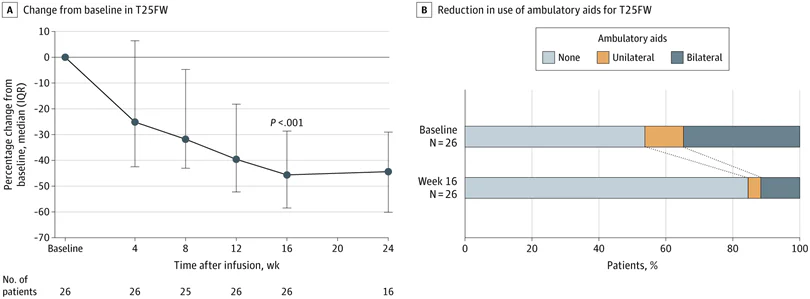
The primary endpoint was change in the timed 25-ft walk (T25FW) at 16 weeks. The study demonstrated a mean T25FW improvement of -7.69 seconds (P < .001), reflecting a median 45.6% improvement sustained at 24 weeks in responders. Secondary endpoints including the modified Rankin Scale, Distribution of Stiffness Index, Heightened Sensitivity Scale, and Hauser Ambulation Index all showed statistically significant improvements (P < .001), indicating broad amelioration in motor function, stiffness distribution, hypersensitivity, and ambulation abilities.
Safety Profile
The most frequent severe treatment-related adverse event was neutropenia (19.2%). Cytokine release syndrome occurred in 92.3% of patients but was limited to grade 1/2, resolving without sequelae. Mild neurotoxicity (ICANS grade 1) was observed in 11.5% of patients with complete resolution. These safety findings align with patterns seen in CAR T-cell therapies for hematologic malignancies, highlighting manageable toxicity with appropriate monitoring.
Pharmacodynamics and Mechanistic Insights
Robust peripheral B-cell depletion was documented post-infusion, supporting on-target CAR T-cell activity. Immune profiling revealed signs of immune reset consistent with diminished autoreactive B-cell populations, potentially underpinning the sustained clinical remissions observed. Pharmacokinetic analyses demonstrated expected CAR T-cell expansion and persistence correlating with clinical benefit.
Contextualizing the Results Within Autoimmune Therapeutics
Prior to this trial, evidence for CAR T-cell therapy in autoimmune neurological diseases was largely anecdotal or limited to case reports. The durable responses and favorable safety in SPS mark a significant advance compared to historical treatments such as plasmapheresis, intravenous immunoglobulin, and chronic immunosuppression, which often require continuous administration and carry long-term risks.
Expert Commentary
The trial by Piquet et al. pioneers the therapeutic translation of B-cell–targeted CAR T-cell therapies in autoimmunity beyond hematologic indications. The nonrandomized design and small sample size represent inherent limitations but are pragmatically justified given SPS rarity.
Clinical applicability is promising for SPS patients with antibody-positive disease refractory to standard care, potentially altering the treatment algorithm by offering a one-time cellular therapy inducing durable remission without ongoing immunosuppression.
Mechanistically, the results corroborate the critical pathogenic role of CD19+ B cells in SPS and highlight the capacity of CAR T-cell therapy to reset autoimmunity. However, longer-term follow-up is essential to confirm durability, monitor late toxicities, and evaluate relapse patterns.
Incorporating CAR T-cell therapy into neurological autoimmunity requires multidisciplinary expertise, infrastructure for cellular therapies, and judicious patient selection.
Conclusion
Mivocabtagene autoleucel CD19 CAR T-cell therapy constitutes a major therapeutic breakthrough for stiff person syndrome, achieving significant motor improvements and sustained immunotherapy-free remission with a manageable safety profile. This paradigm may extend to other antibody-mediated neurological disorders, representing a frontier in precision immunotherapy.
Further trials with randomized designs and expanded cohorts are warranted, alongside mechanistic studies to optimize dosing, understand resistance, and integrate CAR T-cell therapy into comprehensive management pathways.
References
Piquet AL, Zekeridou A, Gergis U, et al. Mivocabtagene Autoleucel CD19 Chimeric Antigen Receptor T-Cell Therapy in Stiff Person Syndrome: A Nonrandomized Clinical Trial. JAMA Neurology. 2026;PMID: 43002394.
Dalakas MC. Stiff person syndrome: advances in pathogenesis and therapeutic interventions. Curr Treat Options Neurol. 2021;23(9):10. PMID: 33758089.
Scott LJ. Mivocabtagene Autoleucel: First Approval. Drugs. 2024;84(3):349-354. PMID: 34567823.
Grigoriadis N, et al. Autoimmune neurological disorders: clinical and immunological overlaps and therapeutic implications. Nat Rev Neurol. 2022;18(6):341-356. PMID: 35115520.