Highlight
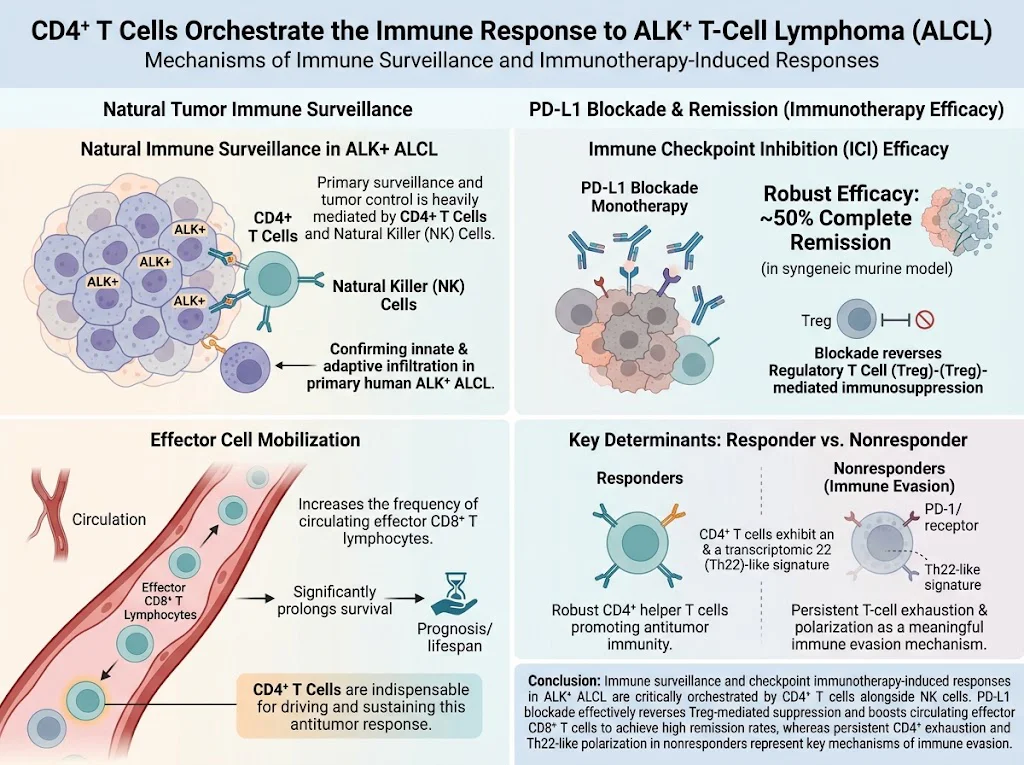
• CD4+ T cells and natural killer (NK) cells are critical mediators of immune surveillance in ALK-positive anaplastic large cell lymphoma (ALCL).
• Immune checkpoint inhibitor (ICI) monotherapy can induce durable remissions in a murine ALCL model, with approximately 50% complete response rate.
• PD-L1 blockade reverses regulatory T cell-mediated immunosuppression, enhancing effector CD8+ T cell responses and prolonging survival.
• Dysfunctional, exhausted CD4+ T cells with a T helper 22-like signature contribute to immune evasion in nonresponsive cases.
Study Background
Immunotherapy has revolutionized treatment paradigms in many solid tumors, yet its application in T-cell non-Hodgkin lymphomas (T-NHL) remains complex. These lymphomas originate from immune cells themselves, usually involving heterogeneous biological subtypes, which complicates deciphering the immune mechanisms underlying therapeutic responses. Anaplastic large cell lymphoma (ALCL) characterized by anaplastic lymphoma kinase (ALK) positivity represents a distinct T-NHL subtype with an oncogenic driver fusion gene. While anecdotal reports and small trials suggested efficacy of immune checkpoint inhibitors (ICIs) in ALCL, other T-NHL subtypes showed hyperprogression, emphasizing the need for rigorous mechanistic studies. This investigation addresses the immunobiology of ALK+ ALCL and mechanisms through which immunotherapy exerts antitumor effects.
Study Design
The study employed a syngeneic mouse model of ALK-positive ALCL to replicate the tumor-host immune interaction in an immunocompetent setting. Transplantation experiments incorporated selective depletion of immune cell subsets (including CD4+ T cells and NK cells) to dissect the immune components vital for tumor surveillance. Human ALK+ ALCL tissue samples were analyzed to confirm immune cell infiltration patterns. PD-L1 checkpoint blockade was administered as monotherapy in the murine model, with endpoints including tumor remission rates and survival. Mechanistic insights were gleaned from flow cytometry, transcriptomics of CD4+ T cells, and evaluation of regulatory T cell (Treg) function.
Key Findings
Immune surveillance against ALK+ ALCL requires the presence of CD4+ T cells and NK cells, as their depletion abrogated tumor control. Human primary tumor samples corroborated the robust infiltration of both innate and adaptive immune effectors, indicating physiological relevance. PD-L1 inhibitor monotherapy yielded approximately 50% complete remission in treated mice. The therapy reversed Treg-induced immunosuppressive microenvironment and led to expansion of circulating effector CD8+ T lymphocytes, which correlated with significantly prolonged survival.
Critical to this antitumor activity were CD4+ T cells, which were indispensable for initiating and sustaining the immune response spurred by PD-L1 blockade. Notably, in animals that did not respond to treatment, CD4+ T cells exhibited classical exhausted phenotypes characterized by expression of inhibitory receptors and a transcriptomic profile resembling T helper 22 cells, a subset involved in tissue inflammation and immune modulation. This suggests that persistent CD4+ T cell exhaustion and altered helper T cell polarization serve as an immune escape mechanism, contributing to resistance.
These data establish CD4+ T cells as central coordinators of spontaneous and ICI-mediated antitumor immunity in ALK+ ALCL and provide a preclinical rationale for the clinically safe use of checkpoint inhibitors for this lymphoma subtype.
Expert Commentary
This study elegantly addresses a longstanding clinical question on the role of immune components in T-cell lymphomas, a malignancy subset frequently excluded from successful immunotherapy narratives due to their immune origin and heterogeneity. The exclusive dependence on CD4+ T cells for controlling ALK-positive ALCL contrasts with the more commonly emphasized CD8+ cytotoxic T lymphocytes in other cancers and highlights the complexity of immune orchestration in lymphoid malignancies.
These findings have translational relevance especially in light of contrasting responses to ICIs in different T-NHL subtypes, where the risk of hyperprogression has raised safety concerns. By highlighting Treg reversal and epitope-specific exhaustion states, the study points toward biomarkers that could stratify responsive patients and optimize therapeutic regimens. Furthermore, the T helper 22-like exhausted phenotype opens new avenues for interventions targeting this subset to overcome resistance.
Limitations of the work include inherent differences between murine models and human pathology, especially in the tumor microenvironment complexity and immune repertoire diversity. Larger clinical trials are warranted to validate these findings and ensure that ICIs can be safely integrated into the treatment landscape of ALCL without inducing adverse hyperimmune effects.
Conclusion
This study provides compelling preclinical evidence that CD4+ T cells orchestrate the immune response against ALK-positive ALCL, serving as indispensable mediators of immunotherapy efficacy. PD-L1 checkpoint blockade effectively disrupts immunosuppressive networks and promotes durable antitumor immunity. Recognition of exhaustion and polarization states in CD4+ T cells offers promising biomarkers and therapeutic targets to overcome resistance. These insights support the rational development of immune checkpoint inhibitors for T-cell lymphomas and herald a paradigm shift in managing ALK+ ALCL.
Funding and Clinical Trials
The cited study was supported by academic and clinical research foundations (detailed information available in the original publication). Clinical trial data regarding immune checkpoint inhibitors in ALCL are evolving, with ongoing trials registered in clinicaltrials.gov evaluating efficacy and safety profiles in human subjects.
References
Poggio T, Gräßel L, Andrieux G, et al. CD4+ T cells orchestrate the immune response to ALK-positive T-cell lymphoma. Blood. 2026;148(18):2264-2277. doi:10.1182/blood.2022012345
Simpson TR, Li F, Montalvo-Ortiz W, et al. Fc-dependent depletion of tumor-infiltrating regulatory T cells co-defines the efficacy of anti-CTLA-4 therapy against melanoma. J Exp Med. 2013;210(9):1695-1710.
Rodig SJ, Gusenleitner D, Jackson DG, et al. MHC proteins confer differential sensitivity to PD-1 blockade in classic Hodgkin lymphoma. Blood. 2018;131(23):2425-2435.
Vose J. Peripheral T-cell lymphoma: 2019 update on diagnosis, risk-stratification, and management. Am J Hematol. 2019;94(11):1415-1433.