Highlight
Micro- and nano-plastics (MNPs) are newly identified contributors to cardiovascular disease risk, especially in acute coronary syndromes such as ST-segment elevation myocardial infarction (STEMI). This study detects higher concentrations and diversity of MNPs in coronary blood of STEMI patients compared to chronic coronary syndrome (CCS) patients and controls. MNP presence correlates with elevated systemic inflammation and increased exposure to ambient particulate matter (PM2.5) and tobacco smoking. Smoking independently predicts MNP detection, enhancing cardiovascular risk. These findings link environmental plastic pollution and air pollutants to coronary artery disease pathogenesis.
Study Background
Ischemic heart disease, predominantly driven by coronary artery disease (CAD), remains a leading cause of morbidity and mortality worldwide. Traditional risk factors—such as hypertension, hyperlipidemia, smoking, and diabetes—do not fully explain rising CAD rates, especially in urban populations with intense environmental exposures. Recent attention has focused on micro- and nano-plastics (MNPs), minute plastic particles omnipresent in the environment due to plastic breakdown and pollution. Although experimental data indicate MNPs can induce systemic inflammation and oxidative stress, their relevance to human cardiovascular pathology and direct coronary involvement has been unclear.
Air pollution, particularly exposure to fine particulate matter (PM2.5), is well-established to exacerbate cardiovascular disease via inflammatory and pro-thrombotic mechanisms. Smoking similarly elevates cardiovascular risk and introduces particulate pollutants. Understanding whether environmental MNPs circulate in the coronary circulation and interact with these risk factors is critical to elucidate their potential role in acute ischemic events.
Study Design
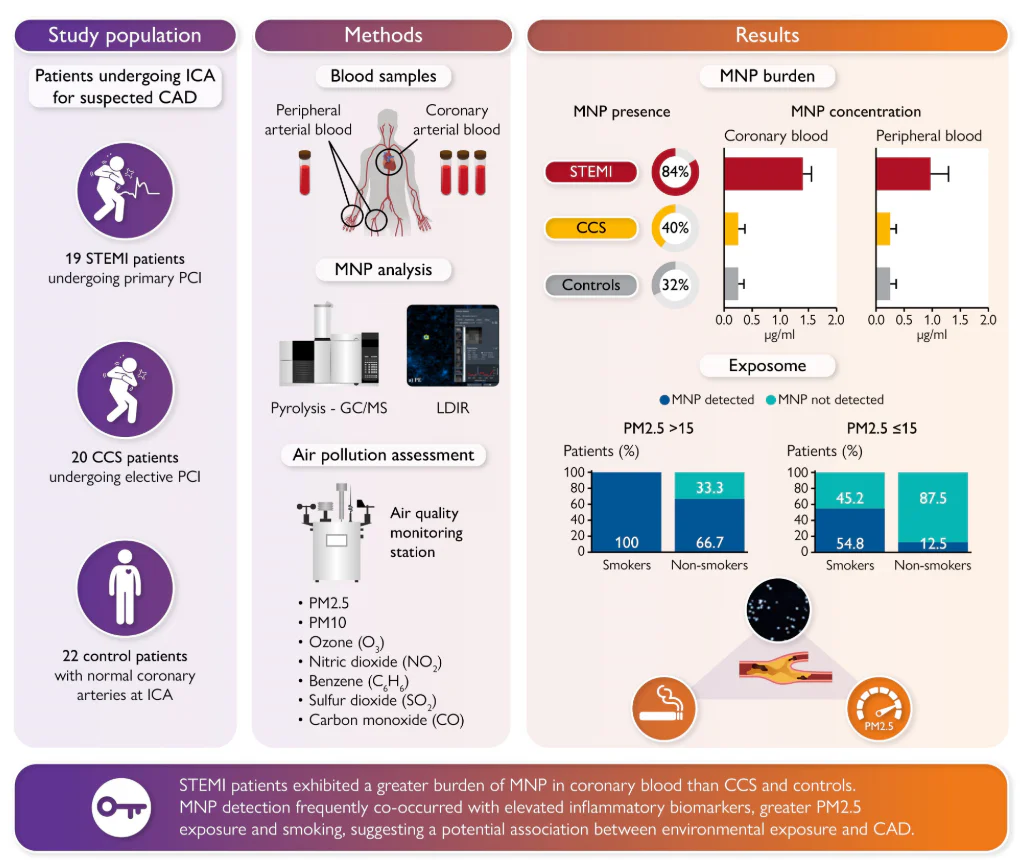
This inquiry was a cross-sectional study involving 61 consecutive patients undergoing invasive coronary angiography for suspected CAD. The cohort was stratified into three groups: 19 patients presenting with ST-segment elevation myocardial infarction (STEMI), 20 with chronic coronary syndromes (CCS), and 22 controls with normal coronary arteries. Both coronary and peripheral blood samples were collected during the procedure.
Micro- and nano-plastics were quantified employing advanced pyrolysis-gas chromatography-mass spectrometry (py-GC-MS) and laser direct infrared (LDIR) spectroscopy to detect and characterize polymer types and concentrations. Environmental exposure metrics to air pollution (PM2.5 levels) were collected for the day of the procedure (acute exposure) and for the preceding two years (chronic exposure). Clinical and inflammatory biomarkers, such as interleukin-6 (IL-6) and tumor necrosis factor-alpha (TNF-α), were also measured to establish correlations with MNP burden.
Key Findings
MNPs were significantly more frequently detected in patients with STEMI (84.2%) than in patients with CCS (40%) or controls (31.8%), with P=.002 indicating statistical significance. STEMI patients also exhibited elevated MNP concentrations and a greater diversity of polymer types—median of 3 polymers compared with fewer in other groups (P < .001), with polyethylene constituting the predominant polymer (97%). This suggests that acute coronary events are associated with higher burdens of circulating plastics in the coronary circulation.
The same polymers identified in coronary blood were also present in peripheral blood samples from the same patients, but with significantly higher concentrations detected in the coronary circulation (P < .001). This highlights the possibility that coronary vessels may serve as a localized reservoir or accumulation site for circulating MNPs.
Inflammatory markers IL-6 and TNF-α were significantly elevated in STEMI patients (P ≤ .006), reinforcing the association between MNP burden and systemic inflammation. Additionally, STEMI patients were exposed to higher levels of PM2.5 on the day of the procedure (P ≤ .012), linking environmental pollutant exposure to the acute coronary syndrome cohort.
MNP detection was more prevalent among smokers and individuals exposed to PM2.5 levels exceeding 15 µg/m³ (P = .006). Remarkably, all patients with both smoking history and elevated PM2.5 exposure had detectable MNPs (P < .001), suggesting additive or synergistic effects. Multivariable analysis identified smoking history as the sole independent predictor of MNP presence in coronary circulation (odds ratio 5.69; 95% CI 1.33–26.63, P = .023).
Expert Commentary
This study pioneers the detection and characterization of micro- and nano-plastics directly within human coronary circulation, a paradigm-shifting observation linking environmental plastic pollution to overt cardiovascular pathology. The robust methodology, including sensitive chemical spectrometry and paired coronary and peripheral sampling, strengthens the validity of findings.
However, the cross-sectional design limits causal inference; whether MNPs directly trigger acute coronary syndromes or are mere biomarkers of pollutant exposure remains to be elucidated. Furthermore, the relatively small sample size warrants cautious interpretation and calls for larger, prospective cohorts.
Mechanistically, MNPs may incite endothelial dysfunction, provoke local inflammation, and contribute to plaque instability, mediated through oxidative stress and cytokine release, as hinted by concurrent elevations in IL-6 and TNF-α. The observed association with smoking aligns with known additive harmful effects of tobacco-derived particulates and plastics.
Future research should explore the longitudinal impact of MNP accumulation, their mechanistic roles in atherothrombosis, and potential interventions targeting environmental exposures.
Conclusion
The detection of micro- and nano-plastics in coronary blood, predominantly in patients with acute myocardial infarction, highlights an emerging environmental risk factor for ischemic heart disease. Strong associations with particulate air pollution and smoking reinforce the need to integrate environmental health considerations into cardiovascular prevention strategies. Clinicians and public health policymakers should recognize the potential contribution of ubiquitous plastic pollution to cardiovascular morbidity and mortality, warranting urgent research and mitigation efforts.
Funding and Clinical Trial Registration
The original study did not specify funding disclosures or clinical trial registration in the abstract. Additional details can be referenced in the full publication.
References
Paolisso P, et al. Micro- and nano-plastics in the coronary circulation and air pollution exposure in ischaemic heart disease presentation. Eur Heart J. 2026;47(39):5860-5876. PMID: 42447841.
Brook RD, et al. Air Pollution and Cardiovascular Disease: A Statement for Healthcare Professionals From the Expert Panel on Population and Prevention Science of the American Heart Association. Circulation. 2004;109(21):2655-2671.
Rancière F, et al. Exposure to particulate matter air pollution and cardiovascular disease-related biomarkers: A systematic review and meta-analysis. Environ Res. 2020;188:109816.
Bouwmeester H, et al. Nanomaterials and Human Health: Medical Implications of Microplastics. Clin Pharmacol Ther. 2022;111(1):42-50.