Highlight
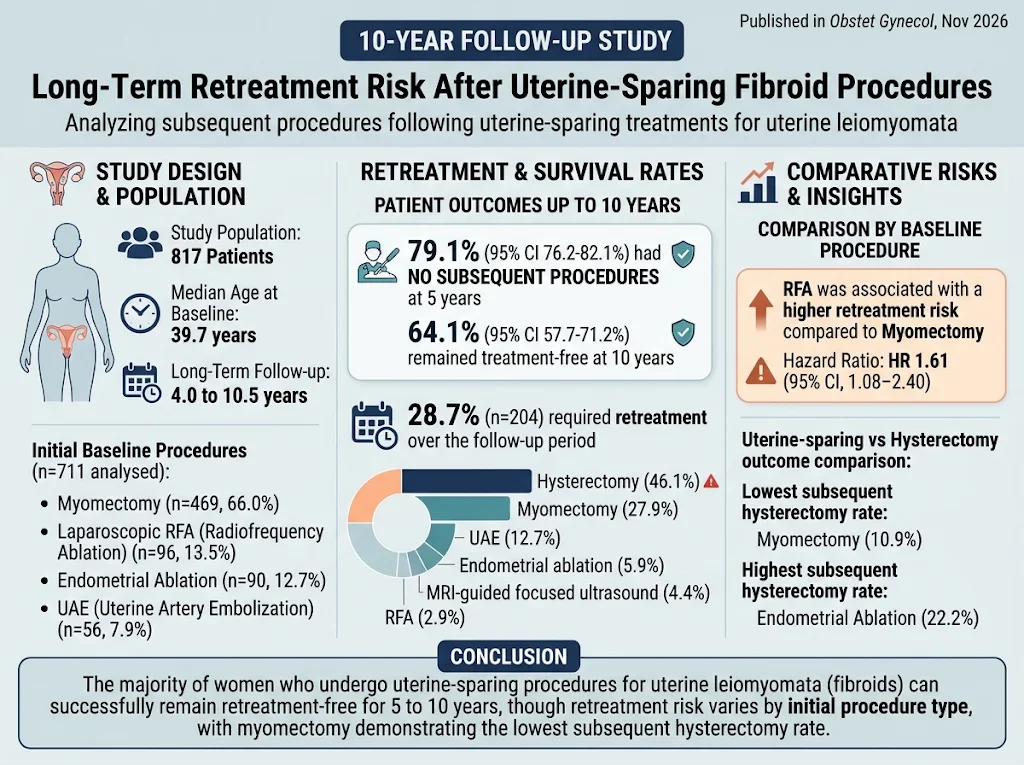
This longitudinal study evaluates retreatment risks up to 10 years after uterine-sparing procedures for uterine leiomyomata, including myomectomy, endometrial ablation, laparoscopic ultrasound-guided radiofrequency ablation (RFA), and uterine artery embolization (UAE). Key findings include a 28.7% overall retreatment rate, predominance of hysterectomy as the subsequent procedure, and notably lower retreatment risk following myomectomy compared to other procedures, especially RFA and endometrial ablation.
Study Background
Uterine leiomyomata, commonly known as fibroids, are benign smooth muscle tumors affecting up to 70% of women by age 50 and a leading cause of morbidity in reproductive-age women, manifesting as heavy menstrual bleeding, pelvic pain, and reproductive dysfunction. With hysterectomy historically regarded as definitive therapy, uterine-sparing procedures have gained prominence for women desiring uterine preservation. Despite several options such as myomectomy, UAE, RFA, and endometrial ablation, limited long-term data exist on the sustainability of symptom relief and risk of subsequent interventions. Understanding these outcomes is critical for shared decision-making and optimizing individualized management strategies.
Study Design
This observational study recontacted participants from two earlier uterine leiomyomata procedure cohorts, including 817 women who had undergone one of four baseline uterine-sparing treatments: myomectomy (n=469), endometrial ablation (n=90), laparoscopic ultrasound-guided RFA (n=96), and UAE (n=56). Median age at baseline was 39.7 years, with follow-up ranging from 4.0 to 10.5 years (median recontact age 46.8 years). Patient-reported data on all subsequent leiomyomata-related uterine procedures were obtained, including hysterectomy and MRI-guided focused ultrasonography. Outcomes focused on time to retreatment and type of subsequent procedures experienced. Statistical analyses included Kaplan-Meier survival curves, Cox proportional hazards models for hazard ratios (HRs) with 95% confidence intervals (CIs), and Fisher exact tests to assess associations between baseline and retreatment procedures.
Key Findings
During follow-up, 204 participants (28.7%) reported at least one retreatment procedure for uterine leiomyomata. The majority of these subsequent procedures were hysterectomy (46.1%), followed by myomectomy (27.9%), UAE (12.7%), endometrial ablation (5.9%), MRI-guided focused ultrasonography (4.4%), and RFA (2.9%). Kaplan-Meier analysis demonstrated that 79.1% (95% CI 76.2–82.1%) of women remained free from additional uterine procedures within 5 years, decreasing to 64.1% (95% CI 57.7–71.2%) at 10 years.
Comparing retreatment risks among baseline procedures with myomectomy as reference, RFA was associated with a significantly increased hazard of subsequent uterine procedures (HR 1.61; 95% CI 1.08–2.40). Endometrial ablation and UAE did not show statistically significant differences in hazard ratios compared with myomectomy after adjusting for follow-up time. Importantly, baseline myomectomy patients had the lowest rate of subsequent hysterectomy (10.9%), whereas those undergoing endometrial ablation exhibited the highest hysterectomy rate (22.2%). This suggests that myomectomy may offer more durable symptom control, particularly for women prioritizing uterine preservation.
The wide range of subsequent treatments indicates variability in clinical decisions, influenced by symptom persistence, fibroid recurrence, or patient preferences. The findings underscore that most women can expect substantial periods without further intervention, but a notable subset will require additional therapy, including hysterectomy.
Expert Commentary
This study substantially informs clinical counseling by providing real-world, long-term patient-reported retreatment outcomes. The strength lies in the diverse inclusion of uterine-sparing procedures and extended follow-up, bridging data gaps in procedural durability. Myomectomy’s protective association against hysterectomy aligns with its role as surgical removal of fibroids, likely improving symptom profile more definitively than ablative or vascular treatments.
However, limitations include reliance on patient self-reporting, which may introduce recall bias, and lack of granular data on fibroid characteristics, symptom severity, or quality-of-life measures. Additionally, heterogeneity in clinical practice patterns over the study period may influence retreatment choices. Future research should integrate objective imaging, symptom scoring, and impact on fertility to refine personalized treatment pathways.
Conclusion
Overall, uterine-sparing procedures for leiomyomata offer substantial therapeutic durability, with the majority of women remaining treatment-free for 5 to 10 years post-procedure. Among these, myomectomy is associated with the lowest risk of subsequent hysterectomy, emphasizing its role in long-term uterine preservation. This data empowers clinicians and patients in selecting appropriate management strategies and underscores the necessity of individualized counseling regarding retreatment risks. Ongoing longitudinal studies and incorporation of patient-centered outcomes will further enhance clinical decision-making frameworks for uterine leiomyomata management.
Funding and ClinicalTrials.gov Registration
This research was registered under ClinicalTrials.gov identifier NCT06430320.
References
Stewart EA. Uterine fibroids. Lancet. 2001;357(9252):293-298. doi:10.1016/S0140-6736(00)03645-7
Jacoby VL, McNeil KA, Sitarik AR, et al. Patient Report of Subsequent Uterine-Sparing Leiomyomata Procedures up to 10 Years. Obstet Gynecol. 2026 Nov 10. PMID: 43008239.
Flynn MK, Colquhoun A, Chen I, Morris JM. Long-term outcomes following uterine artery embolisation for the treatment of fibroids: a systematic review. BJOG. 2019;126(2):246-256. doi:10.1111/1471-0528.15427
Clark NV, Stewart EA. New therapies for uterine leiomyomas. Obstet Gynecol. 2022;140(2):251-260. doi:10.1097/AOG.0000000000004636