We use cookies

Our website uses essential cookies and, with your consent, additional cookies to measure performance and improve our services. Cookie Policy.

You can change your choice at any time.

MMedXYNews
HomeVideos
MedXY AI/MedXY News/Section: Neurology

Long-Term Health Impacts of Military Blast Exposure on Veterans: Insights from the Millennium Cohort Study
MedXY Editorial Team•Sep 21, 2026•Neurology
Veterans Healthoccupational riskblast exposurechronic diseases

Highlight

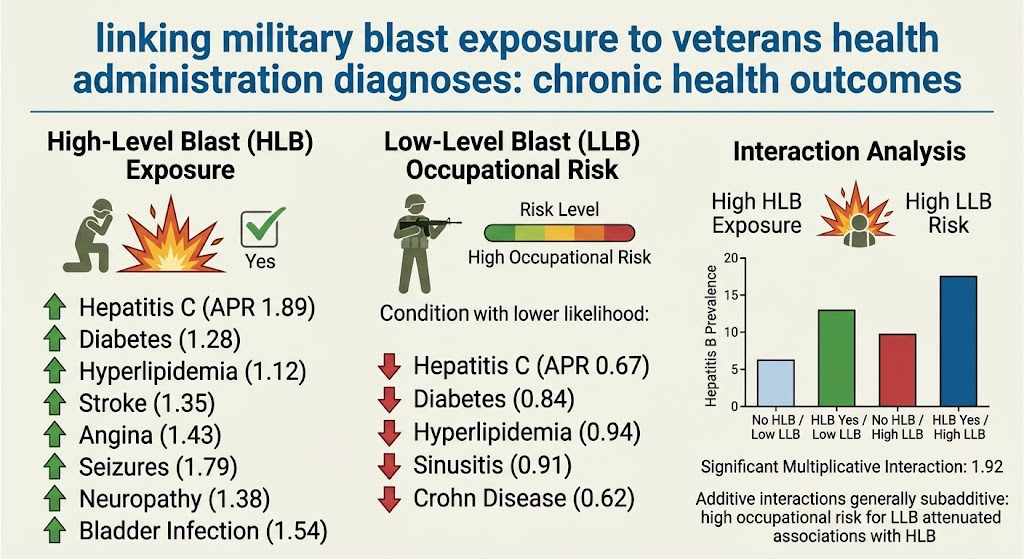
  • High-level blast (HLB) exposure during military service is linked to increased risk of multiple chronic health conditions in Veterans receiving care through the Veterans Health Administration (VHA).
  • Conditions notably associated with HLB include neurologic, cardiovascular, metabolic, respiratory, and infectious diseases, reflecting widespread systemic effects.
  • Occupational risk for low-level blast (LLB) exposure showed a paradoxically lower likelihood for several diseases and appeared to attenuate the impact of HLB for most outcomes.
  • Findings underscore the significance of blast as a long-term occupational health hazard requiring ongoing surveillance and targeted interventions.

Background

MedXY registered readers

Sign in free to continue reading

Create or use your MedXY account to unlock the complete article.

This article was created using several editorial tools, including AI, as part of the process. Human editors reviewed this content before publication.

Related articles

Open language-specific specialty feeds and department pages.

Beyond the Diagnosis: Addressing the Persistent Risk of Suicidal Self-Directed Violence in Veterans with CancerThis review synthesizes recent longitudinal evidence on suicidal self-directed violence (SSDV) among veterans with cancer, identifying high-risk subgroups, temporal vulnerability windows, and the critical need for long-term psychological suMay 31, 2026Longitudinal Suicide Risk in Veterans with Cancer: A Comprehensive Synthesis of Risk Factors and Temporal TrendsThis review synthesizes longitudinal evidence on suicidal self-directed violence (SSDV) among veterans with cancer, identifying high-risk clinical subgroups, temporal peaks in vulnerability, and the critical need for long-term survivorship May 31, 2026Initiation of Medications for Alcohol Use Disorder Among Hospitalized Veterans : A Retrospective Cohort StudyVHA study reveals only 30% of veterans hospitalized for AUD receive evidence-based medications during or shortly after hospitalization, with significant variation across hospitals and demographic factors influencing prescription rates.May 11, 2026
Loading comments...
MedXY briefing

Get the free newsletter

Evidence-led clinical news, trends, and analysis—delivered to your inbox.

Ask MedXY AI

Most popular

Intimate Health
Five Benefits for Women Continuing Sexual Activity After Menopause
Intimate Health
Why Some Women Have a Strong Sex Drive—And Why Men Shouldn't Worry About It
Nursing & care
How often should a couple have sex?
General Surgery
Optimizing Postoperative Opioid Prescriptions After Intra-Abdominal Cancer Surgery: Comparing the 5x-Multiplier and 3-Tier Models
Intimate Health
Classic Intimacy Recommendations: How to Help Women Reach Orgasm and Enjoy Mutual Pleasure
© 2026 MedXY
Contact usAbout usPrivacy PolicyMedXY story
Intersection of Intimate Partner Violence and Substance Use Disorders in the Veteran Population: Screening Gaps, Risk Profiles, and Lethality
This review synthesizes evidence on the high prevalence and severity of intimate partner violence (IPV) among veterans with substance use disorders, highlighting gender-specific lethality risks and the critical need for integrated screening
May 12, 2026
Agent Orange Exposure and Acral Melanoma: Uncovering Non-Ultraviolet Risk Factors in the US Veteran PopulationA large-scale study within the VA health system identifies Agent Orange exposure as a significant risk factor for acral melanoma, while highlighting distinct clinical profiles and a paradoxical inverse association with smoking compared to oFeb 5, 2026