Highlight
Lonapegsomatropin, a once-weekly prodrug formulation of somatropin, demonstrated sustained efficacy in height velocity comparable to daily somatropin injections in children with Turner syndrome over 52 weeks.
The safety and tolerability profile of lonapegsomatropin was similar to daily somatropin, with no new or unexpected adverse events observed.
Once-weekly administration may improve adherence and quality of life by reducing the injection burden in a pediatric population requiring long-term growth hormone therapy.
Study Background and Disease Burden
Turner syndrome is a chromosomal disorder characterized by partial or complete absence of one X chromosome in females, affecting approximately 1 in 2,500 live female births. A common clinical feature is short stature due to haploinsufficiency of the SHOX gene and other growth-related factors. Growth hormone (GH) therapy has long been established as an effective intervention to increase final adult height and improve psychosocial outcomes. However, conventional daily somatropin injections impose a significant treatment burden that can reduce adherence, ultimately compromising clinical efficacy. Thus, there is an unmet need for growth hormone therapies with less frequent dosing that maintain safety and efficacy for pediatric patients with Turner syndrome.
Study Design
The New InsiGHTS trial (ClinicalTrials.gov identifier: NCT05690386) was a randomized, multicenter, phase 2 dose-ranging study conducted at 19 centers across the United States. The study enrolled 49 prepubertal children with genetically confirmed Turner syndrome who had not reached puberty at baseline. Participants were randomized in a 1:1:1:1 ratio to receive either once-weekly subcutaneous lonapegsomatropin at doses of 0.24, 0.30, or 0.36 mg human growth hormone (hGH)/kg/week, or daily somatropin at a total dose of 0.35 mg/kg/week divided into daily injections.
The primary efficacy endpoint was annualized height velocity (AHV) at week 26. Secondary endpoints included AHV at week 52 and changes from baseline in height standard deviation scores (SDS) at weeks 26 and 52. Safety assessments encompassed adverse events, laboratory parameters, and immunogenicity.
Key Findings and Results
At 26 weeks, AHV ranged from 9.23 to 10.36 cm/year across lonapegsomatropin dose groups compared with 10.86 cm/year in the daily somatropin group, indicating comparable growth velocity (mean difference within a clinically acceptable margin). By 52 weeks, pooled lonapegsomatropin cohorts maintained an AHV of 9.05 cm/year versus 9.04 cm/year with daily somatropin, confirming sustained efficacy over one year.
Height SDS gains at 52 weeks were 0.60 in the lonapegsomatropin group and 0.67 in the somatropin group, reflecting clinically meaningful improvements in growth relative to age-matched norms for both treatments. No statistically significant differences were identified between lonapegsomatropin doses and daily somatropin.
Safety profiles were comparable across all groups, with adverse events consistent with known effects of growth hormone therapy. Treatment-emergent adverse events were mostly mild to moderate, and no new safety signals emerged. Importantly, once-weekly dosing with lonapegsomatropin was well tolerated, suggesting no increase in injection-site reactions or systemic intolerance despite reduced injection frequency.
Expert Commentary
The New InsiGHTS results support lonapegsomatropin as a viable once-weekly alternative to daily somatropin in Turner syndrome. This represents a significant advance in treatment convenience, which may enhance adherence and overall patient experience, critical factors in long-term pediatric endocrinology therapies. While efficacy and safety appear robust, larger phase 3 and longer-term follow-up studies will be important to confirm durability and final adult height outcomes.
No study is without limitations; the phase 2 design and modest sample size limit generalizability and statistical power for rare adverse events. In addition, the trial population consisted of prepubertal children only, so efficacy and safety during puberty warrant future evaluation. Mechanistically, the sustained release prodrug design offers smooth pharmacokinetics that may reduce peak-related side effects seen in daily injections.
Current clinical guidelines recognize daily GH as the standard, but growing evidence from this and other trials on long-acting GH formulations may soon shift practice paradigms, incorporating patient-centric dosing regimens to improve treatment adherence.
Conclusion
In children with Turner syndrome, once-weekly lonapegsomatropin provides comparable growth-promoting efficacy and safety to daily somatropin after one year of treatment. The favorable tolerability and reduced injection frequency offer a promising new therapeutic option that could enhance adherence and quality of life in this population. These findings underscore the potential for long-acting GH formulations to transform the management of short stature associated with Turner syndrome, pending further confirmatory studies.
Funding and Clinical Trial Registration
This trial was funded and sponsored by the manufacturer of lonapegsomatropin. ClinicalTrials.gov registration number is NCT05690386.
References
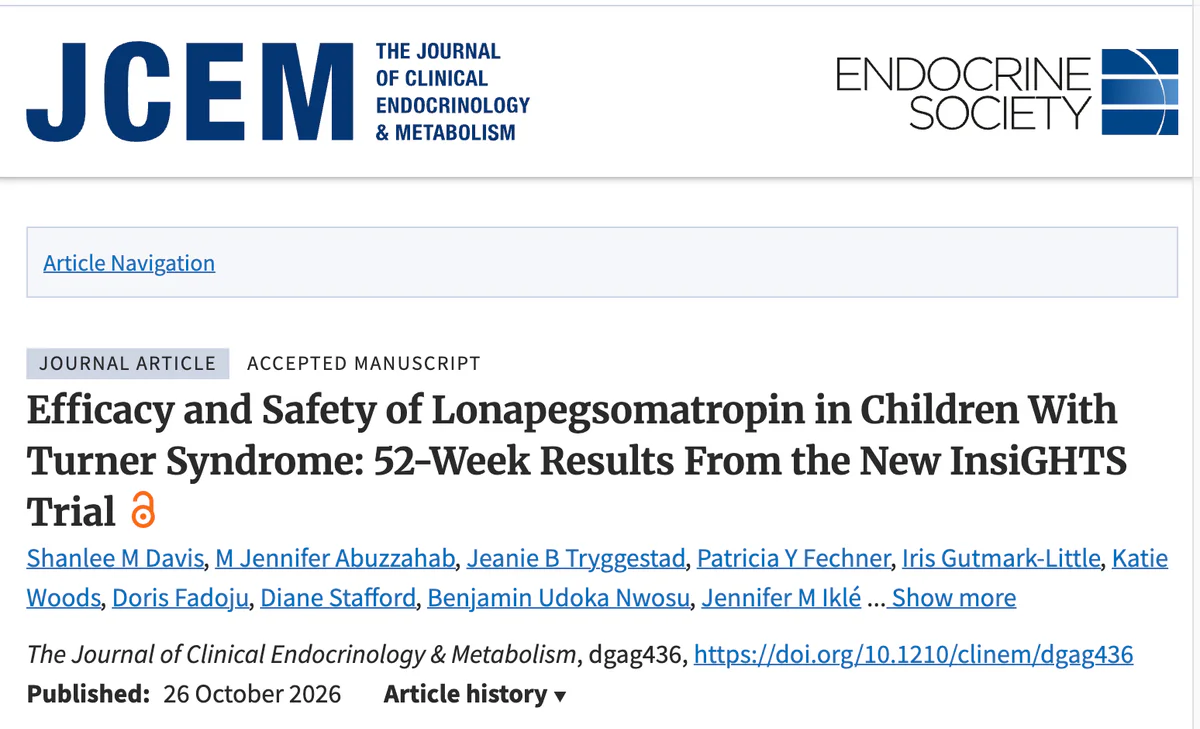
1. Davis SM, Abuzzahab MJ, Tryggestad JB, et al. Efficacy and Safety of Lonapegsomatropin in Children With Turner Syndrome: 52-Week Results From the New InsiGHTS Trial. J Clin Endocrinol Metab. 2026 Oct 26. PMID: 42929032.
2. Ranke MB. Turner syndrome: Growth hormone therapy and adult height. Horm Res Paediatr. 2020;93(5):279-287.
3. Mauritius RE, Quigley CA. Growth hormone treatment in Turner syndrome: clinical guidelines. Endocrine Reviews. 2017;38(3):246-253.