Highlight
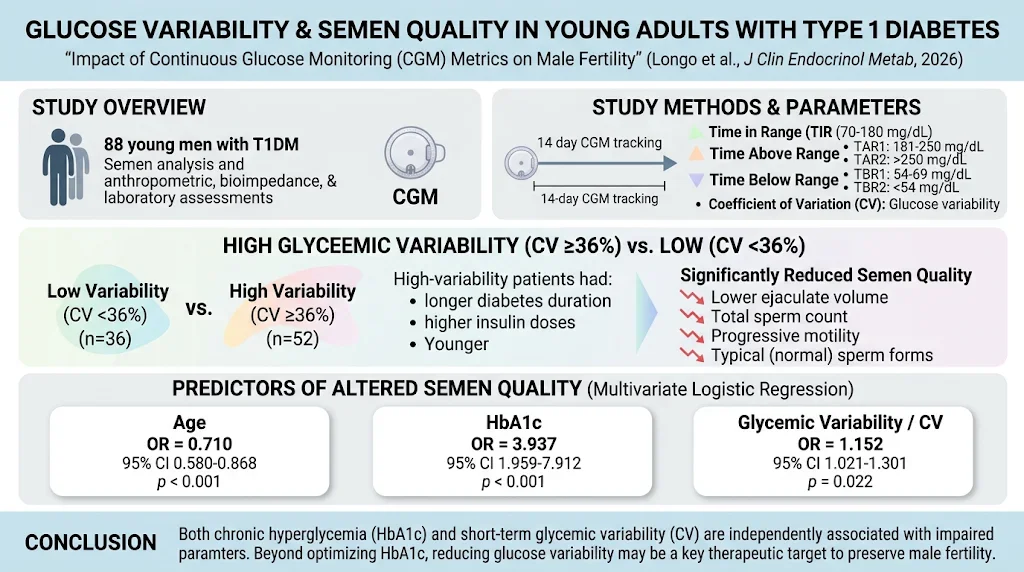
This study demonstrates that in young adults with type 1 diabetes mellitus (T1DM), higher glycemic variability measured by continuous glucose monitoring (CGM) is linked to impaired semen quality independent of HbA1c. Key findings include reduced ejaculate volume, total sperm count, progressive motility, and sperm morphology in men with elevated glucose coefficient of variation (CV). These results suggest that targeting both chronic hyperglycemia and glucose fluctuations may be critical for preserving male reproductive health in T1DM.
Study Background
Type 1 diabetes mellitus (T1DM) is a chronic autoimmune condition characterized by insulin deficiency and lifelong dependence on exogenous insulin. It is well established that diabetes carries a significant systemic burden, including detrimental effects on the male reproductive system. Prior studies have associated T1DM with altered semen parameters such as reduced sperm count, motility, and morphological abnormalities. However, the metabolic factors underlying these changes remain incompletely elucidated.
Traditionally, long-term glycemic control has been evaluated by glycated hemoglobin (HbA1c), which reflects average blood glucose levels over approximately 3 months. Although HbA1c is a strong predictor of diabetic complications, it does not capture glycemic variability — the degree of blood glucose fluctuations over short periods. Emerging evidence links glycemic variability to oxidative stress, endothelial dysfunction, and inflammation, pathological pathways potentially impacting spermatogenesis and sperm function.
Advances in continuous glucose monitoring (CGM) allow real-time quantification of glucose variability and time spent in hypoglycemic and hyperglycemic ranges. This study at the University of Campania “Luigi Vanvitelli” Diabetes Center sought to investigate the associations between CGM-derived metrics, particularly glycemic variability, and semen quality in young men with T1DM.
Study Design
This cross-sectional study enrolled 88 male participants with established T1DM. All subjects were followed at the University of Campania “Luigi Vanvitelli” Diabetes Center and underwent comprehensive semen analysis alongside clinical and laboratory assessments.
Anthropometric parameters, bioimpedance measurements, and standard laboratory tests, including HbA1c, were collected. Importantly, CGM data from the 14 days preceding semen sample collection were analyzed for the following parameters: time in range (TIR: 70–180 mg/dL), time above range (TAR1: 181–250 mg/dL; TAR2: >250 mg/dL), time below range (TBR1: 54–69 mg/dL; TBR2: <54 mg/dL), mean glucose, glucose management indicator, and coefficient of variation (CV) of glucose levels.
Participants were stratified into two groups based on glycemic variability: low variability (CV < 36%) and high variability (CV ≥ 36%). The primary endpoint was semen quality assessed by standard parameters — ejaculate volume, total sperm count, progressive motility, and normal morphological forms.
Key Findings
Among the 88 men, 52 were categorized into the high glycemic variability group (CV ≥ 36%) and 36 into the low variability group (CV < 36%). Men with high CV were younger, with longer diabetes duration and higher insulin doses, indicating a potentially more labile glycemic profile.
Crucially, semen quality was significantly impaired in the high-variability group. Specifically, these men exhibited:
Lower ejaculate volume
Decreased total sperm count
Reduced progressive motility
Fewer typical (normal) sperm forms
Univariate analyses revealed:
Normozoospermia (normal sperm parameters) correlated positively with age and TIR.
Negative associations were found between normozoospermia and HbA1c, CV, TAR2, and TBR2.
Multivariate logistic regression identified independent predictors of altered semen quality:
Age (odds ratio (OR) = 0.710 per year increase; 95% confidence interval [CI]: 0.580–0.868; p < 0.001), indicating younger individuals had worse semen parameters.
HbA1c (OR = 3.937; 95% CI: 1.959–7.912; p < 0.001), consistent with the impact of chronic hyperglycemia.
Glycemic variability measured by CV (OR = 1.152; 95% CI: 1.021–1.301; p = 0.022), confirming the independent deleterious effect of short-term glucose fluctuations.
These findings hold clinical significance as they underscore that beyond traditional HbA1c targets, reducing glycemic variability could be an important therapeutic strategy to preserve male fertility in T1DM patients.
Expert Commentary
The link between glycemic variability and semen impairment aligns with current knowledge about oxidative stress as a mediator of diabetes complications. Acute glucose excursions can induce reactive oxygen species formation, damaging sperm DNA, membrane integrity, and mitochondrial function essential for motility.
The younger age association with worse semen quality may reflect the complex interplay between disease duration, metabolic control, and developmental factors. Earlier and aggressive interventions targeting glucose stability may therefore be imperative.
Limitations of the study include its cross-sectional design, which precludes causal inference, and the relatively small sample size. Future longitudinal studies should investigate whether tight glucose variability control improves reproductive outcomes and fertility in men with T1DM.
Clinicians are encouraged to consider CGM-derived glycemic variability metrics in comprehensive diabetes management, especially when counseling young male patients concerned about reproductive health.
Conclusion
This study from the University of Campania “Luigi Vanvitelli” Diabetes Center highlights the underappreciated role of glycemic variability, in addition to chronic hyperglycemia, as an independent factor impairing semen quality in young men with T1DM. Targeting glucose fluctuations alongside conventional glycemic control metrics may represent a novel therapeutic approach to protect and optimize male reproductive function in diabetes.
Further investigations are warranted to confirm these associations longitudinally and to evaluate strategies that effectively mitigate glucose variability and improve fertility outcomes in this population.
Funding and Clinical Trials Registration
The original study did not specify funding sources or clinical trial registry numbers. Future research in this area should ensure transparent reporting of funding and trial registration to enhance reproducibility and credibility.
References
1. Longo M, Angelino S, Maio A, et al. Glucose variability and semen quality in young adults with type 1 diabetes using continuous glucose monitoring. J Clin Endocrinol Metab. 2026 Nov 11. PMID: 43021445.
2. Bellastella G, Maiorino MI, Esposito K. Diabetes and male reproductive function: from mechanisms to clinical evidence. Hum Reprod Update. 2018;24(5):517-535.
3. Monnier L, Colette C. Glycemic variability: should we and can we prevent it? Diabetes Care. 2008;31(Suppl 2):S150-S154.
4. Agarwal A, Durairajanayagam D, du Plessis SS, et al. Oxidative stress and male fertility. World J Mens Health. 2014;32(1):1-17.
5. American Diabetes Association. Standards of Medical Care in Diabetes—2024. Diabetes Care. 2024;47(Suppl 1):S1-S283.