Highlight
Intravenous bisphosphonates, particularly zoledronic acid, significantly increase short-term uveitis risk.
No significant associations were found between bisphosphonates and scleritis or cystoid macular edema (CME).
Oral bisphosphonates do not appear to raise the risk of inflammatory eye reactions.
Case-case-time-control methodology accounted for temporal trends, strengthening causality insights.
Study Background
Bisphosphonates are cornerstone agents in managing osteoporosis, malignancy-associated bone metastases, and other disorders characterized by excessive bone resorption. Despite their efficacy, these agents—particularly intravenous formulations—have been reported rarely to trigger ocular inflammation, including uveitis, scleritis, and cystoid macular edema (CME). Such inflammatory eye reactions can threaten vision and affect quality of life, emphasizing the importance of delineating the risk associated with bisphosphonate use.
However, previous reports were mostly case series or small observational studies, limiting the ability to quantify risk and distinguish drug effects from confounding temporal trends. This large-scale, nationwide study from Taiwan evaluated short-term associations between bisphosphonate exposure and inflammatory eye conditions using a rigorous case-case-time-control design to mitigate confounding and temporal biases.
Study Design and Methods
The researchers conducted a nationwide case-case-time-control (CCTC) study using Taiwan’s national health claims data spanning 2011 to 2021. They identified patients with incident diagnoses of uveitis, scleritis, or CME. Key aspects included:
Case-Case-Time-Control Design: Each case was matched to a future case serving as a control, allowing adjustment for secular trends in bisphosphonate prescribing and use.
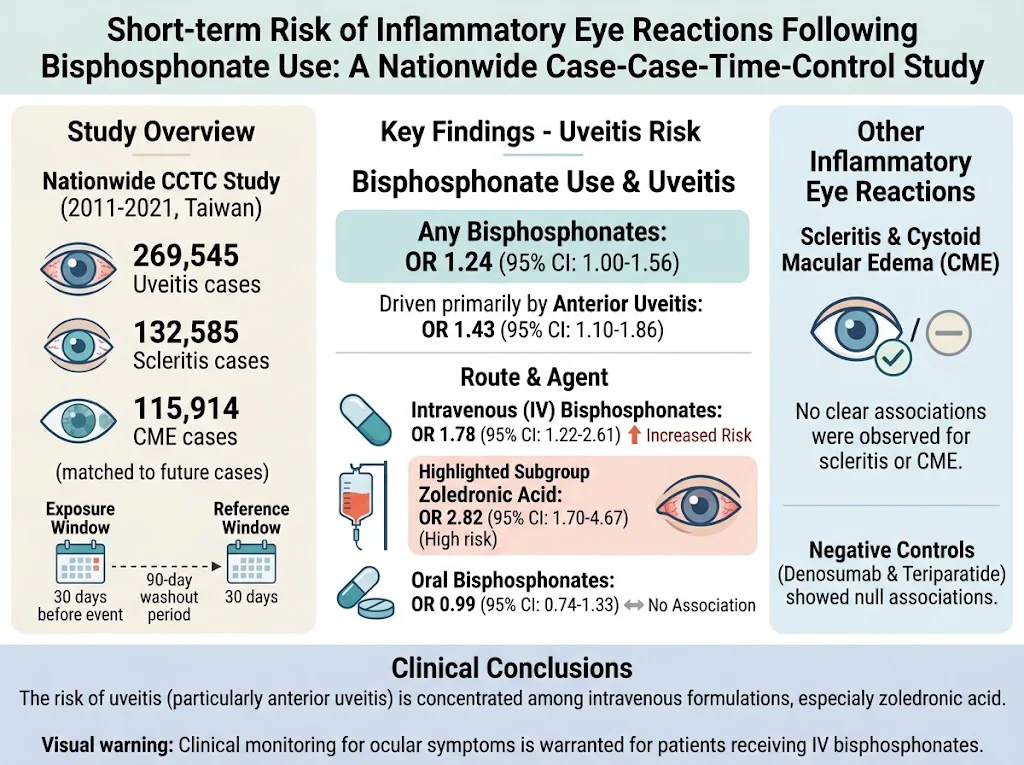
Exposure Windows: Bisphosphonate exposure during a 30-day hazard window immediately preceding the eye inflammation event was compared to exposure during an earlier 30-day reference window, separated by a 90-day washout interval.
Exposure Stratification: Analyses examined bisphosphonate use by administration route (intravenous versus oral) and by individual agents, notably zoledronic acid.
Sensitivity Analyses: Varied window lengths, washout periods, and lag structures tested the robustness of findings.
Negative Controls: Denosumab and teriparatide exposures were assessed to detect residual confounding or bias.
Outcomes measured were incident uveitis, scleritis, and CME cases, with odds ratios (ORs) and 95% confidence intervals (CIs) quantifying associations.
Key Findings
The study identified massive cohorts: 269,545 uveitis, 132,585 scleritis, and 115,914 CME incident cases; over 96% matched successfully to future controls for CCTC analyses.
Uveitis: Bisphosphonate use was associated with a modest but statistically significant increased short-term risk of uveitis (OR 1.24; 95% CI, 1.00–1.56), more pronounced for anterior uveitis (OR 1.43; 95% CI, 1.10–1.86).
Administration route had a strong influence:
Intravenous bisphosphonates increased the risk substantially (OR 1.78; 95% CI, 1.22–2.61).
Zoledronic acid demonstrated the highest risk (OR 2.82; 95% CI, 1.70–4.67).
Oral bisphosphonates showed no significant association (OR 0.99; 95% CI, 0.74–1.33).
Scleritis and Cystoid Macular Edema (CME): No clear or consistent association with bisphosphonate exposure was observed for these conditions across all analyses.
Sensitivity Analyses: Results remained consistent across different hazard/reference window lengths and washout periods, reinforcing the reliability of observed associations.
Negative Controls: Denosumab and teriparatide exposures showed no association with inflammatory eye events, supporting the specificity of findings.
Expert Commentary
This large, methodologically robust study provides compelling evidence that intravenous bisphosphonate administration, especially zoledronic acid, transiently heightens the risk of developing anterior uveitis. The use of CCTC analysis is particularly noteworthy as it largely neutralizes confounding by indication and temporal prescribing trends, a major limitation in prior pharmacoepidemiologic studies.
Biologically, bisphosphonates—and zoledronic acid in particular—are known to induce cytokine release and immune activation shortly after infusion, which plausibly contributes to ocular inflammation. Intravenous delivery leads to higher peak systemic concentrations, consistent with the observed increased risk compared to oral agents.
Limitations include the reliance on administrative diagnosis codes, which may not capture clinical severity or confirm inflammatory subtype fully. Also, while the study adjusted for temporal trends, residual confounding by unmeasured clinical factors cannot be entirely excluded. The findings may have limited immediate relevance for oral bisphosphonate-treated patients but underscore careful ocular monitoring for intravenous infusions.
Conclusion
In summary, this comprehensive nationwide study demonstrates a clear short-term increased risk of uveitis following intravenous bisphosphonate use, particularly zoledronic acid, with no evident risk increase for scleritis or cystoid macular edema. Oral bisphosphonate use appears safe in this regard. Clinicians should remain vigilant for ocular symptoms after intravenous bisphosphonate administration and consider early referral for ophthalmologic evaluation. These results improve clinical risk stratification and patient counseling regarding bisphosphonate therapy.
Future research should focus on mechanistic studies to elucidate the immunopathogenesis of bisphosphonate-induced ocular inflammation and explore preventive measures or safer therapeutic regimens.
Funding and Disclosures
The study was funded by Taiwanese health authorities and institutional grants. There were no declared conflicts of interest related to the bisphosphonate manufacturers.
References
1. Hsieh MHC, Cheng CY, Shao SC, et al. Short-term Risk of Inflammatory Eye Reactions Following Bisphosphonate Use: A nationwide case-case-time-control study. Ophthalmology. 2026 Nov 4; [PMID: 42982279].
2. Maleki A, Ofat A. Ocular adverse effects of bisphosphonates: A review. Drug Saf. 2022;45(3):217-230.
3. Fraunfelder FW, Fraunfelder FT. Bisphosphonates and ocular inflammation. J Ocul Pharmacol Ther. 2011;27(1):1-5.
4. Toussirot E, Wendling D. Bisphosphonate induced ocular inflammation: a review of the literature and pharmacovigilance data. Semin Arthritis Rheum. 2016;45(5):587-92.