Impact of Prior Implant-Based Reconstruction and Radiotherapy on Microvascular Outcomes in Delayed DIEP Flap Breast Reconstruction
Highlight
The study evaluates the impact of prior implant-based reconstruction (IBR) and radiotherapy (RT) on microvascular complications in delayed deep inferior epigastric perforator (DIEP) flap breast reconstruction. Key findings include:
Among irradiated patients, prior IBR nearly doubles the risk of perioperative arterial re-anastomosis.
There was no significant difference in rates of flap necrosis between patients with or without prior IBR, regardless of radiotherapy exposure.
Vein coupler sizes used during microsurgery were smaller in irradiated patients, indicating altered vessel conditions potentially due to fibrosis.
DIEP flap reconstruction remains a safe option after implant failure and radiotherapy, though with increased surgical complexity.
Study Background
Breast reconstruction after mastectomy is a key component of breast cancer management to restore body image and quality of life. Delayed reconstruction with autologous tissue, particularly the deep inferior epigastric perforator (DIEP) flap, is widely considered a gold standard due to its natural cosmetic outcomes and preservation of abdominal muscles. However, many patients initially undergo implant-based reconstruction (IBR), which may later require conversion to autologous methods due to complications such as capsular contracture, often exacerbated by radiotherapy (RT).
RT is commonly used in breast cancer treatment to reduce recurrence risk but negatively impacts surrounding tissues causing fibrosis, microvascular damage, and impaired wound healing. This raises concerns about increased microvascular complications during subsequent DIEP flap reconstruction in patients with prior IBR followed by RT.
Determining whether prior IBR and RT contribute to higher rates of microvascular complications and flap loss is crucial for surgical planning, patient counseling, and optimizing reconstructive outcomes.
Study Design
This retrospective cohort study analyzed data from a tertiary referral hospital between 2005 and 2022. The population included all women undergoing delayed DIEP flap breast reconstruction after mastectomy for breast cancer.
Patients were stratified based on history of prior IBR and exposure to radiotherapy, resulting in four groups: no IBR/no RT, IBR/no RT, no IBR/RT, and IBR/RT.
Primary outcomes assessed were:
Perioperative microvascular re-anastomosis (correction of compromised microvascular anastomoses during surgery)
Flap necrosis within 30 days (partial or total)
Statistical analysis employed logistic regression to estimate odds ratios (ORs) adjusted for confounders, including age, body mass index (BMI), and smoking status.
Key Findings
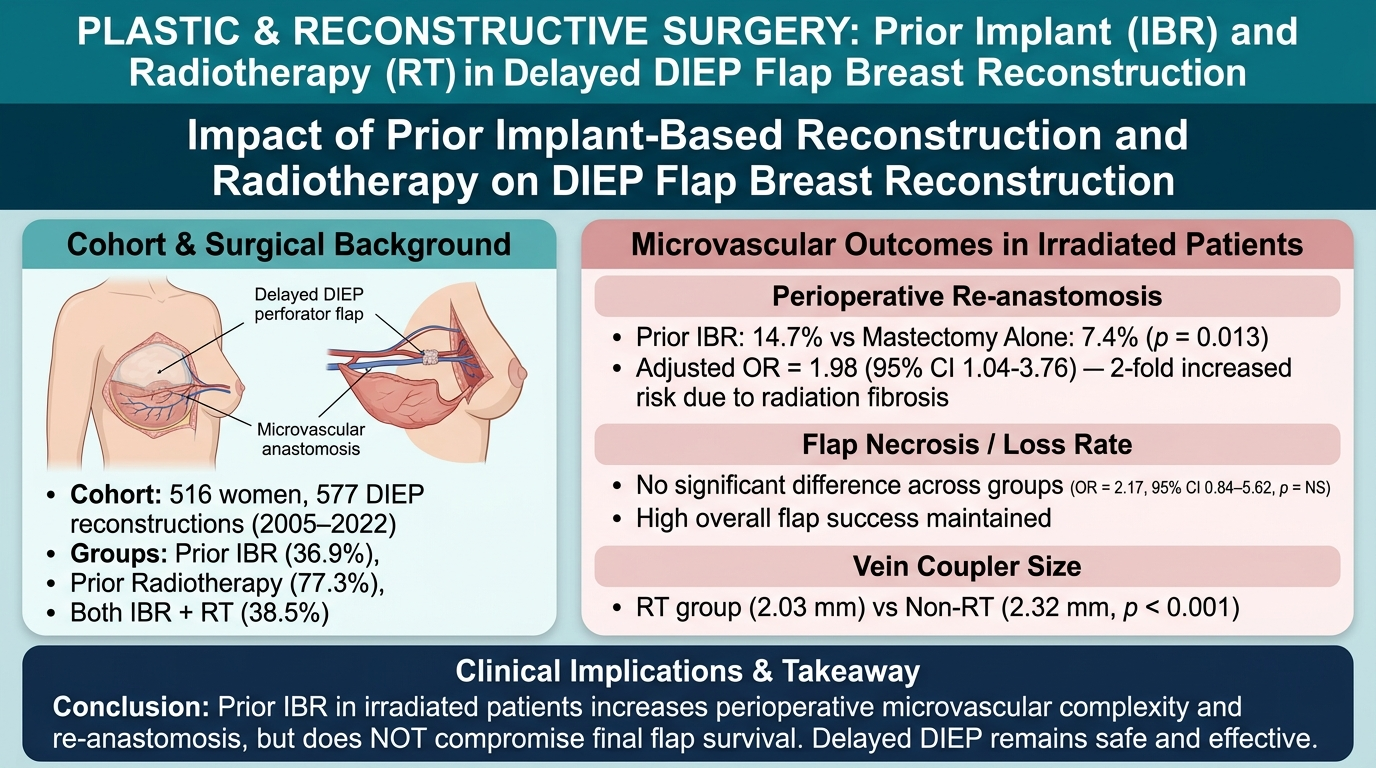
A total of 516 women underwent 577 DIEP flap reconstructions. Of these, 213 (36.9%) had prior implant-based reconstruction, 441 (77.3%) had received radiotherapy, and 170 (38.5%) had both prior IBR and RT.
The incidence of perioperative microvascular re-anastomosis was notably higher in irradiated patients with previous IBR compared to those without prior IBR (14.7% vs. 7.4%, p=0.013). Logistic regression confirmed an almost twofold increased risk of re-anastomosis in the irradiated IBR group (OR 1.98, 95% CI 1.04-3.76).
Conversely, rates of flap necrosis did not differ significantly between groups. Although the OR for flap necrosis among irradiated IBR patients was elevated (OR 2.17), the confidence interval (0.84-5.62) encompassed unity, indicating no statistically significant association.
Vein coupler size—an important technical parameter reflecting vessel caliber—was smaller on average in irradiated patients (2.03 ± 1.03 mm) compared to non-irradiated patients (2.32 ± 0.89 mm, p < 0.001), suggesting possible radiation-induced vessel narrowing or fibrosis.
Overall, despite increased intraoperative vascular challenges in the irradiated IBR group, the absence of increased flap loss underscores that DIEP flap reconstruction remains safe and effective even in this higher-risk subgroup.
Expert Commentary
This study provides valuable clinical insights into the nuanced interplay between prior implant reconstruction, radiotherapy, and microvascular outcomes in delayed DIEP flap surgery. The finding of nearly doubled re-anastomosis rates in irradiated, previously implanted patients highlights the microvascular fragility caused by RT and the added fibrosis from capsular contracture associated with implants.
Such microvascular challenges necessitate vigilant microsurgical technique and possibly longer operative times. The smaller vein coupler sizes further substantiate microvascular compromise, consistent with established radiotherapy-induced vascular changes documented in prior studies.
Notably, the lack of significant difference in flap necrosis rates is reassuring, emphasizing that meticulous surgical planning and experience can overcome these obstacles without compromising flap viability.
Limitations of the study include its retrospective design and potential residual confounding by factors such as radiation dose variability or timing between treatments. Prospective studies could further delineate optimal surgical strategies or preoperative assessments such as imaging of vessel caliber.
Conclusion
The combination of prior implant-based reconstruction and radiotherapy increases the frequency of microvascular complications requiring intraoperative re-anastomosis during delayed DIEP flap breast reconstruction, but does not significantly elevate the risk of flap necrosis. This suggests that while the surgical procedure is more complex and demands heightened technical vigilance, it remains a safe and viable option for patients undergoing salvage reconstruction after implant failure and radiotherapy.
Clinicians should counsel patients accordingly and prepare for potential microvascular challenges when planning delayed autologous reconstruction in this subgroup. Further research may focus on refining perioperative protocols and preoperative vascular assessments to optimize outcomes.
Reference
Liu Y, Rittri S, Johansson ALV, Nord ÅE, Sackey H, de Boniface J, Halle M. Impact of Prior Implant-Based Reconstruction and Radiotherapy on Microvascular Outcome in Deep Inferior Epigastric Perforator Flap Breast Reconstruction. Plast Reconstr Surg. 2026 Oct 12. doi: 10.1097/PRS.0000000000013522. Epub ahead of print. PMID: 42862123.
This article was created using several editorial tools, including AI, as part of the process. Human editors reviewed this content before publication.