We use cookies

Our website uses essential cookies and, with your consent, additional cookies to measure performance and improve our services. Cookie Policy.

You can change your choice at any time.

MMedXYNews
HomeVideos
MedXY AI/MedXY News/Section: General Surgery

Impact of Intraoperative Recurrent Laryngeal Nerve Monitoring on Post-Thyroidectomy Airway Outcomes: Insights from a Large National Cohort

MedXY Editorial Team•Sep 28, 2026•General Surgery
Postoperative Airway ComplicationsRecurrent Laryngeal Nerve Monitoringsurgical outcomesthyroid surgery
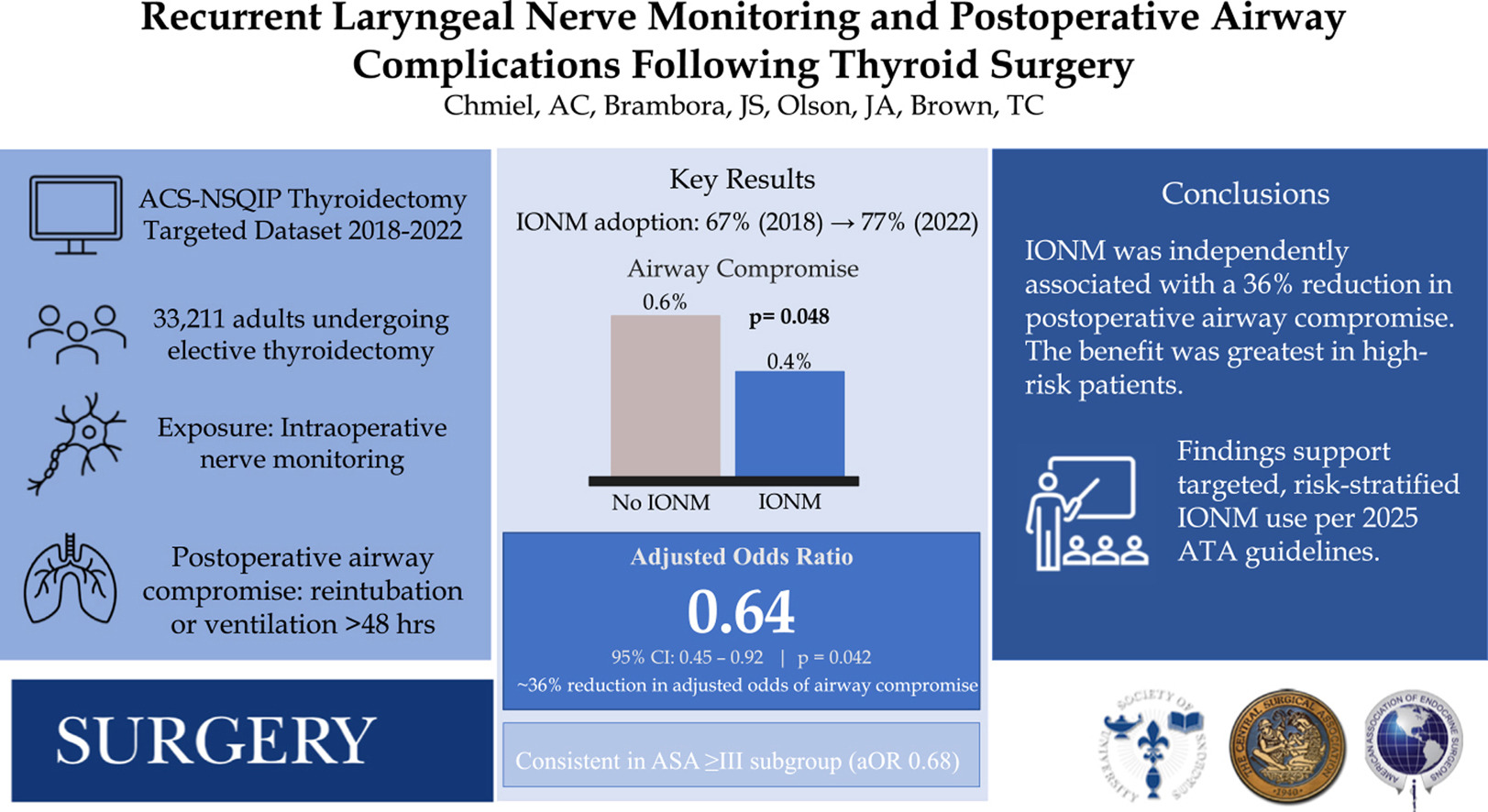
Highlight

  • Intraoperative recurrent laryngeal nerve (RLN) monitoring was used in over 70% of thyroid surgeries in a national cohort study.
  • RLN monitoring was independently associated with a significant reduction in postoperative airway compromise, including prolonged ventilation and unexpected reintubation.
  • Patient factors such as advanced age, comorbidities (e.g., COPD), and tumor stage were key drivers of airway complication risk post-thyroidectomy.
  • The protective effect of RLN monitoring was most pronounced in high-risk surgical patients with American Society of Anesthesiologists (ASA) class III or above.

Study Background

MedXY registered readers

Sign in free to continue reading

Create or use your MedXY account to unlock the complete article.

This article was created using several editorial tools, including AI, as part of the process. Human editors reviewed this content before publication.

Related articles

Open language-specific specialty feeds and department pages.

Chronic Steroid Use Does Not Increase Short-Term Risks After Distal Pancreatectomy: Insights from a Large National DatabaseA national propensity-matched analysis shows that chronic glucocorticoid use does not elevate 30-day morbidity or mortality after distal pancreatectomy, challenging perceptions of steroid-related surgical risk.Sep 30, 2026Frailty as a Predictor of Surgical Outcomes in Cricopharyngeus Muscle Dysfunction: Enhancing Patient Selection and ExpectationsFrailty negatively impacts swallowing improvement after UES surgery for cricopharyngeus muscle dysfunction, with nonfrail patients experiencing greater benefits. Frailty assessment aids preoperative planning without excluding patients fromSep 23, 2026Environmental Burden and Its Influence on Surgical Outcomes: Unveiling the Hidden DisparitiesThis study links environmental burdens, notably air pollution and proximity to transportation, to increased postoperative complications, revealing a critical pathway for health disparities in surgery.Sep 23, 2026
Loading comments...
MedXY briefing

Get the free newsletter

Evidence-led clinical news, trends, and analysis—delivered to your inbox.

Ask MedXY AI

Most popular

Intimate Health
Five Benefits for Women Continuing Sexual Activity After Menopause
Intimate Health
Why Some Women Have a Strong Sex Drive—And Why Men Shouldn't Worry About It
Nursing & care
How often should a couple have sex?
Cardiology
Precision Medicine for Long QT Syndrome Type 2: Lumacaftor Corrects Trafficking Defects and Shortens QT Interval
General Surgery
Optimizing Postoperative Opioid Prescriptions After Intra-Abdominal Cancer Surgery: Comparing the 5x-Multiplier and 3-Tier Models
© 2026 MedXY
Contact usAbout usPrivacy PolicyMedXY story
Thyroid Compressive Symptoms: Optimizing Diagnosis and Management for Improved Outcomes
This article reviews the clinical evaluation, differential diagnosis, and treatment outcomes of patients presenting with thyroid compressive symptoms, emphasizing the importance of thorough preoperative workup and individualized surgical se
Sep 22, 2026
Assessing the Learning Curve of Robotic Left-Sided Pancreatectomy: Safety and Oncological Outcomes in a Multicenter International StudyThis multicenter study evaluates how the surgical learning phase impacts major complications and oncological quality in robotic left-sided pancreatectomy, demonstrating safe adoption with consistent morbidity and highlighting the need for oSep 21, 2026
Robotic Versus Laparoscopic Cholecystectomy: Balancing Safety, Efficacy, and Cost with a Novel Risk CalculatorThis study compares robotic and laparoscopic cholecystectomy, highlighting robotic surgery’s advantages in safety for high-risk and obese patients despite higher costs, and introduces a predictive risk calculator to aid surgical decisSep 21, 2026