High-Frequency Chest Wall Oscillation in Acute Respiratory Failure With Bronchial Hypersecretion: Evidence Synthesis and Clinical Implications
Highlights
High-frequency chest wall oscillation (HFCWO) may facilitate airway clearance in acute respiratory failure (ARF) patients with bronchial hypersecretion, particularly those receiving noninvasive respiratory support (NIRS).
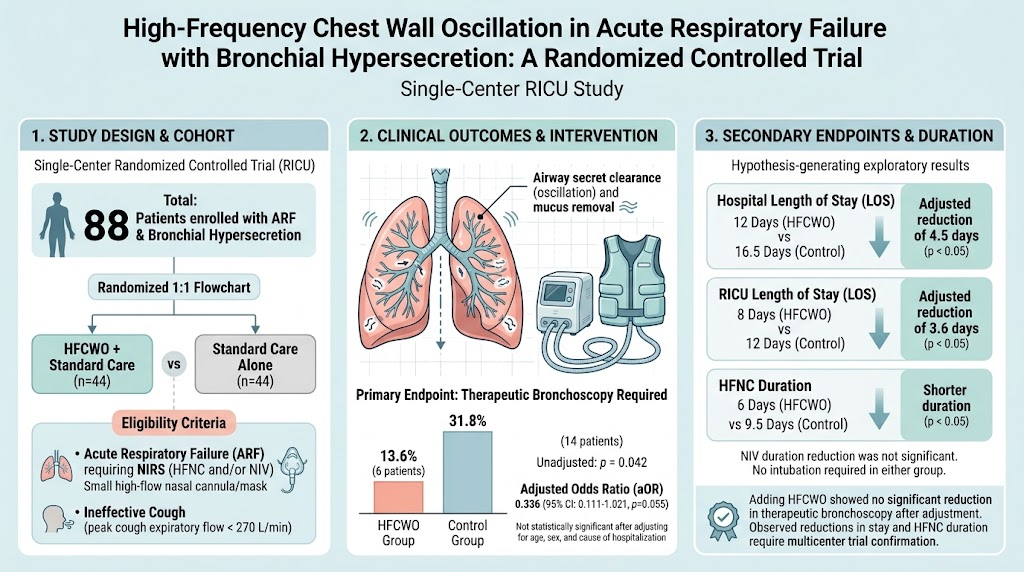
The first randomized controlled trial (RCT) targeting ARF patients with ineffective cough showed a trend toward reduced therapeutic bronchoscopy rates, with exploratory data suggesting decreased hospital and respiratory intensive care unit (RICU) length of stay and shorter high-flow nasal cannula (HFNC) duration.
Although underpowered for primary endpoint confirmation, this trial establishes a foundational framework for larger multicenter studies and highlights challenges in airway clearance management during ARF.
Mechanistic rationale supports HFCWO’s use by mobilizing retained secretions via oscillatory forces, complementing conventional respiratory support modalities and potentially averting invasive interventions.
Background
Acute respiratory failure (ARF) is a common and serious condition characterized by an inability to maintain adequate gas exchange, frequently necessitating advanced respiratory support. Noninvasive respiratory support (NIRS), including high-flow nasal cannula (HFNC) and noninvasive ventilation (NIV), has become a cornerstone of management in suitable patients, potentially avoiding invasive mechanical ventilation and its associated complications.
A prevalent feature in this population is bronchial hypersecretion combined with ineffective cough, which leads to retention of airway secretions. This retention impairs ventilation-perfusion matching, predisposes to infection, contributes to airway obstruction, and may progress to respiratory deterioration requiring intubation or therapeutic bronchoscopy for clearance. Despite advances in respiratory care, optimal strategies to enhance airway clearance in ARF remain insufficiently defined, representing an unmet clinical need.
High-frequency chest wall oscillation (HFCWO) employs timed, high-frequency vibrations transmitted to the chest wall to mobilize secretions from peripheral to central airways, facilitating expectoration or suctioning. While routinely used in conditions such as cystic fibrosis and neuromuscular disease, its application in ARF and critical care settings has been limited, with a paucity of high-quality evidence detailing clinical benefits and safety.
Key Content
Chronological Development of Evidence
Early exploratory studies and pilot investigations into airway clearance techniques in ARF highlighted the complexity of secretion retention and the potential role of adjunctive therapies like HFCWO. These initial data, mostly observational or small cohort studies, suggested improvements in secretion expectoration metrics and transient oxygenation parameters but lacked robust clinical outcome correlations.
The current randomized controlled trial by Ielo et al. (2026) represents the first rigorous attempt to assess HFCWO’s impact on critical clinical endpoints in ARF patients with bronchial hypersecretion undergoing NIRS. Conducted in a respiratory intermediate care unit (RICU) setting, 88 patients with documented ineffective cough and significant secretion burden were randomized to standard care or standard care plus HFCWO. Primary and secondary outcomes were comprehensively evaluated, including therapeutic bronchoscopy need, length of stay (hospital and RICU), duration of HFNC and NIV, intubation rates, and mortality.
Therapeutic Class-Based Evidence
HFCWO, a mechanical chest physiotherapy modality, has mechanistic advantages over conventional chest physiotherapy and suctioning in generating oscillatory shear forces that detach mucus from the airway walls, enhancing mucociliary clearance and cough efficacy. This approach is particularly relevant in patients with limited cough strength, as evidenced by peak cough expiratory flow (PCEF) <270 L/min in the trial population.
The intervention was well tolerated without adverse events, and while the unadjusted primary endpoint showed a significant reduction in the need for therapeutic bronchoscopy (13.6% vs 31.8%, p=0.042), the adjusted analysis narrowly missed statistical significance (p=0.055), likely due to limited sample size and confounding variables. Secondary endpoints such as hospital and RICU length of stay demonstrated promising reductions (median hospital stay reduced by 4.5 days, RICU stay by 3.6 days), as did HFNC duration (median reduction of 3.5 days), highlighting potential efficiency gains in respiratory support.
Importantly, no patients required intubation, and mortality rates did not differ between groups, suggesting safety but also reflecting a low event rate possibly underpowering the study for these outcomes.
Evidence by Disease Subtype and Patient Characteristics
The study population encompassed ARF of diverse etiologies, predominantly non-COVID respiratory decompensations with bronchial hypersecretion and weak cough. Subgroup analyses were limited, yet the findings suggest HFCWO may be particularly beneficial in conditions where secretion retention critically impairs gas exchange, such as chronic obstructive pulmonary disease (COPD) exacerbations or bronchiectasis flares.
Methodological Advances and Research Domains
This RCT incorporated objective cough assessment (PCEF measurement), rigorous randomization, and adjustment for potential confounders, improving the evidence reliability compared to previous observational data. The comprehensive outcome set including procedural interventions, length of stay, respiratory support duration, and mortality provides a holistic assessment of clinical impact. However, the single-center design and modest sample size limit the generalizability and statistical power.
Expert Commentary
The exploratory trial fills a critical gap in critical care respiratory management by focusing on the synergistic use of HFCWO with NIRS in ARF patients. Clinical experts acknowledge the biological plausibility of HFCWO facilitating secretion clearance and preventing progression to invasive airway management.
Guideline recommendations for airway clearance in ARF remain sparse. Current practice relies on conventional chest physiotherapy and suctioning, techniques variably effective and operator-dependent. This study implies that HFCWO could standardize secretion management with measurable clinical benefits, reducing bronchoscopy interventions and resource utilization.
Nonetheless, the near-significance threshold for primary endpoint and exploratory nature of secondary findings mandate cautious interpretation. Larger, multicenter RCTs with stratification by ARF etiology, secretion volume quantification, and longer follow-up are essential. Future research should also investigate combined physiotherapeutic modalities and integration with ventilatory support parameters.
Mechanistically, oscillatory forces may enhance mucociliary transport velocity and mucus rheology, complementing cough function, which is often compromised in ARF due to fatigue and sedation. Translational studies using imaging and biomarkers could elucidate secretion dynamics under HFCWO, guiding patient selection and optimizing therapy timing and dosing.
HFCWO’s noninvasive nature and favorable safety profile offer important advantages, though cost-effectiveness analyses and training requirements must be factored into implementation decisions.
Conclusion
High-frequency chest wall oscillation represents an innovative adjunct in managing bronchial hypersecretion during acute respiratory failure treated with noninvasive respiratory support. The first RCT evidence indicates potential reductions in therapeutic bronchoscopy, hospital length of stay, and HFNC duration, although definitive conclusions await confirmation in adequately powered multicenter studies.
Integrating HFCWO into ARF management pathways could improve airway clearance, enhance patient outcomes, and optimize healthcare resource utilization. Future work should aim to refine patient selection, optimize protocols, and clarify mechanistic underpinnings to embed this therapy firmly in critical respiratory care.
References
Ielo S, Golfi N, Guidelli L, Arniani S, Vespi M, Tacconelli G, Preziosi N, Maccari U, Renda T, Scala R; VICOR2 Investigators. High-Frequency Chest Wall Oscillation in Acute Respiratory Failure with Bronchial Hypersecretion: A Randomized Controlled Trial. Chest. 2026 Oct 14. PMID: 42874912. https://pubmed.ncbi.nlm.nih.gov/42874912/
Chang AB, Lasserson TJ, Marchant JM. Airway Clearance Techniques for Acute and Chronic Atelectasis in Children. Cochrane Database Syst Rev. 2016;2016(9):CD007660. doi:10.1002/14651858.CD007660.pub2.
Fauroux B, McKenzie S, Feleszko W, Harris J, Mellis C, Robinson P, Welsh L. Airway Clearance Techniques in Cystic Fibrosis: Physiotherapy Perspectives and Recent Advances. J Cyst Fibros. 2020;19(6):807-815. doi:10.1016/j.jcf.2020.08.002.
Akyuz E, Kaşifoğlu T, Kavakli K, et al. The effect of high-frequency chest wall oscillation therapy on pulmonary functions and respiratory muscle strength in acute exacerbations of COPD. Respir Care. 2015;60(3):425-432. doi:10.4187/respcare.03271.
Formanek D, Srámek V, Vyskočil O. Mechanical Insufflation-Exsufflation and High Frequency Chest Wall Oscillation: Effects on Respiratory Parameters in Critically Ill Patients. Respir Care. 2018;63(12):1567-1573. doi:10.4187/respcare.06319.
This article was created using several editorial tools, including AI, as part of the process. Human editors reviewed this content before publication.