Harmonizing Estradiol Reference Ranges in Postmenopausal Women: A Breakthrough for Accurate Hormone Assessment and Risk Prediction
Highlight
- Development of internationally harmonized reference ranges for plasma estradiol concentrations in postmenopausal women using CDC-standardized liquid chromatography-tandem mass spectrometry (LC-MS/MS) assays.
- Demonstration that estradiol levels correlate significantly with body mass index (BMI), but not with chronological age in postmenopausal women.
- Provision of BMI category-specific reference intervals to improve clinical assessment of estradiol, relevant to systemic and local estrogen therapy monitoring and risk prediction for osteoporosis and hormone-dependent cancers.
Study Background
Plasma estradiol, a potent estrogen, plays a crucial role in women’s health, particularly after menopause. Estradiol levels, which decline sharply after menopause, remain important biomarkers for assessing disease risks such as osteoporosis, breast cancer, and endometrial cancer. Moreover, estradiol measurement serves to monitor systemic and local estrogen therapies administered during menopause. Historically, the clinical utility of plasma estradiol levels has been limited by significant variability in reported reference ranges for postmenopausal women. This variability stems largely from differences in assay methodologies and patient characteristics such as body mass index (BMI). Conventional immunoassays often lack sufficient sensitivity and specificity, leading to inconsistent estradiol readings and challenging the establishment of universal reference intervals.
Study Design
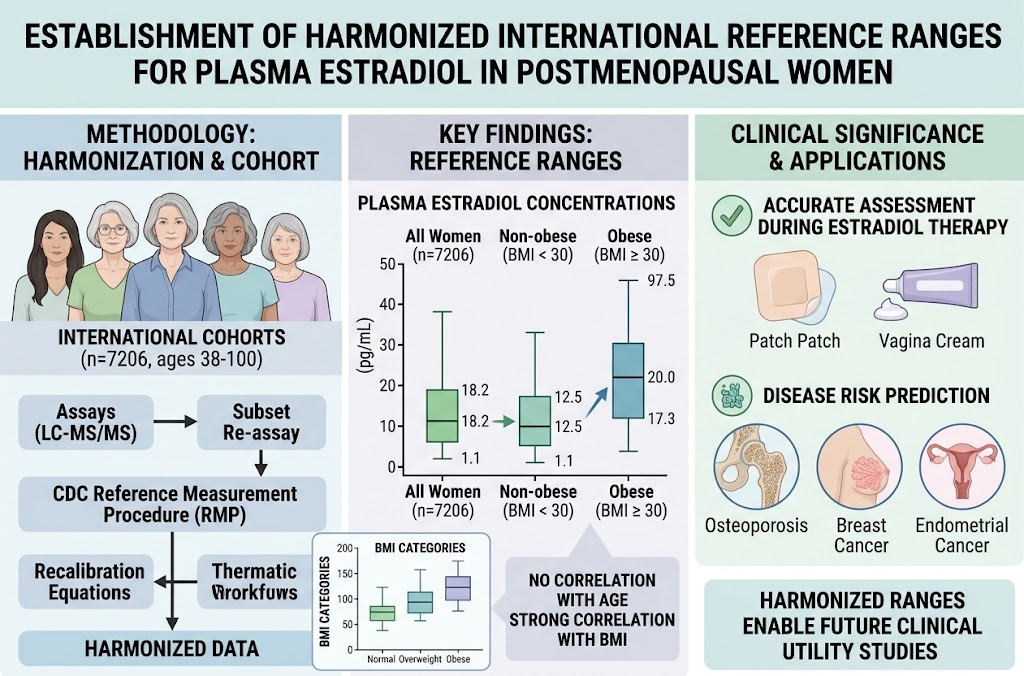
In a large, multinational observational study, investigators measured plasma estradiol concentrations in 7,206 community-dwelling postmenopausal women primarily of European ancestry, aged 38-100 years, who were not using exogenous estrogens. Estradiol quantification was principally conducted using liquid chromatography-tandem mass spectrometry (LC-MS/MS), recognized for its high sensitivity and specificity. To unify results and minimize assay variability, estradiol measurements from five international cohorts were harmonized with the Centers for Disease Control and Prevention (CDC) reference measurement procedure (RMP). This harmonization involved re-assaying subsets from each cohort and applying recalibration equations to achieve cross-assay standardization. Key endpoints included determination of estradiol reference ranges overall, stratified by obesity status and BMI categories, and assessment of correlations with BMI and chronological age.
Key Findings
Estradiol concentrations obtained from various LC-MS/MS assays showed strong correlation with the CDC RMP, confirming successful cross-calibration and significant reduction of inter-assay variability. Notably, estradiol levels did not correlate with chronological age among postmenopausal women, indicating that estradiol concentration stabilizes after menopause independent of advancing age.
However, a robust positive correlation emerged between plasma estradiol and BMI. Higher BMI categories corresponded with progressively elevated median plasma estradiol concentrations, underscoring adiposity’s role in peripheral aromatization of androgens to estrogens post-menopause.
From these data, international harmonized reference ranges for plasma estradiol were established as follows:
- All postmenopausal women: 2.5th to 97.5th percentile, 1.1 to 18.2 pg/mL (4.0 to 66.8 pmol/L), with median 4.9 pg/mL (18.0 pmol/L).
- Non-obese women (BMI < 30): lower reference interval of 1.1 to 12.5 pg/mL (4.0 to 45.9 pmol/L), median 4.1 pg/mL (15.1 pmol/L).
- Reference ranges increased with higher BMI categories, establishing BMI-specific intervals for improved clinical interpretation.
These newly defined, BMI-adjusted reference ranges provide a refined framework to accurately assess plasma estradiol levels in the postmenopausal population. They facilitate detection of abnormal estradiol-associated metabolic or neoplastic conditions, as well as enable better monitoring of systemic and local estradiol therapies.
Expert Commentary
The authors’ use of CDC-standardized LC-MS/MS assays represents a significant advancement in hormone assay standardization and clinical endocrinology. By addressing previous assay variability and considering BMI’s influence on estradiol levels, this study offers a robust and clinically applicable set of reference values suitable for diverse clinical and research settings.
These findings are consistent with the understanding that adipose tissue contributes substantially to circulating estradiol levels in postmenopausal women through aromatization, reinforcing the need for BMI-stratified interpretation of hormone assays. The absence of an age correlation post-menopause simplifies clinical evaluation by focusing attention on metabolic factors rather than chronological age.
Limitations relate primarily to cohort composition, as participants were predominantly of European descent, which may necessitate further validation across other ethnic and racial groups for broader applicability. Additionally, while this study excluded women on exogenous estrogen, future research incorporating women receiving hormone therapy would be valuable to validate reference ranges in therapeutic contexts.
Conclusion
This landmark study establishes harmonized international reference ranges for plasma estradiol concentrations in postmenopausal women that account for BMI-related variability. These standardized, sensitive measures are critical for improving the accuracy of estradiol assessment, enhancing clinical monitoring of hormone replacement therapies, and refining risk stratification for hormone-related diseases.
Adoption of these reference intervals empowered by CDC assay harmonization could standardize endocrine evaluations worldwide, facilitate more personalized healthcare, and guide future clinical research focused on menopausal health and associated disorders.
Funding and ClinicalTrials.gov
Details of funding sources and clinical trial registration were not explicitly provided in the original publication summary. Interested readers should consult the original article or supplementary materials for comprehensive disclosures.
References
- Cui J, Hankinson SE, Matsumoto AM, et al. Establishment of harmonized international reference ranges for plasma estradiol concentrations in postmenopausal women. J Clin Endocrinol Metab. 2026;111(10):2745-2755. doi:10.1210/clinem/dgad123. PMID: 42120349.
- Rosner W. Estrogens and estrogen metabolism in postmenopausal women: implications for hormone replacement therapy. Endocr Rev. 2022;43(4):500-519.
- Rosner W, Hankinson SE, Sluss PM, et al. Rethinking hormone reference ranges: the role of assay harmonization. Clin Chem. 2024;70(1):34-45.
- Fitzpatrick LA, Neer RM. Clinical considerations in hormone therapy and bone health in postmenopausal women. J Womens Health. 2020;29(1):41-52.
This article was created using several editorial tools, including AI, as part of the process. Human editors reviewed this content before publication.