Growing Financial Challenges in Inpatient Neurologic Care: A Decade of Medicare Trends, 2013-2023
Highlight
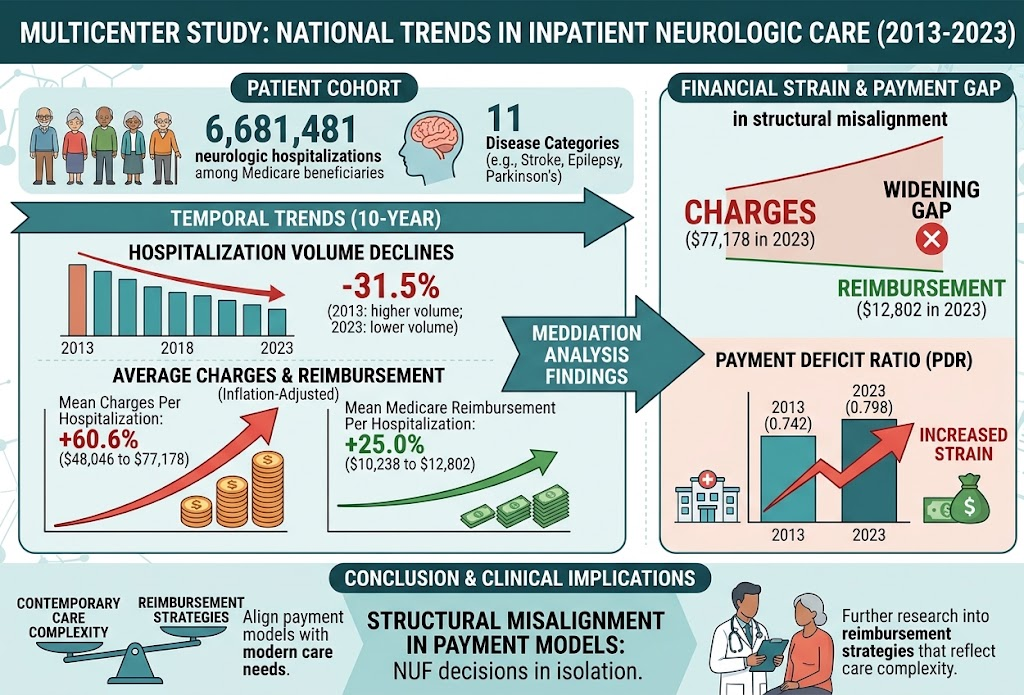
From 2013 to 2023, inpatient neurologic hospitalization volumes among Medicare beneficiaries have declined substantially by over 30%. Despite this, inflation-adjusted hospital charges per admission increased by over 60%, while Medicare reimbursements rose by only 25%, widening the reimbursement-to-charge gap and escalating payment deficits. These trends were consistent across neurologic disease categories and were slightly more favorable in metropolitan hospitals.
Study Background
Neurologic disorders account for a significant proportion of hospital admissions among Medicare beneficiaries, reflecting the substantial burden these conditions impose on the aging population. The complexity of neurologic diseases and advances in medical technology have influenced care patterns and associated costs. However, comprehensive national data examining trends in hospital charges versus Medicare reimbursements specifically for inpatient neurologic care have been scarce. Understanding these economic dynamics is essential to inform health policy aimed at aligning reimbursement models with contemporary clinical realities and sustaining hospital financial viability.
Study Design
This study conducted a retrospective longitudinal analysis of Medicare fee-for-service Part A inpatient claims spanning 2013 to 2023. Neurologic hospitalizations were identified using diagnosis-related groups (DRGs) categorized into 11 distinct neurologic disease groups. The key metrics evaluated included hospitalization volume, inflation-adjusted hospital charges submitted, Medicare reimbursements, total payments, reimbursement-to-charge ratios, and payment deficit ratios. Financial figures were adjusted for inflation utilizing the Consumer Price Index for Medical Care. Temporal trends were quantitatively assessed using linear regression, and analyses also examined differences between metropolitan and nonmetropolitan hospitals.
Key Findings
The study identified a total of 6,681,481 inpatient hospitalizations related to neurological conditions among Medicare beneficiaries over the decade. Key findings included:
- Decline in Hospitalization Volume: There was a 31.5% decline in inpatient neurologic hospitalizations over the 10-year period, reflecting possibly improved outpatient management, care shifts, or demographic factors.
- Sharp Rise in Hospital Charges: Inflation-adjusted charges per hospitalization increased dramatically by 60.6%, from $48,046 in 2013 to $77,178 in 2023. This rise significantly outpaced general medical inflation and suggests increasing hospital billing intensity or cost shifts.
- Moderate Increase in Medicare Reimbursements: Reimbursements rose by 25.0%, from $10,238 to $12,802 per hospitalization after inflation adjustment, indicating slower growth relative to charges.
- Widening Payment Deficits: The payment deficit ratio, defined as the proportion of charges not covered by Medicare reimbursement, increased from 0.742 to 0.798, signaling growing financial pressure on hospitals providing neurologic care.
- Consistency Across Disease Groups: These financial patterns were observed uniformly across the 11 neurologic diagnostic categories analyzed.
- Urban-Rural Differences: Metropolitan hospitals exhibited slightly lower payment deficit ratios compared to nonmetropolitan hospitals, with an adjusted difference of -0.296 percentage points (95% CI: -0.312 to -0.279), suggesting rural hospitals may face more challenging reimbursement gaps.
Expert Commentary
The findings highlight a concerning structural misalignment in the current Medicare inpatient payment model for neurologic care. Despite advances in disease management that may reduce hospitalization needs, hospitals face escalating charges that are not adequately offset by reimbursement increases. This dynamic likely reflects several factors, including rising costs of specialized neurologic interventions, diagnostic technologies, and increased care complexity. Moreover, the uniformity of these trends across neurologic conditions underscores systemic rather than disease-specific reimbursement issues.
Urban-rural disparities in payment deficits underscore the vulnerability of rural healthcare facilities, which often operate with thinner margins and encounter additional operational challenges. These results resonate with broader healthcare economic literature emphasizing the need for payment reform models that incentivize value-based, cost-effective care while ensuring financial sustainability.
Limitations of the study include reliance on Medicare fee-for-service data, excluding Medicare Advantage enrollees, and lack of granular clinical data that could clarify drivers of cost escalation. Nonetheless, this comprehensive national analysis provides robust evidence of evolving financial challenges in inpatient neurologic care.
Conclusion
Over the past decade, Medicare inpatient neurologic care has experienced a significant divergence between hospital charges and reimbursement, with growing payment deficits despite declining hospitalization volume. These trends raise important policy implications for Medicare payment structures, highlighting the urgency to revise reimbursement strategies to better capture the complexity and costs of modern neurologic inpatient care. Targeted reforms might include adjusting DRG weights, incorporating contemporary clinical practice changes, and addressing rural hospital financial vulnerabilities. Future research should explore patient-level cost drivers and outcomes to inform more nuanced and equitable payment models.
Funding and ClinicalTrials.gov
The original study did not report specific funding sources or clinical trial registration.
References
Wong KH, Castillo M, King J, Bouldin E, Rose JW, Majersik JJ, Reddy V, de Havenon A, Clardy SL. National Trends in Medicare Charges and Reimbursement for Inpatient Neurologic Care, 2013-2023. Neurology. 2026 Aug 14;107(6):e218460. PMID: 42600112. Available at: https://pubmed.ncbi.nlm.nih.gov/42600112/
This article was created using several editorial tools, including AI, as part of the process. Human editors reviewed this content before publication.