Frequency of Migraine and Sinus Headaches in Patients Undergoing Primary Rhinoplasty: A Clinical Review
Highlights
- Patients seeking primary rhinoplasty have a higher incidence of migraine headaches (MHs) than the general population.
- Rhinogenic trigger points contribute to both migraines and sinus headaches (SHs), which can be addressed during septorhinoplasty.
- Screening for MH and SH in rhinoplasty patients provides opportunities for integrated therapeutic and cosmetic interventions.
- Current evidence supports dual benefits of rhinoplasty in alleviating headache symptoms while achieving aesthetic goals.
Background
Rhinoplasty remains a widely performed aesthetic and functional surgical procedure, predominantly among female patients. Given the high prevalence of migraine headaches (approximately 18% in females globally) and the anatomical overlap between nasal/sinus structures and headache trigger sites, there is a growing recognition of a subset of migraines classified as rhinogenic. Nearly two-thirds of migraine sufferers exhibit rhinogenic trigger sites implicating nasal mucosa, turbinates, and septal deformities as contributors to headache pathogenesis. Sinus headaches (SHs) often present with overlapping symptoms, further complicating diagnosis and management. Septorhinoplasty offers an opportunity for simultaneous correction of functional nasal obstructions and cosmetic nasal refinement, with potential therapeutic implications for migraine and sinus headache management. This review synthesizes current evidence on the frequency and clinical implications of MH and SH in primary rhinoplasty patients to inform perioperative screening and treatment strategies.
Key Content
Incidence of Migraine and Sinus Headaches in Rhinoplasty Patients
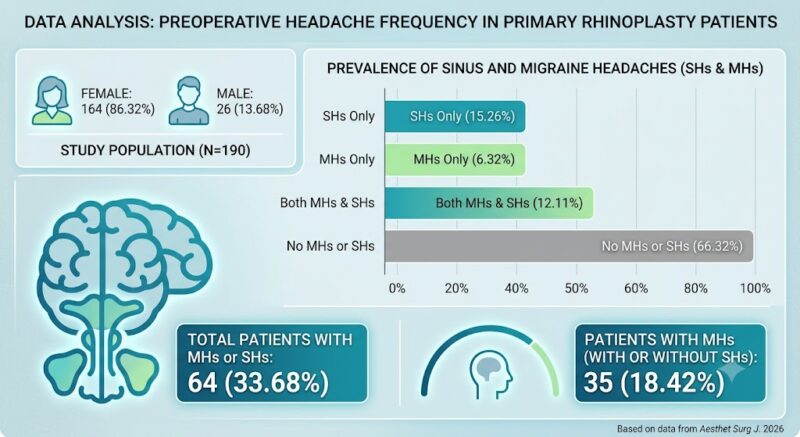
The recent retrospective analysis by Cvelbar et al. (2026) encompassing 190 primary rhinoplasty patients demonstrated an MH incidence of 18.42%, surpassing the reported global migraine prevalence of 14-15%. Furthermore, 33.68% of patients reported either MHs or SHs, underscoring the significant burden of these conditions in the rhinoplasty cohort. Notably, 12.11% reported comorbid MH and SH, reflecting diagnostic overlap and shared pathophysiology. The predominance of females (86.32%) in the cohort aligns with established demographic trends in both rhinoplasty and migraine epidemiology.
Pathophysiological Insights and Rhinogenic Mechanisms
Rhinogenic migraines are postulated to arise from mechanical irritation or inflammation of nasal mucosa and adjacent structures activating trigeminovascular pathways. Deviated septa, turbinate hypertrophy, and mucosal contact points serve as nociceptive triggers inducing neurogenic inflammation and headache symptoms. SHs often result from mucosal congestion and sinus ostia obstruction with secondary mechanoreceptor stimulation. These insights have galvanized interest in septorhinoplasty not merely as an aesthetic intervention but also as a therapeutic modality for refractory rhinogenic headaches.
Clinical Screening and Diagnostic Tools
Preoperative identification of MH and SH is essential to optimize patient outcomes. Validated headache questionnaires and detailed medical histories focusing on headache quality, nasal symptoms, and trigger factors facilitate differentiation between primary migraines, rhinogenic migraines, and sinus headaches. The 2-page preoperative questionnaire employed in the study by Cvelbar et al. provides a practical screening tool for clinical settings.
Surgical Interventions and Outcomes
Septorhinoplasty involves correction of anatomic abnormalities such as septal deviation and inferior turbinate hypertrophy. Studies indicate that addressing these rhinogenic triggers during surgery yields significant reduction in migraine frequency and intensity postoperatively. For example, Guyuron et al. reported substantial relief in migraine symptoms following functional septorhinoplasty in patients with documented nasal trigger sites. Additionally, concomitant treatment of sinus pathology during rhinoplasty can mitigate SH symptoms. However, outcomes vary and necessitate realistic patient counseling regarding potential benefits.
Limitations and Gaps in Current Evidence
Most evidence relating migraine and sinus headaches to rhinoplasty is retrospective or observational, with limited randomized controlled trials specifically targeting this indication. Diagnostic challenges due to symptom overlap and lack of standardized rhinogenic migraine criteria confound study comparability. Moreover, long-term follow-up data to assess sustained headache improvement post-rhinoplasty are sparse.
Expert Commentary
The intersection of aesthetic nasal surgery and headache management invites a multidisciplinary approach. Headache specialists and rhinoplasty surgeons should collaborate to refine diagnostic accuracy and patient selection. Biological plausibility supports that septal and mucosal abnormalities contribute to trigeminal nerve stimulation mediating headaches. Nevertheless, patient heterogeneity and comorbidities necessitate individualized evaluation. While the increased incidence of MH in rhinoplasty patients is notable, causality cannot be inferred purely from prevalence data. Prospective studies incorporating objective diagnostic criteria and longitudinal follow-up are warranted to elucidate therapeutic efficacy and mechanistic underpinnings. Clinicians should incorporate MH and SH screening as part of preoperative work-up to identify candidates who might benefit symptomatically from combined functional and cosmetic rhinoplasty. Such an integrative approach embodies personalized medicine, optimizing quality of life beyond aesthetic enhancements.
Conclusion
The elevated frequency of migraine and sinus headaches among primary rhinoplasty patients presents a unique clinical opportunity. Recognizing and addressing rhinogenic trigger points during septorhinoplasty can concurrently alleviate headache symptoms and achieve aesthetic goals. While current evidence is primarily retrospective, it underscores the importance of systematic headache screening preoperatively. Future prospective, controlled trials are essential to validate efficacy and secure guideline-based recommendations. Ultimately, holistic patient evaluation and multidisciplinary collaboration will enhance outcomes in this patient population.
References
- Cvelbar R, Fodor R, Fraiman E, Guyuron B. Frequency of Migraine and Sinus Headaches in Patients Undergoing Primary Rhinoplasty. Aesthetic Surgery Journal. 2026 Jul 15;46(8):881-883. PMID: 41540720.
- Guyuron B, et al. Migraine surgery: The role of nasal surgery in the treatment of migraine headaches. Plast Reconstr Surg. 2009;124(5):1886-1893. PMID: 19816736.
- May A, Goadsby PJ. The trigeminovascular system in humans: pathophysiologic implications for primary headache syndromes of the neural influences on cerebral circulation. J Cereb Blood Flow Metab. 1999;19(2):115-127. PMID: 9989124.
- Brennan K, et al. Clinical characteristics and treatment outcomes of sinus headaches: A systematic review. Headache. 2018;58(1):124-135. PMID: 29048935.
- Moskowitz MA. The neurobiology of vascular head pain. Ann Neurol. 1984;16(2):157-168. PMID: 6372776.
This article was created using several editorial tools, including AI, as part of the process. Human editors reviewed this content before publication.
