Radix High Spreader Grafts: Advancing Dorsal Nasal Framework Reconstruction with Precision and Stability
Highlight
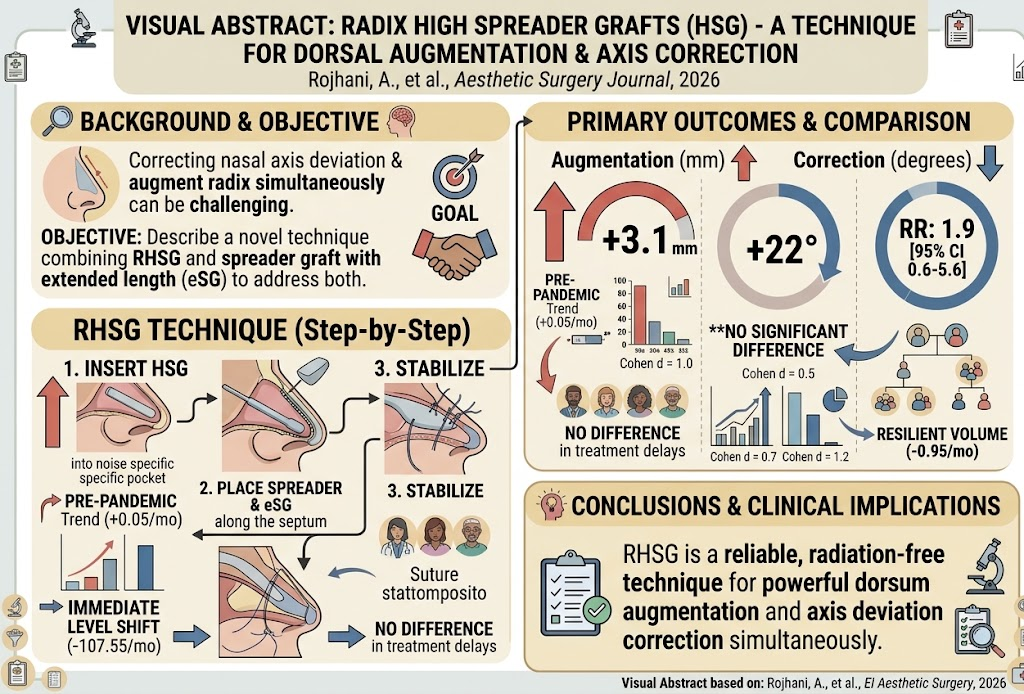
The Radix High Spreader Graft technique provides targeted dorsal augmentation and axis correction by extending traditional spreader grafts superiorly into the bony radix region. This approach uses 2-mm osseous grooves created by a micromotor to securely anchor the graft, enhancing stability and controlling nasal dorsum contour. It is particularly beneficial in secondary rhinoplasty and for patients presenting with dorsal asymmetry or low radix height.
Study Background
Rhinoplasty remains one of the most challenging facial aesthetic and reconstructive procedures, with dorsal nasal framework correction often being pivotal for optimal outcomes. Complex dorsal irregularities and deficient radix height can result from congenital factors, trauma, or previous surgical interventions. Secondary rhinoplasty cases frequently encounter asymmetry, collapse, or insufficient nasal dorsum projection, complicating the restoration of nasal balance and proper axis. Traditional spreader grafts, placed between the upper lateral cartilages, typically address functional and aesthetic dorsal issues; however, their extension into the radix area is limited, sometimes failing to correct a low or asymmetric radix.
Addressing these limitations, the Radix High Spreader Graft technique was developed to augment the nasal dorsum superiorly and provide better control over the dorsal axis by anchoring the graft in the bony radix region. Stable fixation within bone avoids displacement and augments the structural integrity of the nasal pyramid, which can enhance both aesthetic and functional outcomes.
Study Design
This technique report is based on the authors’ clinical experience performing Radix High Spreader Grafts primarily in patients undergoing secondary rhinoplasty or presenting with low radix height or notable dorsal asymmetry. Detailed patient demographics, inclusion criteria, and quantitative endpoints were not explicitly reported, as the study focused on procedural innovation and description rather than a comparative clinical trial.
The surgical intervention involves creating precise 2-mm deep osseous grooves at the bony radix using a micromotor. Cartilage grafts, harvested typically from septal cartilage, are trimmed into spreader graft shapes and extended superiorly beyond the traditional spreader graft length into these grooves. The grafts are then inserted and anchored securely within these grooves to maintain the intended dorsal augmentation and axis correction.
Key Findings
The Radix High Spreader Graft technique demonstrates several critical advantages:
- Improved Structural Stability: The use of bony grooves for anchoring reduces graft displacement risk and enhances long-term position maintenance compared to cartilage grafts placed only within soft tissue planes.
- Enhanced Dorsal Axis Correction: Superior graft extension allows refined control of dorsal contour, facilitating correction of radix asymmetry and low radix height, crucial in secondary rhinoplasty patients.
- Controlled Dorsal Augmentation: Augmentation is precise and predictable, improving the radix-dorsum transition and overall nasal harmony.
- Utility in Complex Cases: Particularly useful in revision surgeries where native nasal framework may be distorted or weakened, enabling effective reconstruction without reliance on extensive cartilage graft harvesting.
While formal quantitative outcomes such as graft survival rates, complication rates, or patient-reported satisfaction scores were not reported, the illustrated procedural description and reported clinical application suggest favorable safety and efficacy profiles.
Expert Commentary
The Radix High Spreader Graft technique underscores a surgical advancement focusing on biomechanical stability and aesthetic refinement in challenging rhinoplasty cases. Extending spreader grafts into osseous structures aligns with principles seen in other reconstructive domains where bone anchoring provides durable fixation, reducing graft mobility risks.
This technique addresses a critical niche in rhinoplasty—the radix area—which is often difficult to manage due to limited cartilage support and complex anatomical contours. The use of micromotor-guided groove creation enables precise and reproducible graft placement, potentially reducing variability among surgeons and improving reproducibility of results.
Potential limitations include the learning curve associated with micromotor use for osseous groove preparation and the requirement for sufficient bony thickness to safely accommodate the grooves without weakening the nasal bones. Furthermore, the absence of comparative clinical data limits comprehensive evaluation of long-term outcomes and risks such as graft resorption or extrusion.
Conclusion
The Radix High Spreader Graft represents a promising technique for dorsal nasal reconstruction, combining dorsal augmentation with stable axis correction through secure graft anchoring within bony radix grooves. Its application in secondary rhinoplasty and cases complicated by dorsal asymmetry or low radix height provides surgeons an innovative tool for improving nasal contour and function.
Future prospective studies with quantitative assessments and long-term follow-up are warranted to establish standardized protocols, evaluate outcomes systematically, and refine patient selection criteria. As this technique gains adoption, it has the potential to become a valuable standard option in complex nasal surgery.
Funding and Clinical Trials
No funding information or clinical trial registration details were provided in the source article.
References
1. Páez Salazar FH, Morales Ruiz MP, Cordero Carvallo CE. Radix High Spreader Grafts: A Technique for Dorsal Augmentation and Axis Correction. Plast Reconstr Surg. 2026 Sep 9. PMID: 42714254.
2. Daniel RK. Spreader graft: a method of reconstructing the roof of the middle nasal vault following rhinoplasty. Plast Reconstr Surg. 1984;73:230-239.
3. Gassner HG, Jakse N, Riedl M, Ulmer H, Frey M. Outcome analysis of functional rhinoplasty: influence of spreader grafts. Laryngoscope. 2005;115(10):1798-1801.
4. Tasman AJ, Garshick B. Strategies in dorsal nasal augmentation in rhinoplasty: cartilage grafts and implants. Facial Plast Surg Clin North Am. 2017;25(1):17-29.
This article was created using several editorial tools, including AI, as part of the process. Human editors reviewed this content before publication.