Highlight
– MLB pitchers with nonoperative forearm flexor strain have approximately threefold increased risk of UCL surgery within one year post-return.
– Time to return to play (RTP) is inversely related to UCL surgery risk; longer recovery correlates with lower risk.
– Fastball velocity, pitching workload, and demographic factors were not significant predictors of UCL surgery post-flexor strain.
– Strain grade and medial elbow pathology were not assessed, limiting causal inference regarding return timing and UCL injury risk.
Study Background
Ulnar collateral ligament (UCL) injury represents a major cause of arm morbidity and time loss among baseball pitchers, frequently necessitating surgical intervention such as Tommy John surgery. While biomechanical factors, pitching workload, and velocity have been identified as contributors to UCL injury risk, the role of adjacent soft tissue structures—namely the forearm flexor-pronator muscle complex—is less well-characterized. The flexor-pronator muscles dynamically stabilize the medial elbow alongside the UCL, and strain injuries in these muscles could signify mechanical stress or early pathology predisposing to subsequent UCL injury. Identifying markers that predict UCL surgery risk could refine injury prevention strategies and guide return-to-play decisions in professional pitchers.
Study Design
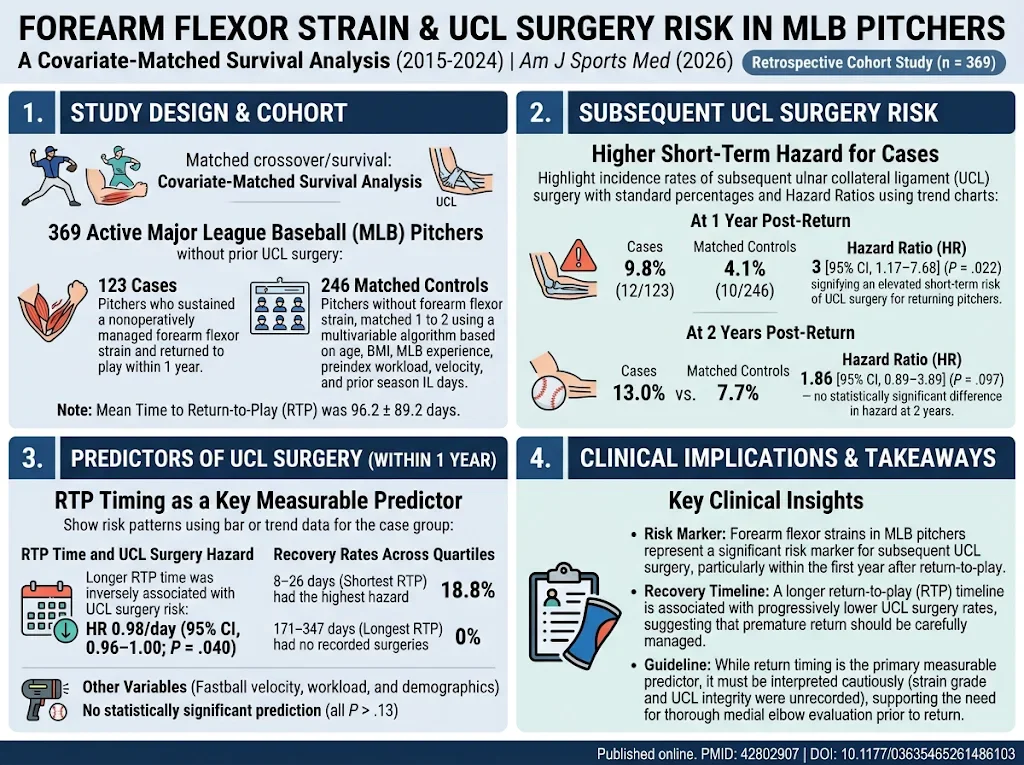
This retrospective cohort study investigated 123 MLB pitchers who sustained nonoperatively managed forearm flexor strains during 2015 to early 2024 and successfully returned to MLB play within one year. Cases with prior UCL surgery were excluded.
Each case was matched to two controls without reported forearm flexor strains but active in MLB at the time of the case’s return. Matching controlled for age, body mass index, MLB experience, pre-injury workload (pitches per game and total pitches), fastball velocity, and prior season elbow/forearm injury list days to balance baseline morbidity.
Primary endpoint was UCL surgery occurrence within 1 and 2 years post-return. Survival analyses using stratified Cox proportional hazards models and Kaplan-Meier estimations assessed UCL surgery risk between cases and controls. Secondary analysis within cases evaluated predictors of UCL surgery including RTP timing, workload, and velocity.
Key Findings
On average, pitchers returned to play 96 days after sustaining a forearm flexor strain.
Within 1 year of RTP, 9.8% of cases underwent UCL surgery compared to 4.1% of matched controls, corresponding to a hazard ratio (HR) of 3.0 (95% CI, 1.17-7.68; P = .022), indicating a statistically significant threefold increase in short-term UCL surgical risk associated with preceding flexor strain.
At 2 years, the cumulative surgery rates were 13.0% for cases versus 7.7% for controls, with hazard ratio 1.86 (95% CI, 0.89-3.89; P = .097), showing a trend toward increased risk that did not reach statistical significance.
Within the cases, RTP timing exhibited a significant inverse association with UCL surgery risk (HR, 0.98 per day delay; 95% CI, 0.96-1; P = .040), with UCL surgery rates declining from 18.8% in the earliest RTP quartile (8–26 days) to 0% in the longest RTP quartile (171–347 days).
Other factors such as fastball velocity, pitching workload, age, and MLB experience were not significant predictors of UCL surgery post-strain.
Expert Commentary
This study provides compelling evidence that forearm flexor strains serve as an important clinical marker for subsequent UCL injury risk in elite pitchers. The threefold increased hazard within the first year underscores the interconnected role of forearm musculature and ligamentous stability in medial elbow health. Of clinical relevance, return timing after flexor strain emerges as a practical risk marker: earlier RTP confers higher risk, possibly reflecting incomplete healing or residual medial elbow pathology.
However, the absence of imaging-confirmed strain grades or UCL status limits mechanistic conclusions. The observed associations may reflect confounding by injury severity or unmeasured medial elbow pathology that prolongs RTP and independently mitigates UCL risk. Hence, caution is warranted in interpreting longer recovery as causally protective.
Future prospective studies incorporating MRI or ultrasound assessments of the flexor-pronator mass and UCL, alongside biomechanical profiling, would clarify the pathophysiology linking forearm soft tissue injury and UCL failure. Moreover, return-to-play protocols might benefit from integrating such imaging to individualize timing and rehabilitation efforts to minimize UCL injury risk.
Conclusion
Forearm flexor strain is a notable risk marker for subsequent UCL surgery in Major League Baseball pitchers, with a concentrated risk during the first year after return to play. Delayed return following flexor strain correlates with decreased UCL surgery risk, although this likely reflects underlying injury complexity rather than a direct protective effect of prolonged rest. Integration of forearm flexor strain history into surveillance and management protocols could enhance preventative strategies for UCL injury and optimize RTP decision-making in professional baseball pitching.
Funding and ClinicalTrials.gov
The original study did not specify funding sources or clinical trial registration details.
References
1. Dillon MR, Mastroianni MA, Frappa N, et al. Forearm Flexor Strain and Subsequent Ulnar Collateral Ligament Surgery Risk in Major League Baseball Pitchers: A Covariate-Matched Survival Analysis. Am J Sports Med. 2026;54(13):3271-3279. PMID: 42802907.
2. Conte S, Camp CL, Dines JS, et al. Injury trends in Major League Baseball over 18 seasons: 1998-2015. Am J Orthop (Belle Mead NJ). 2016;45(3):116-123.
3. Erickson BJ, Gupta AK, Harris JD, et al. Ulnar collateral ligament reconstruction: the Rush experience. Orthop J Sports Med. 2016;4(8):2325967116668326.
4. Fleisig GS, Barrentine SW, Zheng N, Escamilla RF, Andrews JR. Kinematic and kinetic comparison of baseball pitching among various levels of development. J Biomech. 1999;32(12):1371-1375.
5. Rohrbough JT, Altchek DW, Hyman J, Williams RJ 3rd, Botts JD, Warren RF. Medial collateral ligament injuries of the elbow in athletes. Am J Sports Med. 1998 Jan-Feb;26(1):23-31.