Highlight
Introduction of an advanced practice provider (APP)-directed body contouring clinic serves as a force multiplier in plastic surgery practice, increasing patient access and optimizing surgical conversion rates. Rigorous patient eligibility screening by APPs reduces unnecessary surgeon visits and allocates resources efficiently. Over a three-year period, over half of referred patients met criteria for surgery, with 88% appointment completion rates and almost 12% no-shows. This clinic model enhances patient education on risk modification and comorbidity optimization, thereby promoting safer surgical outcomes.
Study Background
Body contouring surgeries, including reduction mammaplasty, mastopexy, panniculectomy, brachioplasty, abdominoplasty, lower body lift, and thighplasty, are complex procedures often sought after significant weight loss or for cosmetic and functional reasons. With increasing demand for these surgeries, surgical practices face challenges in managing referral volumes, optimizing patient readiness for surgery, and avoiding unnecessary surgeon consultations. These factors can limit access to care, reduce surgical efficiency, and impact healthcare resource allocation.
Advanced practice providers (APPs), including nurse practitioners and physician assistants, have increasingly been integrated into surgical specialties to enhance care delivery, patient education, and operational efficiency. However, their role specifically in body contouring clinics requires further evaluation to understand impact on access to care and surgical conversion rates.
Study Design
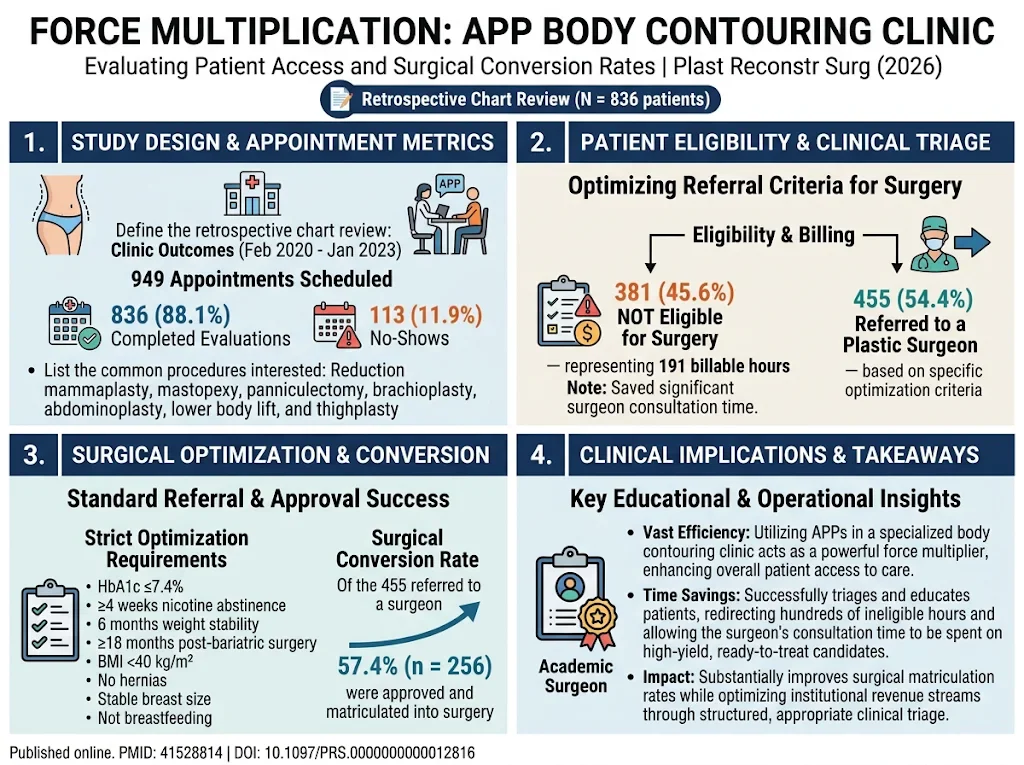
This study utilized a retrospective chart review analyzing appointments scheduled in an APP-directed body contouring clinic over a three-year period (February 2020 to January 2023). Patients interested in body contouring surgeries—reduction mammaplasty, mastopexy, panniculectomy, brachioplasty, abdominoplasty, lower body lift, and thighplasty—were included.
Data extracted encompassed patient demographics, medical history, consultation reason, surgical eligibility assessments based on strict optimization criteria, surgery conversion rates, and documented procedures performed after plastic surgeon referral.
Optimization criteria for surgeon referral included controlled comorbid conditions, hemoglobin A1c (HbA1c) ≤7.4%, minimum 4 weeks nicotine abstinence, 6 months weight stability, at least 18 months post-bariatric surgery, body mass index (BMI) <40 kg/m², absence of hernias, stable breast size, and non-lactating status.
Key Findings
A total of 949 appointments were scheduled; completion rate was 88.1% (836 appointments), and 11.9% were no-shows. Among these patients, 381 (45.6%) were deemed not eligible for surgery due to failure to meet optimization criteria or presence of contraindications. These visits accounted for approximately 191 billable hours directed toward patient education and risk factor modification.
The remaining 455 patients (54.4%) met criteria and were referred to surgical consultation. Of these, 256 (57.4% of the referred cohort) were ultimately approved for surgery. This conversion rate represents a substantial triaging efficiency with focused surgical evaluation.
Patient education focused on risk factor optimization, including smoking cessation, weight management, glycemic control, and timing relative to bariatric procedures, was effectively delivered by APPs, which is expected to enhance postoperative outcomes and reduce complications.
This APP clinic model alleviates surgeon workload by screening out ineligible patients early, allowing surgeons to allocate more time to candidates ready for operative intervention, thereby improving the throughput and efficiency of body contouring services.
Expert Commentary
The deployment of APPs in specialized surgical clinics exemplifies an effective team-based care model. By standardizing preoperative optimization protocols and implementing stringent surgical eligibility criteria, this approach enhances patient safety and facilitates shared decision-making. Surgical conversion rates reported align favorably compared to traditional referral pathways lacking pre-screening.
Limitations of the study include its retrospective design from a single academic institution, which may affect generalizability to other practice settings. Prospective studies comparing patient outcomes and satisfaction between APP-led clinics versus traditional referral processes would further validate these findings.
Additionally, integrating multidisciplinary support such as nutritionists, smoking cessation programs, and psychological counseling might further improve patient optimization and surgical candidacy.
Conclusion
Implementing an APP-directed body contouring clinic serves as a significant force multiplier within plastic surgery practice. It substantially improves patient access by efficiently triaging candidates, optimizes surgical conversion rates through stringent eligibility screening, and enhances patient education on modifiable risk factors. This model promotes APP autonomy under appropriate supervision and yields operational benefits via better allocation of surgeon consultation time and revenue optimization.
Future directions include prospective validation, multi-institutional collaboration, and expansion of this framework to other surgical specialties where demand outstrips surgical capacity.
References
1. West JM, McConaghy N, Kluemper J, et al. Force Multiplication: Improving Access to Care and Surgical Conversion Rates through Implementation of an Advanced Practice Provider Body Contouring Clinic. Plast Reconstr Surg. 2026;158(5):746-749. doi:10.1097/PRS.0000000000009458
2. Sarwer DB, Steffen KJ. Psychological considerations in body contouring surgery. Curr Opin Plast Surg. 2018;30(3):263-268. doi:10.1097/SAP.0000000000001564
3. Hooker RS, McCue JD. The use of physician assistants and nurse practitioners in body contouring clinics: a systematic review. J Plast Reconstr Aesthet Surg. 2021;74(8):1963-1970. doi:10.1016/j.bjps.2021.01.011