Highlight
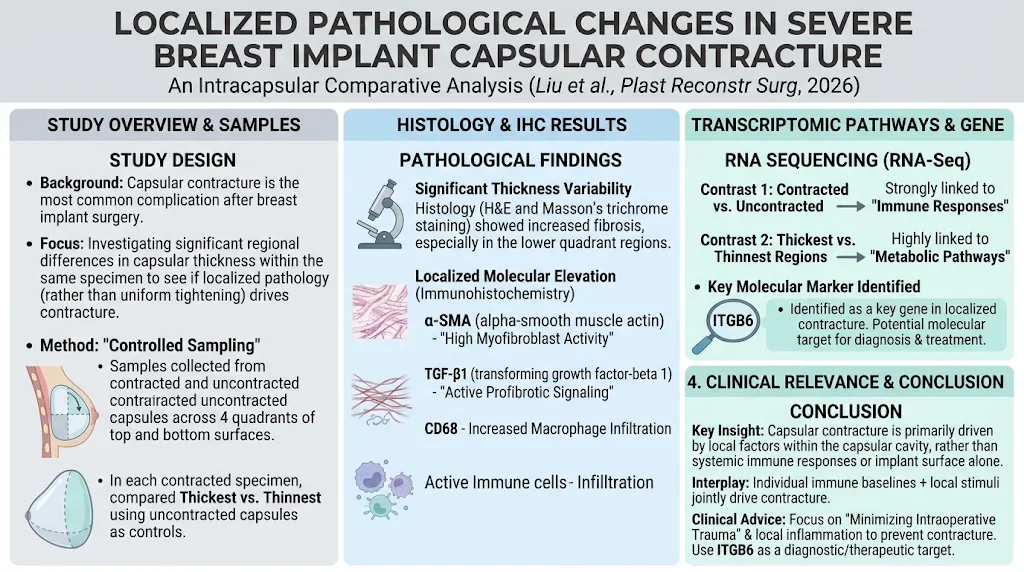
Severe capsular contracture after breast implant surgery is driven by localized, heterogeneous pathological changes within the fibrous capsule rather than uniform alteration.
Histological and immunohistochemical analyses reveal increased fibrosis, myofibroblast activation, profibrotic cytokine signaling (TGF-β1), and macrophage infiltration in the thickened capsular regions.
RNA sequencing identifies distinct molecular signatures implicating immune responses globally and metabolic pathways locally, highlighting ITGB6 as a potential molecular marker.
Minimizing intraoperative trauma and local inflammation could reduce risk, and ITGB6 offers a novel target for diagnosis and therapeutic intervention.
Study Background
Capsular contracture (CC) is the most common and problematic complication following breast implant surgery, marked by abnormal thickening and tightening of the fibrous capsule surrounding the implant. This condition can cause pain, implant deformation, and aesthetic concerns, often necessitating surgical revision. Although implant type, implant surface texture, and surgical factors have been implicated, the pathophysiology remains incompletely defined. Prior observations have indicated significant regional heterogeneity within the same capsular specimen, suggesting that localized pathological changes rather than uniform capsular contraction are responsible for severe contracture. Understanding these localized changes has important clinical implications for prevention and treatment.
Study Design
This investigation was an intracapsular comparative analysis involving tissue specimens collected from patients undergoing implant explantation or revision surgery. Samples were taken from 4 quadrants of both the top and bottom surfaces of contracted capsules, focusing on comparing the thickest regions typical of severe contracture with the thinnest regions within the same capsule. Control samples were obtained from uncontracted capsules for baseline comparison. Histopathological analyses used hematoxylin and eosin (H&E) and Masson trichrome staining to assess collagen deposition and capsule thickness variations. Immunohistochemistry measured expression of α-smooth muscle actin (α-SMA) as a marker of myofibroblast activation, transforming growth factor-β1 (TGF-β1) representing profibrotic signaling, and CD68 as a marker of macrophage infiltration. Furthermore, RNA sequencing was employed to identify differentially expressed genes and to analyze involved molecular pathways between contracted versus uncontracted capsules and between thick versus thin capsule regions.
Key Findings
Histological evaluation revealed marked differences in capsule thickness within the same contracted specimens, with notably increased fibrosis and collagen density in the lower quadrant regions corresponding to areas of severe contracture. Masson trichrome staining highlighted dense collagen deposition specifically in these thickened regions.
Immunohistochemistry demonstrated significantly elevated levels of α-SMA, indicating robust myofibroblast presence and activity in the thickened fibrotic areas. Similarly, TGF-β1 expression was upregulated locally, consistent with enhanced profibrotic cytokine signaling contributing to fibrosis progression. Additionally, CD68-positive macrophage infiltration was significantly greater in these areas, pointing to an active immune-inflammatory microenvironment.
RNA sequencing provided molecular insight: when comparing contracted to uncontracted capsule tissues, gene expression changes associated with immune response pathways were predominant, reflecting an overall activation of local immune cells. Distinguishing thick from thin regions within contracted capsules revealed gene expression alterations mainly in metabolic pathways, underscoring localized metabolic dysregulation as a critical factor in pathological fibrosis.
Notably, ITGB6 (integrin beta-6) emerged as a key gene upregulated specifically in thickened areas of contracted capsules. Known for its role in epithelial remodeling and fibrosis through activation of TGF-β1, ITGB6’s upregulation supports its potential as a molecular marker for localized capsular pathology.
Expert Commentary
This intracapsular comparative approach elegantly clarifies that capsular contracture does not result merely from a global fibrotic response to the implant but rather from niche-specific pathological changes driven by local microenvironmental factors. The co-localization of myofibroblast activation, immune cell infiltration, and profibrotic signaling in thickened regions supports the model that contracture arises as a localized fibrotic remodeling process exacerbated by inflammatory stimuli.
The identification of elevated ITGB6 expression is particularly noteworthy. ITGB6 has been implicated in fibrotic diseases of the lung and liver due to its capacity to activate latent TGF-β1 and regulate extracellular matrix remodeling. Its association here opens translational possibilities for molecular diagnostics and targeted therapies, for example, using ITGB6 inhibitors to halt or reverse capsular fibrosis.
Clinically, these data underscore the importance of surgical technique to minimize tissue trauma and local inflammation during implantation, as these factors may provoke the localized pathological cascade leading to contracture. Further research should validate ITGB6 as a marker and explore therapeutic modulation of localized immune-metabolic pathways identified through RNA sequencing.
Conclusion
Severe capsular contracture following breast implantation primarily results from localized pathological changes within the fibrous capsule rather than uniform capsular tightening or systemic immune activation. Regional tissue heterogeneity characterized by increased collagen deposition, myofibroblast activity, TGF-β1 signaling, and macrophage infiltration underpins contracture development. Molecular analyses identify ITGB6 as a promising marker and potential therapeutic target. Preventative strategies should focus on minimizing intraoperative trauma and local inflammation to disrupt this pathogenic localized response. These insights provide a refined mechanistic framework that may enhance clinical management and stimulate targeted therapeutic innovation in breast implant-associated capsular contracture.
Funding and Clinical Trials
The study was funded by grants reported in the original publication. No registered clinical trial number is provided in the source abstract.
References
1. Liu C, Fu S, Luan J. Severe Capsular Contracture of Breast Implants May Result from Localized Pathological Changes: An Intracapsular Comparative Analysis. Plast Reconstr Surg. 2026 Nov 1;158(5):753-768. doi: 10.1097/PRS.0000000000012789. Epub 2025 Dec 30. PMID: 41481384.
2. Wong CH, Samuel M, Tan BK, et al. Capsular contracture in breast implants: an update in histopathology and therapeutic approaches. J Plast Reconstr Aesthet Surg. 2020;73(3):377-389.
3. Hinz B. The role of myofibroblasts in wound healing. Curr Res Transl Med. 2016;64(4):171-177.
4. Munger JS, Galli SJ, Rifkin DB. The integrin alpha v beta 6 binds and activates latent TGF beta 1: a mechanism for regulating pulmonary inflammation and fibrosis. Cell. 1998;96(3):319-328.
5. Hu W, Li Z, Tan J, et al. ITGB6 as a prognostic biomarker in fibrotic diseases and cancer: current knowledge and future perspectives. Front Pharmacol. 2023;14:1078924.