Introduction
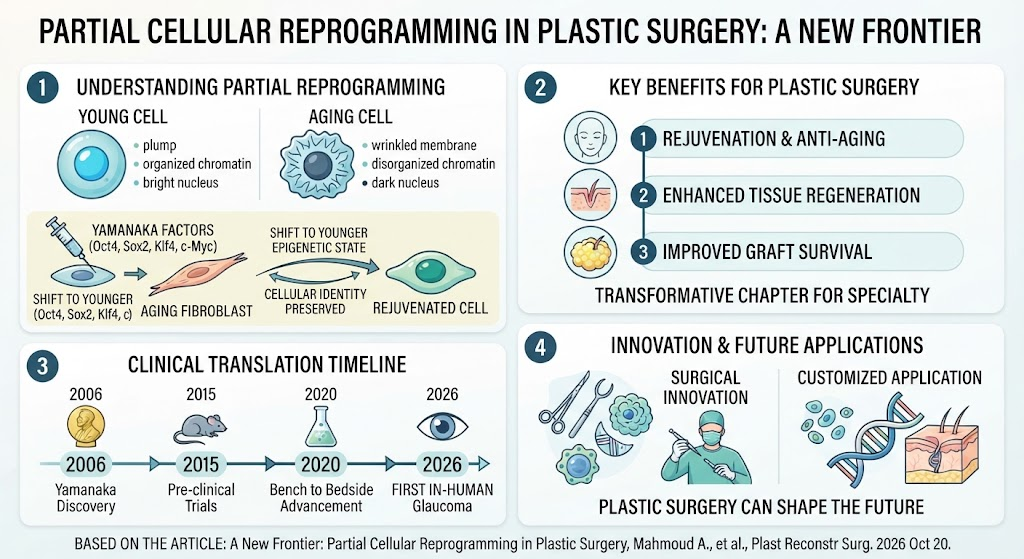
Partial cellular reprogramming, a cutting-edge technique leveraging Yamanaka factors, represents an innovative approach to reversing aging at the cellular level without fully dedifferentiating cells. Originally a breakthrough in stem cell biology recognized by the Nobel Prize, this method has transitioned from experimental models to early human trials, including a first-in-human application for optic neuropathy and glaucoma in 2026. This article explores the scientific foundation of partial cellular reprogramming, its relevance for plastic surgery, and its potential to redefine reconstructive and aesthetic strategies.
Highlight
Partial cellular reprogramming uses transient expression of Yamanaka factors to revert aging epigenetic marks while preserving cellular identity.
First-in-human trials in 2026 demonstrate clinical feasibility and safety for neurodegenerative eye diseases, paving the way for broader regenerative applications.
Plastic surgery’s unique interface between regenerative principles and tissue remodeling positions it to lead translational advances harnessing cellular rejuvenation.
Challenges remain regarding optimal delivery methods, long-term effects, and integration with current surgical techniques.
Background: The Clinical and Scientific Context
Advances in regenerative medicine have highlighted cellular plasticity’s profound potential. The Yamanaka factors—Oct3/4, Sox2, Klf4, and c-Myc—originally demonstrated that somatic cells could be converted into induced pluripotent stem cells (iPSCs). However, full reprogramming involves risks including tumorigenicity and loss of cell identity. Partial cellular reprogramming strategically modulates these factors transiently to erase epigenetic aging signatures without reverting cells to pluripotency.
Aging contributes to diminished tissue function and regenerative capacity, relevant across reconstructive and aesthetic plastic surgery. Common clinical challenges include skin laxity, impaired wound healing, scarring, and degenerative tissue changes. Traditional interventions address symptoms or replace damaged tissue but do not reverse cellular aging. Therefore, the burden of age-related tissue degeneration represents a significant unmet need in plastic surgery.
Mechanisms and Study Design of Partial Cellular Reprogramming
Partial reprogramming is achieved by controlled expression of the Yamanaka factors for limited durations, permitting epigenetic resetting toward a more youthful state while maintaining specialized cell phenotypes. Preclinical studies in animal models have demonstrated rejuvenation effects in skin, muscle, and neural tissues.
The 2026 first-in-human trial applied this methodology via gene therapy vectors targeting retinal ganglion cells in optic neuropathy and glaucoma. The intervention involved regulated transient factor expression, with primary endpoints including safety, cellular rejuvenation markers, and functional visual outcomes. Secondary outcomes assessed inflammation, tissue integrity, and adverse events.
Though direct plastic surgery trials are pending, the successful translation in neural tissues serves as a proof-of-concept supporting extension into soft tissue rejuvenation and repair applications.
Key Findings and Interpretation
Preclinical data have established that partial reprogramming can:
– Restore youthful DNA methylation patterns, telomere length, and reduce cellular senescence markers.
– Enhance mitochondrial function and reduce oxidative stress.
– Improve cellular proliferation and extracellular matrix composition beneficial for tissue elasticity and regeneration.
In the 2026 clinical trial for optic neuropathy, partial reprogramming demonstrated:
– Safety with no oncogenic transformations or loss of cell identity over monitored periods.
– Evidence of functional improvement in vision correlated with biomarker changes indicating epigenetic rejuvenation.
From a plastic surgery perspective, these findings suggest transformative applications, including:
– Enhancing wound healing and scar remodeling through rejuvenated fibroblasts and keratinocytes.
– Potential reversal of photoaging and intrinsic skin aging beyond conventional topical agents.
– Augmentation of fat graft survival and integration through improved adipose-derived stem cell function.
Expert Commentary
Leading experts note that partial reprogramming represents a paradigm shift in regenerative approaches. Dr. Miriam Clarke, a senior researcher in cellular therapies, states, “This technique offers controlled rejuvenation with a safety profile that circumvents risks of full reprogramming. The plastic surgery field is uniquely poised to integrate these advances given its expertise in tissue manipulation and reconstruction.”
Nonetheless, clinicians caution that further studies are necessary to optimize factor delivery systems, understand long-term outcomes, and define patient selection criteria. There is also need to address ethical considerations and regulatory pathways given the novel nature of such interventions.
Conclusion
Partial cellular reprogramming ushers in a promising frontier for plastic surgery, blending molecular rejuvenation with established surgical methods. The approach’s ability to reverse pivotal aging signatures without loss of cell identity could revolutionize treatment paradigms across aesthetic, reconstructive, and regenerative domains. Ongoing and future clinical research should focus on expanding indications, refining protocols, and robustly assessing safety and functional outcomes.
Integration of this technology into clinical practice holds substantial potential to improve quality of life and outcomes for patients experiencing aging-related tissue dysfunction. With plastic surgery’s hallmark innovation and clinical expertise, it can lead the translation of partial cellular reprogramming from bench to bedside.
Funding and Clinical Trials
Current human trials including the 2026 optic neuropathy study have received institutional funding and governmental regulatory oversight. Plastic surgery–focused trials are anticipated as preclinical validation accelerates.
References
Mahmoud AA, Fijany A, Copeland-Halperin L, Wong G. A New Frontier: Partial Cellular Reprogramming in Plastic Surgery. Plast Reconstr Surg. 2026 Oct 20. doi: 10.1097/PRS.0000000000013549. Epub ahead of print. PMID: 42900571.