Extracranial Bleeding Risk on Oral Anticoagulants in Atrial Fibrillation: Insights from COMBINE-AF Analysis
Highlight
1. Extracranial clinically relevant bleeding is common in patients with atrial fibrillation (AF) on oral anticoagulants (OACs), occurring in approximately 26% over about two years follow-up.
2. Gastrointestinal bleeding predominates among major extracranial bleeds, constituting nearly half of these events.
3. Baseline clinical risk factors explain about two-thirds of the population’s bleeding risk, underscoring the presence of additional unmeasured contributors.
4. Extracranial bleeding frequency and severity suggest the need for comprehensive bleeding risk assessment beyond major bleeding alone in AF management.
Study Background
Atrial fibrillation (AF) is the most common sustained cardiac arrhythmia worldwide and markedly increases stroke risk. Oral anticoagulants (OACs), including vitamin K antagonists and direct oral anticoagulants (DOACs), drastically reduce stroke incidence in AF but impose bleeding risks. While intracranial hemorrhages have garnered much clinical focus due to their severity, extracranial bleeding represents a more frequent, yet sometimes underrecognized, complication that affects patient morbidity and therapy continuation.
Understanding the incidence, severity, and predictors of extracranial bleeding on OAC therapy is crucial for optimizing stroke prevention strategies and minimizing harm in patients with AF. The COMBINE-AF collaboration pooled data from pivotal randomized trials to provide a robust characterization of extracranial bleeding events using standardized criteria, aiming to improve risk prediction and clinical management.
Study Design
The COMBINE-AF analysis aggregated data from five major randomized controlled trials comparing warfarin and direct oral anticoagulants in patients with AF. The combined cohort included 73,737 patients receiving OAC therapy, followed for an average of 705 days (~1.9 years). The primary outcome was extracranial clinically relevant bleeding (CRB), encompassing both International Society on Thrombosis and Haemostasis (ISTH) major bleeding and clinically relevant non-major bleeding (CRNMB) events occurring outside the intracranial compartment.
Bleeding events were adjudicated and categorized by severity. Kaplan-Meier methods computed the cumulative incidence of extracranial bleeding. Multivariable Cox proportional hazards models identified baseline predictors of bleeding risk, with results expressed as adjusted hazard ratios (HRs) and 95% confidence intervals (CIs). Population attributable fractions were calculated using logistic regression to estimate the proportion of bleeding risk accounted for by measured clinical factors.
Key Findings
Incidence and Severity of Extracranial Bleeding
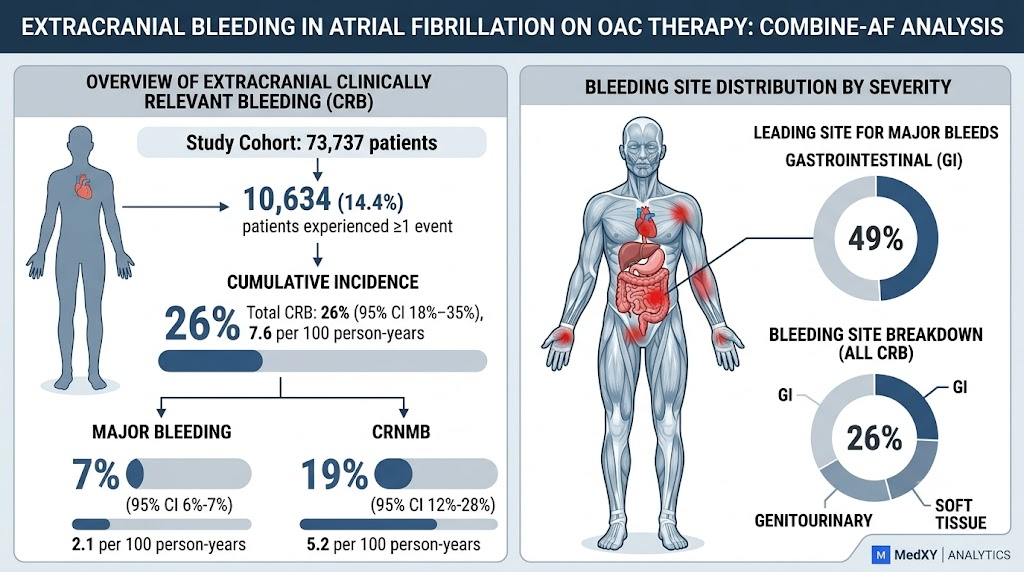
Among the 73,737 patients treated with OACs, 10,634 (14.4%) experienced at least one extracranial clinically relevant bleeding event over the mean follow-up period. The cumulative incidence of extracranial CRB was 26% (95% CI, 18%-35%), with an incidence rate of 7.6 per 100 person-years.
Separately, major extracranial bleeds occurred in 3,188 patients (cumulative incidence 7%, 95% CI 6%-7%) corresponding to 2.1 per 100 person-years, while 7,446 patients experienced CRNMB (cumulative incidence 19%, 95% CI 12%-28%) or 5.2 per 100 person-years.
Bleeding Site Distribution
The anatomical sites of extracranial bleeding varied with severity. Gastrointestinal (GI) bleeding was the leading site for major bleeds, accounting for 49% of these events. GI bleeding contributed 26% of all clinically relevant extracranial bleeds and 15% of clinically relevant nonmajor bleeds. Other common bleeding sites included genitourinary and soft tissue sites, although detailed site-specific proportions were not presented.
Risk Factors and Population Attributable Risk
Consistent baseline risk factors predicted extracranial bleeding across severity categories. These included older age, prior bleeding history, impaired renal function, concomitant use of antiplatelet agents, and certain comorbidities such as anemia and liver disease. Multivariable Cox regression models adjusted for these covariates yielded hazard ratios demonstrating their significant association with bleeding risk.
Importantly, the examined baseline covariates explained approximately 66% to 69% of the population attributable fraction for bleeding risk, indicating that these clinical factors substantially contributed to the probability of bleeding events but also highlighting the role of other unmeasured or unknown contributors.
Expert Commentary
This large-scale pooled analysis robustly confirms that extracranial bleeding is a common and clinically meaningful complication in AF patients receiving OAC therapy. The differentiation between major and nonmajor bleeding using standardized ISTH criteria lends uniformity and reproducibility to event adjudication.
The predominance of gastrointestinal bleeding among major extracranial bleeds aligns with prior clinical observations, underscoring the importance of GI risk assessment and management (e.g., Helicobacter pylori screening, proton pump inhibitors) in anticoagulated patients.
While the identified clinical predictors are consistent with existing bleeding risk scores, the substantial residual risk not explained by these factors indicates a need for novel biomarkers, genetic determinants, or more granular clinical phenotyping to improve risk stratification.
From a clinical perspective, this study supports more comprehensive bleeding risk discussions and individualized monitoring to optimize the balance between stroke prevention and bleeding harm. It also justifies considering extracranial clinically relevant bleeding, beyond major bleeding alone, when evaluating anticoagulant safety in both research and practice.
Limitations include the post hoc nature of pooled trial data and potential heterogeneity in bleeding event ascertainment among trials. The analysis did not differentiate bleeding risk by specific OAC agents or dosages, which merits further investigation.
Conclusion
The COMBINE-AF analysis highlights that extracranial clinically relevant bleeding is a frequent and important complication in patients with atrial fibrillation treated with oral anticoagulants. Gastrointestinal bleeding predominates among major extracranial bleeding events. Traditional baseline clinical factors explain a majority, but not all, of the population risk, suggesting additional unknown contributors to bleeding risk.
These findings emphasize the need for enhanced bleeding risk assessment and personalized management strategies in AF patients receiving anticoagulation therapy to minimize bleeding complications while preserving stroke prevention benefits. Future research should focus on identifying novel risk factors and refining prevention approaches to improve clinical outcomes.
Funding and Clinicaltrials.gov
The study was supported by institutional collaborations within COMBINE-AF, involving industry and academic partnerships. Details of individual trial funding can be accessed via the respective trial registry entries.
The original randomized trials contributing data to COMBINE-AF are registered on ClinicalTrials.gov.
References
Siegal DM, Carrier M, Bahit MC, et al. Incidence and Predictors of Extracranial Bleeding on Oral Anticoagulants for Stroke Prevention in Patients With Atrial Fibrillation: A COMBINE-AF Analysis. Circulation. 2026; PMID: 42549517.
Steffel J, Verhamme P, Potpara TS, et al. The 2018 European Heart Rhythm Association Practical Guide on the use of non-vitamin K antagonist oral anticoagulants in patients with atrial fibrillation. Europace. 2018;20(6):e1-e46.
January CT, Wann LS, Calkins H, et al. 2019 AHA/ACC/HRS Focused Update of the 2014 Atrial Fibrillation Guideline. J Am Coll Cardiol. 2019;74(1):104-132.
Holster IL, Valkhoff VE, Kuipers EJ, Tjwa ET. New oral anticoagulants increase risk for gastrointestinal bleeding: a systematic review and meta-analysis. Gastroenterology. 2013;145(1):105-112.e15.
This article was created using several editorial tools, including AI, as part of the process. Human editors reviewed this content before publication.