Evaluation of a Commercial Pediatric Sepsis Early Detection Alert in Emergency Departments: Efficacy, Equity, and Clinical Implications
Highlights
The Epic Systems Pediatric Sepsis Early Detection Model (PESM) exhibits low sensitivity (36%) for identifying pediatric sepsis within 24 hours of ED arrival.
Performance disparities are evident, with significantly reduced sensitivity in Black children, those under 5 years, and in non-tertiary EDs.
Independent evaluations reveal that current algorithmic alerts offer limited early detection, underscoring the need for integrated clinical and algorithmic approaches.
Disparities in sepsis recognition and outcome emphasize urgent needs for equitable, sensitive screening tools and quality improvement initiatives.
Background
Sepsis remains a leading cause of morbidity and mortality in pediatric populations globally, with early identification crucial for timely intervention and improved outcomes. Despite the adoption of various screening tools in emergency departments (EDs), evidence supporting their diagnostic effectiveness and equity is limited. The Epic Pediatric Sepsis Early Detection Model (PESM), widely implemented across numerous U.S. EDs, offers an automated alert system designed to identify sepsis before clinical deterioration. Nevertheless, independent validation of this commercial tool’s accuracy and timeliness was lacking, raising concerns about its utility in diverse pediatric populations and care settings.
Key Content
Evaluation of the Epic PESM Alert System
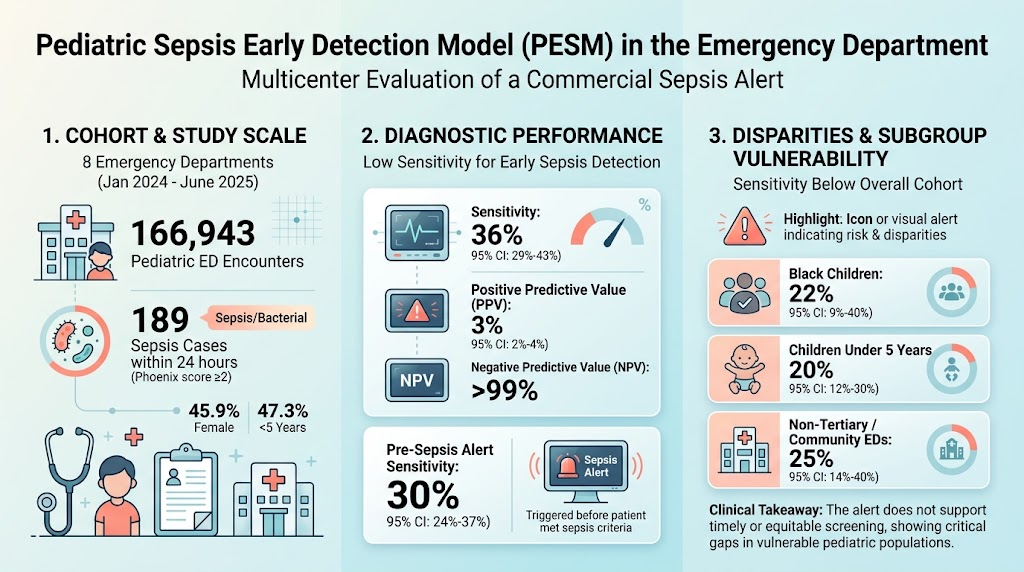
Mitchell et al. (2026) conducted a rigorous retrospective multicenter cohort study across eight EDs in a New York health system including 166,943 pediatric encounters from January 2024 through June 2025, excluding behavioral health visits and early deaths. The study applied the Phoenix Sepsis Score (PSS) – a validated organ dysfunction-based sepsis definition – using a threshold score ≥2 as the primary outcome for sepsis within 24 hours of ED arrival.
The PESM demonstrated a sensitivity of 36% (95% CI, 29%-43%) for sepsis detection, with a positive predictive value (PPV) of 3% and negative predictive value (NPV) over 99%. Notably, the alert’s sensitivity before measurable sepsis onset was just 30%, indicating considerable delays or missed opportunities for early intervention. Subgroup analysis revealed clinically meaningful reductions (>10% absolute decrease) in sensitivity among Black children (22%), children under 5 years (20%), and EDs outside tertiary children’s hospitals (25%). This finding highlights significant inequities in sepsis screening performance that may exacerbate health disparities.
Comparative Performance of Other Screening Tools
Complementary research underlines the challenges in pediatric sepsis detection. For instance, an evaluation of algorithmic sepsis alerts in Qatar’s pediatric hospital (2026) found a sensitivity as low as 9.7%, albeit with higher specificity. Clinician judgment and clinical suspicion offered modest improvements but remained suboptimal. Similarly, scores such as the quick Pediatric Septic Shock Screening Score (qPS4) have shown greater sensitivity (~68%) for Phoenix sepsis criteria compared to Liverpool quick SOFA and other tools, reflecting variability in screening efficacy.
Prognostic Scoring and Outcome Associations
The Phoenix Sepsis Criteria (PSC) and Phoenix Sepsis Score (PSS) have been prospectively validated in PICU settings with superior prognostic accuracy compared to older consensus criteria (e.g., IPSCC), particularly for mortality prediction. These scores strongly correlate with organ dysfunction and may inform risk stratification, but their real-world integration with early detection models in ED settings remains under investigation.
Disparities and Quality Improvement Efforts
Regional and social determinants of health critically influence sepsis care outcomes. Studies document variations in pediatric sepsis mortality related to hospital resources (presence of children’s hospitals), regional standardization efforts, and social determinants as measured by indices like the Child Opportunity Index (COI). Improvement collaboratives have demonstrated potential in reducing care disparities by enhancing standardized recognition and guideline adherence, particularly benefiting populations in lower COI quintiles.
Mechanistic and Biomarker Studies in Pediatric Sepsis
Beyond clinical tools, emerging research explores immunologic biomarkers such as sTREM1 and IGFBP6 pathways, and physiological indices like the pediatric shock index adjusted for age, to augment early sepsis detection and enhance prognostication. Integration of these markers represents a promising avenue to improve sensitivity and specificity of early warning systems.
Expert Commentary
The low sensitivity and subgroup disparities identified in the evaluation of the Epic PESM underscore critical limitations in current automated pediatric sepsis screening. With a PPV under 5%, the alert’s utility as a standalone tool is severely constrained by false positives, risking alarm fatigue. More concerning is the attenuated sensitivity in vulnerable subpopulations and settings — notably young children, Black children, and non-tertiary centers — which could amplify inequities in sepsis outcomes.
These findings align with prior literature indicating the difficulty of applying one-size-fits-all screening algorithms across diverse pediatric populations and clinical environments. The complex, dynamic presentation of pediatric sepsis necessitates multi-modal strategies combining algorithmic alerts with nuanced clinical judgment, thorough patient evaluation, and consideration of social and institutional contexts.
The reported superiority of Phoenix sepsis scoring for outcome prognostication reinforces the value of organ dysfunction-based definitions but also highlights the gap in early detection prior to clinical deterioration. Thus, integration of refined biomarkers and objective clinical indices (e.g., age-adjusted shock index, inflammatory markers) into screening workflows may enhance sensitivity.
Importantly, quality improvement initiatives that focus on standardization, shared learning, and addressing social determinants demonstrate promise for mitigating disparities seen in sepsis care delivery.
Conclusion
Evaluations of commercial pediatric sepsis detection tools reveal limited sensitivity and significant disparities by race, age, and care setting, challenging their current widespread clinical reliance. The Epic PESM alert, despite wide implementation, performs suboptimally for early and equitable sepsis screening in pediatric ED populations.
Future research should prioritize developing and validating integrated clinical-algorithmic models incorporating robust biomarkers, dynamic vital sign indices, and social determinants data. Concurrently, quality improvement efforts aimed at standardizing sepsis recognition, treatment timing, and equity can help improve outcomes and reduce disparities.
Enhanced pediatric sepsis screening demands a multifaceted approach balancing technological tools with expert clinical assessment and tailored strategies for vulnerable groups and diverse healthcare environments.
References
Mitchell CM et al. Evaluation of a Commercial Pediatric Sepsis Early Detection Alert in the Emergency Department. JAMA Pediatr. 2026 Oct 5. PMID: 42832216.
Scott HF et al. Comparing Screening Tools for Predicting Phoenix Criteria Sepsis and Septic Shock Among Children. Pediatrics. 2025 May;155(5):e2025071155. PMID: 40287144.
Ranard BL et al. Evaluation of Sepsis Algorithmic Alerts Among Hospitalized Pediatric Patients in Qatar: A Retrospective Cohort Study. Health Sci Rep. 2026 Sep;9(9):e72588. PMID: 42724376.
Mitchell RK et al. Predictive and Prognostic Performance of the Phoenix Sepsis Criteria and Phoenix Sepsis Score in PICU Patients With Suspected Infection: A Multicenter Prospective Study. Crit Care Med. 2026 Jun;54(6):1329-1340. PMID: 41532812.
Child Opportunity Index and Pediatric Sepsis Care Collaborative Study. BMJ Qual Saf. 2026 Jan;35(2):106-117. PMID: 40345682.
Liamis D et al. Risk stratification of childhood infection using host markers of immune and endothelial activation in Asia (Spot Sepsis): a multi-country prospective cohort study. Lancet Child Adolesc Health. 2025 Sep;9(9):634-645. PMID: 40774784.
Mitchell S et al. Impact of Race and Ethnicity, Income, Language, and Insurance on Timeliness of Pediatric Emergency Department Sepsis Care. Pediatr Emerg Care. 2025 Nov;41(11):841-846. PMID: 40820288.
This article was created using several editorial tools, including AI, as part of the process. Human editors reviewed this content before publication.