We use cookies

Our website uses essential cookies and, with your consent, additional cookies to measure performance and improve our services. Cookie Policy.

You can change your choice at any time.

MMedXYNews
HomeVideos
MedXY AI/MedXY News/Section: Gastroenterology

Nationwide Dutch Study Reveals Limited Prior Endoscopic Surveillance in Barrett’s Esophagus-Related Dysplasia and Cancer Diagnosis
MedXY Editorial Team•Sep 27, 2026•Gastroenterology
Esophageal Adenocarcinomaearly detectionBarrett's esophagusEndoscopic Surveillance

Highlight

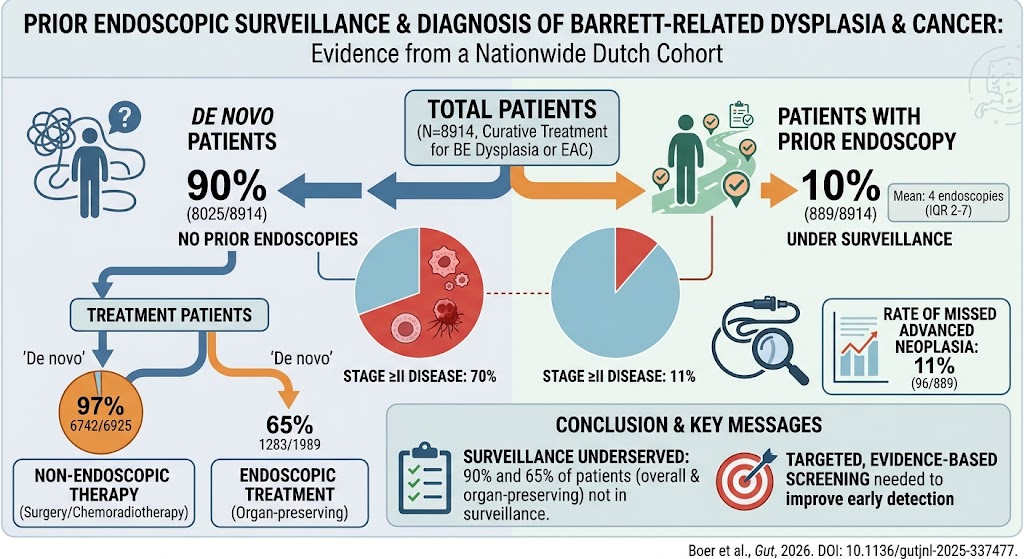
1. This nationwide Dutch cohort study found that 90% of patients diagnosed with Barrett’s esophagus (BE)-related dysplasia or esophageal adenocarcinoma (EAC) had not undergone prior endoscopic surveillance.
2. Patients without prior surveillance presented predominantly with advanced stage (≥II) disease, underscoring late detection.
3. Among patients with prior surveillance, the incidence of missed advanced neoplasia was low, suggesting effective surveillance when conducted.
4. The findings emphasize an urgent need for targeted, evidence-based screening and surveillance strategies to improve early diagnosis and optimize patient outcomes.

Study Background

MedXY registered readers

Sign in free to continue reading

Create or use your MedXY account to unlock the complete article.

This article was created using several editorial tools, including AI, as part of the process. Human editors reviewed this content before publication.

Related articles

Open language-specific specialty feeds and department pages.

Unveiling Pre-Hospitalization Healthcare Encounters in Pediatric Sepsis: Opportunities for Early Detection and InterventionOver half of pediatric sepsis hospitalizations are preceded by healthcare visits within 7 days, highlighting a critical window for early sepsis recognition and intervention in children.Sep 27, 2026Achalasia and Its Differential Impact on Esophageal Squamous Cell Carcinoma and Adenocarcinoma Risk: Insights from a Large Nordic Case-Control StudyA comprehensive multinational study reveals that achalasia significantly raises the risk of esophageal squamous cell carcinoma independently, while its association with adenocarcinoma is modest and largely mediated by gastroesophageal refluSep 5, 2026Harnessing Artificial Intelligence for Early Detection of Ovarian Cancer: Development and Validation of a Predictive Risk ModelA novel AI-driven risk prediction model for ovarian cancer demonstrates high accuracy and potential to improve early detection in screening settings.Aug 31, 2026
Loading comments...
MedXY briefing

Get the free newsletter

Evidence-led clinical news, trends, and analysis—delivered to your inbox.

Ask MedXY AI

Most popular

Intimate Health
Five Benefits for Women Continuing Sexual Activity After Menopause
Intimate Health
Why Some Women Have a Strong Sex Drive—And Why Men Shouldn't Worry About It
Nursing & care
How often should a couple have sex?
General Surgery
Optimizing Postoperative Opioid Prescriptions After Intra-Abdominal Cancer Surgery: Comparing the 5x-Multiplier and 3-Tier Models
Intimate Health
Classic Intimacy Recommendations: How to Help Women Reach Orgasm and Enjoy Mutual Pleasure
© 2026 MedXY
Contact usAbout usPrivacy PolicyMedXY story
Comparing FLOT and CROSS Protocols: Survival and Recurrence in Esophageal Adenocarcinoma with Pathological Complete Response
This cohort study compares long-term survival and recurrence in esophageal adenocarcinoma patients achieving pathological complete response (pCR) after neoadjuvant FLOT chemotherapy versus CROSS chemoradiotherapy, highlighting better outcom
Jul 24, 2026
Advancing Early Detection of Nasopharyngeal Carcinoma: Evaluating the Novel Anti-BNLF2b Antibody TestThis article critically appraises a multicenter study validating the Anti-BNLF2b antibody (P85-Ab) assay, highlighting its superior sensitivity and specificity for early nasopharyngeal carcinoma detection compared to established EBV-based bJul 11, 2026
Pathology-Driven Epithelial Sulfide Loss Reprograms the Redox Proteome and Triggers Barrett’s EsophagusA study shows that reflux-related sulfide loss rewires esophageal redox proteins, increases PGE2 signaling, and helps drive Barrett’s esophagus, revealing a new potential therapeutic target.Jun 5, 2026