Highlight
Unexplained syncope poses a diagnostic challenge in emergency settings, particularly for cardiac arrhythmias.
The ASPIRED randomized controlled trial assessed the impact of immediate 14-day ambulatory ECG monitoring versus standard care.
Extended ECG monitoring did not significantly reduce syncope recurrence or improve intermediate clinical outcomes at 1 year.
Ambulatory ECG monitoring was associated with a higher number of adverse events, although serious events were rare in both groups.
Study Background
Syncope, defined as a transient loss of consciousness due to cerebral hypoperfusion, affects approximately 1-3% of emergency department (ED) visits worldwide. While many causes of syncope are benign, identifying potentially life-threatening cardiac arrhythmias among patients with unexplained syncope remains critical for appropriate management and prevention of adverse cardiovascular outcomes. Diagnosing underlying arrhythmias can be challenging, as intermittent arrhythmogenic events may not be captured during routine ED assessment or standard cardiac investigations.
Ambulatory electrocardiographic (ECG) monitoring devices, including Holter monitors and event recorders, have historically played a role in extended cardiac rhythm surveillance. However, the optimal timing and duration of monitoring in syncope patients after ED evaluation have not been definitively established. This has clinical relevance given resource implications and the balance between diagnostic yield and patient burden.
Study Design
The ASPIRED trial was a pragmatic, open-label, randomized controlled trial conducted at 45 hospitals across the United Kingdom. It enrolled adults presenting to the emergency department with syncope that remained unexplained after initial assessment, including clinical evaluation, baseline ECG, and standard local testing.
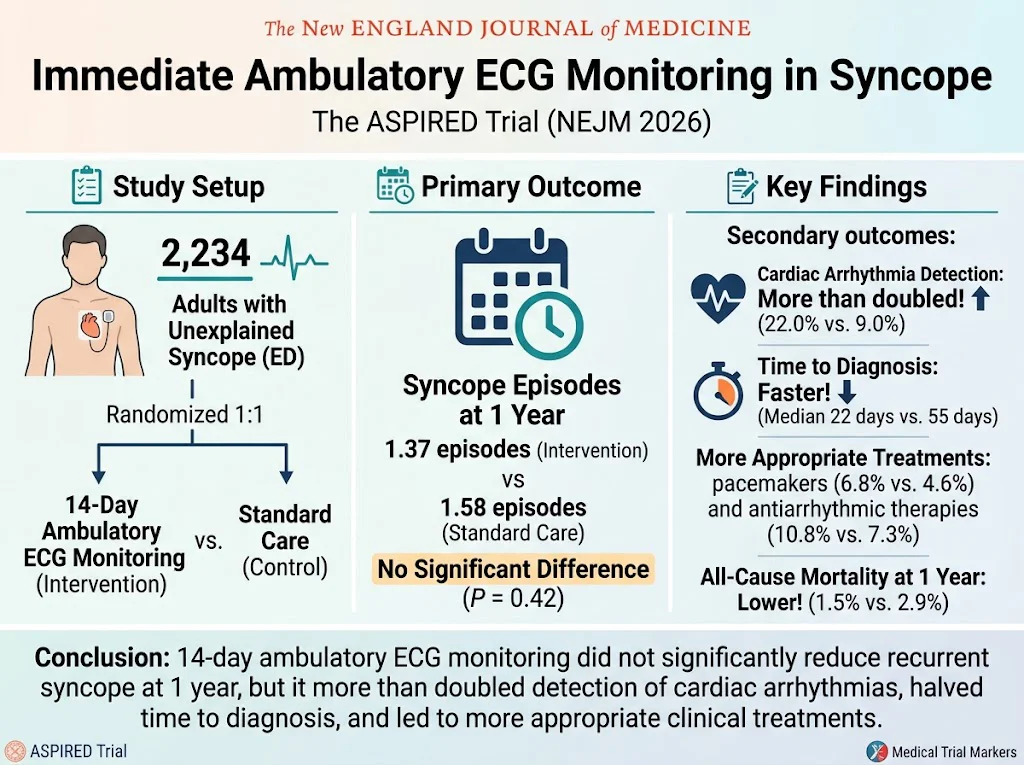
Eligible patients were randomized in a 1:1 ratio to either the intervention arm, undergoing immediate 14-day ambulatory ECG monitoring, or the control arm, receiving usual standard care as per each site’s protocols for unexplained syncope.
The primary outcome was the mean number of patient-reported syncope episodes within 1 year of randomization. Secondary outcomes included adverse events related to monitoring, detection rates of arrhythmias, subsequent treatments, and healthcare utilization.
Key Findings
A total of 2234 patients were randomized: 1123 to the intervention group and 1111 to standard care. The mean age of participants was 58.3 years, with a slight male predominance (52.1%). After excluding patients without follow-up data, 1004 intervention and 966 standard-care patients were analyzed for the primary outcome.
The mean number of syncope episodes reported at 1 year was 1.37 (±5.10) in the intervention group versus 1.58 (±8.56) in the standard-care group. The incidence rate ratio was 0.89 (95% confidence interval [CI], 0.68 to 1.18; P = 0.42), indicating no statistically significant difference between groups.
Regarding safety, 49 adverse events occurred in the intervention group compared to 8 in the control group, with only one serious adverse event reported in each group. The higher number of adverse events in the intervention arm were mostly minor, related to skin irritation or tolerability issues with the ambulatory monitor.
Although detailed arrhythmia detection rates and treatment adjustments were not presented in the abstract, the primary negative result suggests the extended ECG monitoring strategy did not confer a meaningful clinical benefit over standard approaches in this patient population.
Expert Commentary
This large multicenter trial addresses a key clinical dilemma in syncope management: whether immediate, prolonged ECG monitoring can improve diagnostic and prognostic outcomes in patients with unexplained syncopal episodes after ED evaluation. The findings suggest that routine deployment of 14-day ambulatory ECG monitoring does not reduce syncope recurrence or significantly impact patient outcomes relative to usual care.
The trial’s strengths include its randomized design, substantial sample size, and pragmatic approach reflecting real-world clinical practice across diverse centers. However, some points merit consideration. The definition of standard care likely varied between centers, possibly diluting differences. The study did not emphasize arrhythmia diagnosis rates or subsequent treatment changes, which could elucidate mechanisms behind the neutral results.
Moreover, the lack of benefit might reflect that extended monitoring beyond initial evaluation primarily identifies benign or non-actionable findings, or that arrhythmogenic syncope is relatively uncommon in this population subset. Future studies might explore tailored patient selection using risk stratification tools or novel technologies such as implantable loop recorders in higher-risk cohorts.
Conclusion
In patients with syncope unexplained after emergency department evaluation, immediate initiation of 14-day ambulatory ECG monitoring does not significantly reduce the number of syncope recurrences at 1 year compared to standard care. While extended cardiac monitoring is a theoretically attractive diagnostic tool, its routine use in this context may not improve clinical outcomes and is associated with increased minor adverse events.
These findings inform clinical decision-making and resource allocation by suggesting that standard diagnostic approaches remain appropriate for most unexplained syncope presentations. Further research to identify patients likely to benefit from intensified rhythm monitoring strategies is warranted to optimize care pathways and improve prognostication.
Funding and Trial Registration
The ASPIRED trial was funded by the British Heart Foundation and National Health Service Research Scotland. It is registered with the ISRCTN registry under number ISRCTN10278811.
References
1. Reed MJ, Goodacre S, Weir CJ, et al. Immediate Ambulatory Electrocardiographic Monitoring in Syncope. N Engl J Med. 2026;395(17):1691-1702. DOI: 10.1056/NEJMoa2600824
2. Moya A, Sutton R, Ammirati F, et al. Guidelines for the diagnosis and management of syncope (version 2009). Eur Heart J. 2009;30(21):2631-2671.
3. Shen WK, Sheldon RS, Benditt DG, et al. 2017 ACC/AHA/HRS Guideline for the Evaluation and Management of Patients With Syncope. J Am Coll Cardiol. 2017;70(5):e39-e110.