Evaluating Quality of Life and Recurrence in Recurrent Diverticulitis: A Prospective Multicenter Study Comparing Colectomy and Observation
Highlight
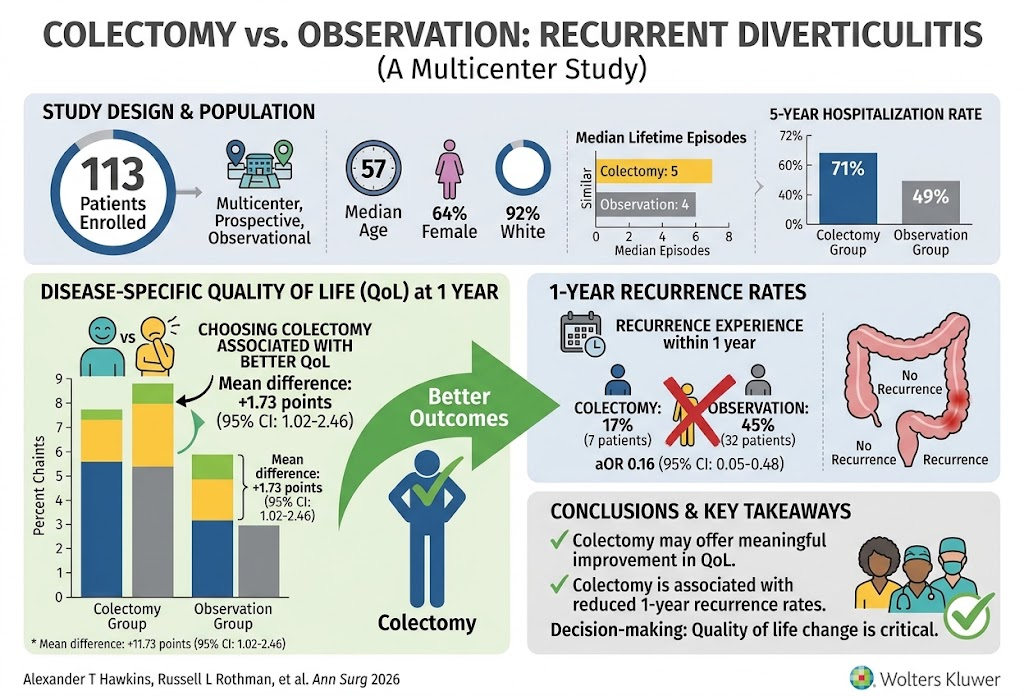
This prospective multicenter observational study demonstrates that among patients with recurrent uncomplicated sigmoid diverticulitis, those who elected colectomy at surgical consultation reported significantly better disease-specific quality of life at 1 year compared to those choosing observation. Additionally, the colectomy group experienced markedly lower rates of diverticulitis recurrence within one year.
Key points include: (1) Colectomy is associated with a 1.73-point improvement in quality of life scores on the validated Diverticulitis Quality of Life questionnaire; (2) Surgical patients had a significantly reduced recurrence risk at 1 year (adjusted odds ratio 0.16); (3) Despite more hospitalizations in the colectomy group prior to enrollment, surgery conferred meaningful clinical benefit within one year of follow-up.
Background: Clinical Context and Disease Burden
Recurrent diverticulitis, characterized by inflammation of diverticula primarily in the sigmoid colon, represents a common gastroenterological condition in middle-aged and older adults. Episodes can cause significant pain, hospitalization, and impaired quality of life. While initial uncomplicated episodes are often treated conservatively, management of recurrent episodes remains contentious due to variable clinical courses and unclear long-term benefits of surgery.
Elective colectomy after recurrent diverticulitis aims to reduce symptom burden and prevent future episodes. However, recommendations have evolved from routine surgery after two episodes toward individualized decision-making balancing risks and benefits. Understanding how surgical versus non-surgical management impacts quality of life and recurrence informs shared decision-making and tailored patient care.
Study Design and Methods
The study was a multicenter prospective observational cohort involving 113 patients with recurrent uncomplicated sigmoid diverticulitis. Participants were enrolled at surgical consultation across multiple centers and self-selected their management approach: colectomy or observation. Median age was 57 years, predominantly female (64%) and white (92%).
The primary endpoint was disease-specific quality of life at 1 year, measured by the Diverticulitis Quality of Life questionnaire— a validated instrument assessing symptoms and psychosocial impact. Secondary outcomes included diverticulitis recurrence rates and hospitalizations.
Baseline characteristics were collected, including the number of lifetime diverticulitis episodes and hospitalization history. Statistical analysis employed adjusted linear mixed-effects models to estimate differences in quality of life and logistic regression for recurrence risk, controlling for confounders.
Key Findings
Of 113 patients enrolled, 42 (37%) elected colectomy. The number of diverticulitis episodes prior to consultation was similar between groups (median 5 vs 4), although the colectomy group had a higher frequency of hospitalization in the preceding 5 years (71% versus 49%), suggesting more severe or complicated clinical histories.
At one-year follow-up, the colectomy group exhibited an adjusted mean improvement in the Diverticulitis Quality of Life total score of 1.73 points over the observation group (95% CI 1.02 to 2.46), indicating a clinically meaningful enhancement in disease-specific quality of life. This finding supports the efficacy of surgery in symptom and quality of life amelioration.
Importantly, diverticulitis recurrence occurred in 17% of the colectomy group versus 45% in the observation group. Adjusted odds of recurrence were substantially reduced with colectomy (aOR 0.16; 95% CI 0.05–0.48), highlighting a significant protective effect of surgical intervention against disease recurrence.
Safety data and adverse event rates were not detailed in the report but are critical for contextualizing the benefits in future publications.
Expert Commentary
This study adds to emerging evidence that elective colectomy after recurrent uncomplicated diverticulitis can improve quality of life and reduce recurrence risk. It underscores the importance of individualized surgical consultation incorporating patient preferences, disease history, and symptom burden.
Notably, the prospective observational design and patient self-selection introduce potential confounding variables; patients opting for surgery may differ in unmeasured ways affecting outcomes. Nonetheless, the multicenter approach and statistical adjustments strengthen the validity of the conclusions.
Current guidelines increasingly emphasize shared decision-making rather than rigid episode-count thresholds for surgery. This study provides empirical data quantifying quality of life improvements and recurrence risk reduction, aiding clinicians and patients in weighing surgery versus observation.
Conclusion
In recurrent uncomplicated sigmoid diverticulitis, elective colectomy is associated with significantly improved disease-specific quality of life and markedly lower 1-year recurrence rates compared to observation. These robust findings support offering surgery as a viable management option in symptomatic patients presenting for surgical consultation.
Further research including randomized trials and longer-term follow-up is warranted to better define patient subgroups most likely to benefit while assessing surgical risks. For now, this evidence facilitates evidence-based discussions empowering patients and practitioners to tailor treatment strategies for recurrent diverticulitis.
Funding and Clinical Trials Registration
The original study funding sources and clinical trial registration details were not specified in the abstract.
References
Hawkins AT, Rothman RL, Samuels LR, Geiger T, Mutch M, Regenbogen S, Kuo MC, Feng M, Schafer I, Penson D. A Multicenter Prospective, Observational Study of Observation Versus Colectomy in Recurrent Diverticulitis. Ann Surg. 2026 Sep 4. PMID: 42693491.
Hjern F, Hjern A. Treatment and recurrence of diverticulitis. Scand J Gastroenterol. 2019;54(8):977-983. doi:10.1080/00365521.2019.1623338.
Salzman GA, Lasson A, Martin M. Diverticulitis management: evolving treatment paradigms. Gastroenterol Clin North Am. 2021;50(2):297-312.
This article was created using several editorial tools, including AI, as part of the process. Human editors reviewed this content before publication.