Evaluating Early Outcomes of Robotic versus Laparoscopic and Open Cholecystectomy in the US: A Nationwide Analysis
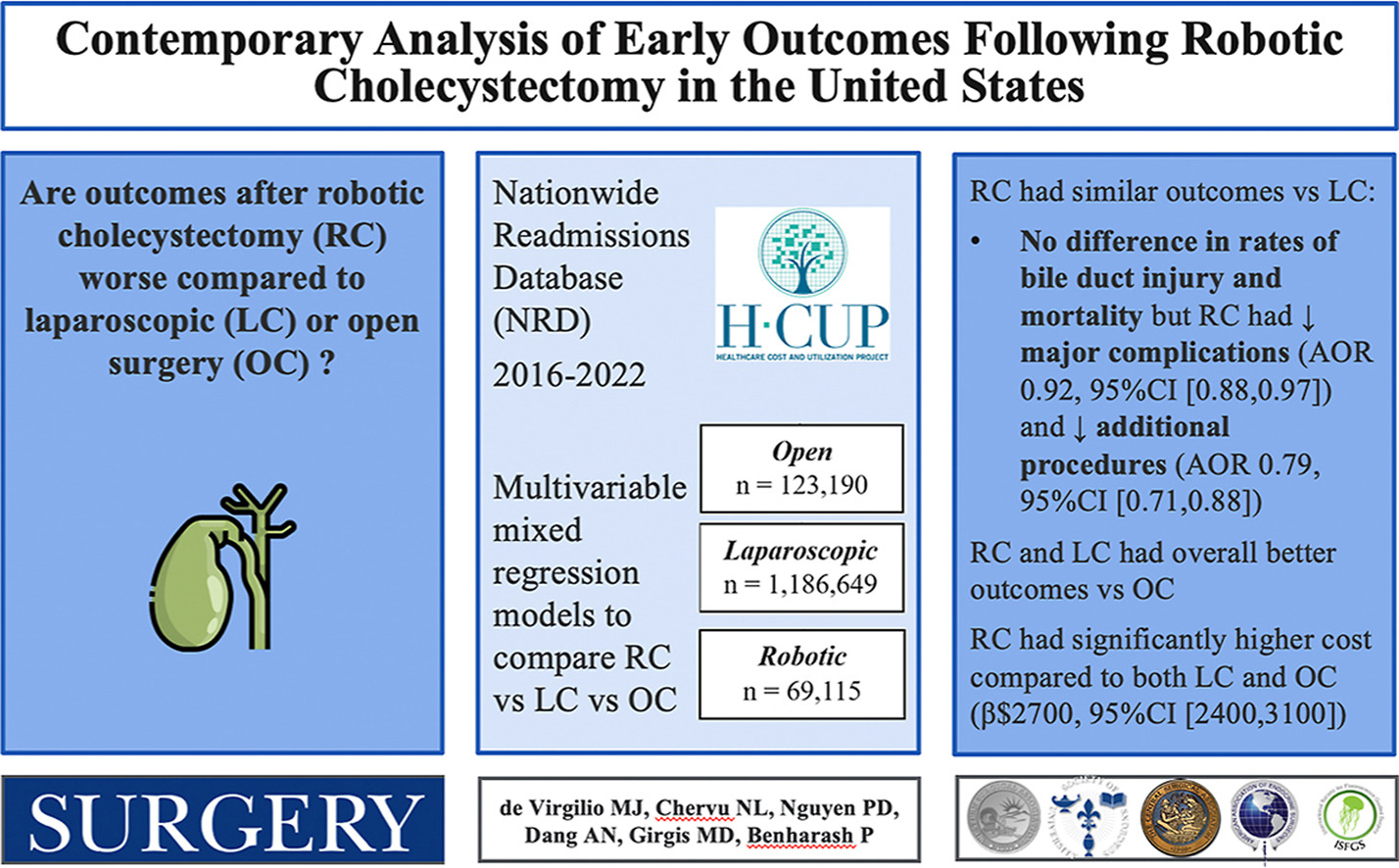
Highlight
– Robotic cholecystectomy adoption in the U.S. rose significantly from 1.5% in 2016 to 11.7% in 2022.
– After adjustment, robotic cholecystectomy was associated with lower odds of bile duct injury, death, additional procedures, and major complications compared to open surgery.
– When directly compared to laparoscopic cholecystectomy, robotic surgery demonstrated similar bile duct injury rates but reduced complications and hospital length of stay, albeit with higher costs.
– Both minimally invasive approaches significantly outperform open cholecystectomy in key clinical outcomes.
Study Background
Cholecystectomy is among the most commonly performed general surgical procedures worldwide, primarily to treat gallstone disease and symptomatic cholelithiasis. The past several decades have seen laparoscopic cholecystectomy emerge as the gold standard due to reduced pain, shorter hospital stays, and faster recovery compared to open surgery. More recently, robotic-assisted surgery has gained traction, purportedly offering enhanced three-dimensional visualization and precision through articulating instruments, which theoretically could reduce complications such as bile duct injury—a serious adverse event with lasting morbidity. However, initial findings on bile duct injury risk with robotic techniques have been mixed and mostly derived from single-payer or single-center datasets, limiting generalizability.
This study by de Virgilio et al. aimed to evaluate early outcomes and trends of robotic cholecystectomy across a comprehensive, multipayer nationwide cohort, with comparison to laparoscopic and open surgical approaches. Understanding these comparative outcomes is critical to guiding surgical practice, resource allocation, and patient counseling.
Study Design
This retrospective cohort analysis used the Nationwide Readmissions Database from 2016 to 2022, encompassing data on approximately 1.38 million cholecystectomy patients in the United States. Patients were categorized based on surgical approach: robotic-assisted, laparoscopic, or open cholecystectomy. The primary endpoints evaluated included bile duct injury, need for postoperative gastroenterology or interventional radiology interventions, mortality, major complications (such as bleeding or infection), postoperative length of hospital stay, and procedural costs.
The authors employed mixed multivariable regression models to adjust for confounders and to compare odds ratios and beta coefficients among surgical approaches, using open cholecystectomy as the reference standard. Additional subgroup analysis directly compared robotic to laparoscopic approaches.
Key Findings
During the study period, robotic cholecystectomy utilization increased markedly, from representing 1.5% of cases in 2016 to 11.7% in 2022, highlighting rapid adoption of this technology.
Compared with open surgery, robotic cholecystectomy was associated with a significant reduction in:
– Bile duct injury (adjusted odds ratio [aOR] 0.15, 95% CI 0.09-0.24), indicating an 85% lower odds.
– Additional procedures needed postoperatively (aOR 0.53, 95% CI 0.48-0.60).
– Death (aOR 0.26, 95% CI 0.22-0.30).
– Major complications (aOR 0.46, 95% CI 0.44-0.49).
Additionally, robotic surgery led to a shorter postoperative length of stay by approximately 3.4 days (95% CI -3.5 to -3.3).
However, robotic procedures were associated with an increase in hospital costs by roughly $1,000 (95% CI 400-1,600), reflecting the known economic burden of robotic platforms.
When robotic cholecystectomy was directly compared to laparoscopic surgery, the odds of bile duct injury were similar, alleviating safety concerns previously reported. Moreover, robotic surgery had significantly fewer major complications, fewer additional postoperative interventions, and reduced length of stay, suggesting a clinical advantage. The higher cost of robotic surgery remains a consideration.
Expert Commentary
This study provides important real-world evidence supporting the maturation and safety of robotic cholecystectomy in the United States. Unlike smaller or single-payer studies, the multipayer nationwide data enhance generalizability across diverse care settings.
The findings challenge earlier concerns about increased bile duct injuries with robot-assisted cholecystectomy, revealing comparable safety to laparoscopy. The improved outcomes in complications and hospital stay with robotic surgery may stem from better visualization and instrument dexterity, especially in complex cases or inflammation.
Nonetheless, the demonstrable cost increase warrants careful evaluation of cost-effectiveness, as robotic platforms require significant investment, and not all hospitals have high surgical volumes to offset expenses. Future studies should examine long-term outcomes, patient-reported metrics, and health economic analyses to fully characterize value.
Limitations include the retrospective design and reliance on administrative coding, which may underreport complications or fail to capture clinical nuances such as surgeon experience or anatomical variations.
Conclusion
In this extensive multipayer study, robotic cholecystectomy has emerged as a safe and effective alternative to laparoscopic cholecystectomy with comparable rates of bile duct injury and superior reductions in complications and hospital stay when compared directly. Both minimally invasive approaches significantly outperform open surgery in early postoperative outcomes and mortality.
These data may represent a key inflection point in the adoption of robotic cholecystectomy, indicating increased surgeon proficiency and institutional support nationwide. While robotic surgery carries higher upfront costs, its clinical benefits in selected patient populations support continued integration into practice.
Future prospective randomized trials and cost-effectiveness models are needed to refine patient selection and optimize resource utilization for robotic biliary surgery.
Funding and ClinicalTrials.gov
The study did not indicate specific funding sources. This retrospective database analysis is not registered with ClinicalTrials.gov.
References
1. de Virgilio MJ, Chervu NL, Nguyen PD, Dang AN, Wright K, Girgis MD, Benharash P. Contemporary analysis of early outcomes following robotic cholecystectomy in the United States. Surgery. 2026 Jun 13;197:110388. PMID: 42413321.
2. Strasberg SM, Hertl M, Soper NJ. An analysis of the problem of biliary injury during laparoscopic cholecystectomy. J Am Coll Surg. 1995;180(1):101-125.
3. Hunter JG, et al. A clinical comparison of laparoscopic and robotic cholecystectomy: a multicenter trial. Surg Endosc. 2020;34(3):1230-1236.
4. Gilling-Smith GL, et al. Cost-effectiveness of robotic surgery: A systematic review. Surg Endosc. 2022;36(5):2904-2912.
5. Phillips E, et al. Bile duct injury rates in robotic versus laparoscopic cholecystectomy: a systematic review. Surg Endosc. 2024;38(7):3350-3358.
This article was created using several editorial tools, including AI, as part of the process. Human editors reviewed this content before publication.