Highlight
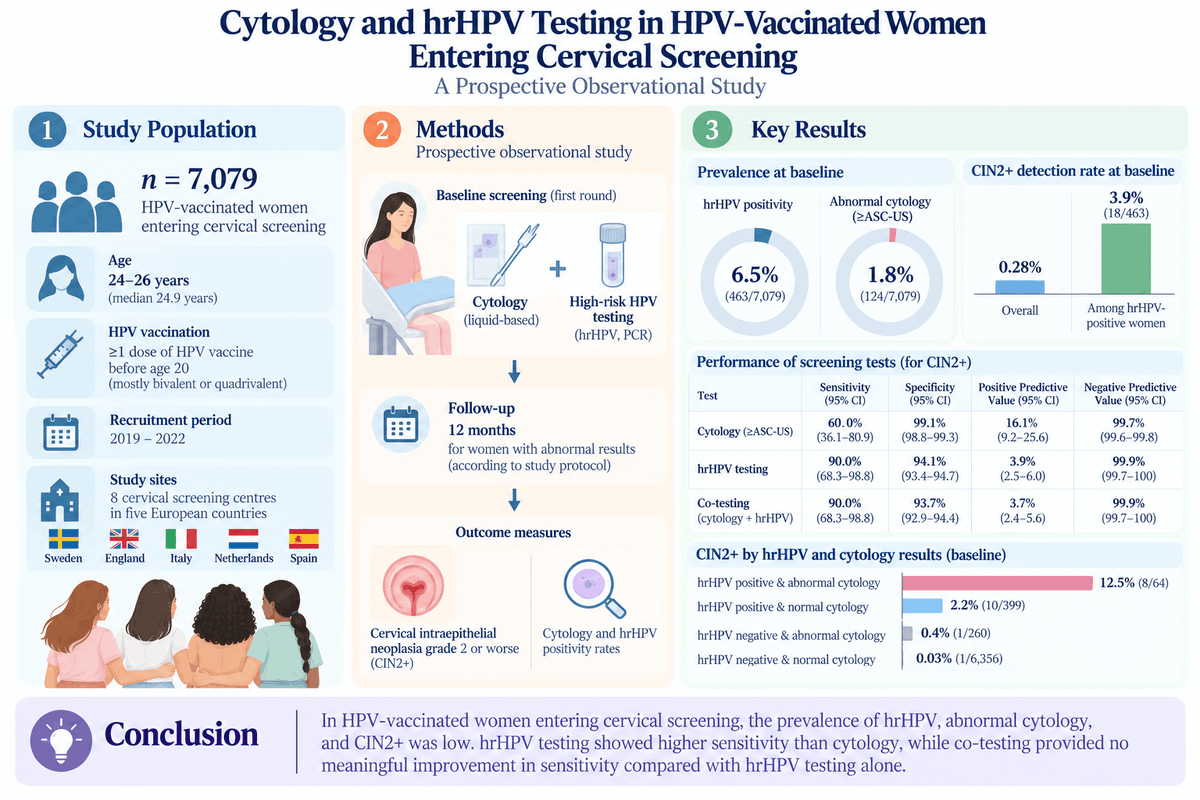
A prospective study comparing cytology and high-risk HPV (hrHPV) testing performance in HPV-vaccinated young women within Scotland’s cervical screening programme.
hrHPV testing showed a high negative predictive value (98.9%) but a low positive predictive value (14.3%) for detecting cervical intraepithelial neoplasia grade 2 or worse (CIN2+), reflecting low disease prevalence in vaccinated populations.
High-grade cytology demonstrated a much higher PPV (71.7%) but lower NPV (89.2%), supporting cytology’s role as a triage method in hrHPV-positive women.
Study highlights the need for careful evaluation of screening algorithms in highly vaccinated cohorts due to changing prevalence and test performance.
Study Background
Human papillomavirus (HPV) infection is a necessary cause of cervical cancer, with high-risk HPV (hrHPV) genotypes responsible for most cases. Prophylactic HPV vaccination programs targeting young women have markedly reduced vaccine-covered HPV type prevalence and associated cervical precancerous lesions. However, as vaccination alters the epidemiology and prevalence of cervical disease, the accuracy and predictive value of established cervical screening methods—cytology and hrHPV testing—may change. Understanding how these tests perform in vaccinated populations is critical to optimize screening algorithms, balance harms and benefits, and maintain cervical cancer prevention efficacy.
Scotland introduced a comprehensive HPV vaccination programme for young girls starting in 2008 with catch-up cohorts, accompanied by routine cervical screening invitations commencing at age 20 years through cytology-based protocols. This prospective observational study leverages this setting to assess the relative performance of cytology and hrHPV testing in HPV-vaccinated women entering cervical screening, providing real-world insights into screening test characteristics in the vaccine era.
Study Design
This study was a prospective observational analysis performed within routine cervical screening services across three Scottish Health Boards from 2011 to 2015. The population comprised women born between 1991 and 1995 who were eligible for HPV immunisation, including catch-up vaccination cohorts.
Residual liquid-based cytology samples from routine screening were retrospectively tested for hrHPV using the Hybrid Capture 2 assay. Women referred to colposcopy included those with high-grade cytology, hrHPV-positive with borderline/mild cytology, and a subset of hrHPV-positive with negative cytology from one region. Outcomes from colposcopy and histology were linked through the National Colposcopy Clinical Information Audit System (NCCIAS).
Key endpoints included positive predictive value (PPV) and negative predictive value (NPV) for histologically confirmed CIN grade 2 or worse (CIN2+) within this selective colposcopy referral framework. Additionally, patterns of hrHPV persistence were examined in women undergoing repeat testing.
Key Findings
Out of 10,000 co-tested residual cervical samples, hrHPV positivity was found in 86% of those with borderline/mild cytological abnormalities and 27% of cytology-negative samples. Among 1,352 women who attended colposcopy in the sampled cohort, 184 cases of CIN2+ were detected.
Within the referral framework:
HrHPV testing showed a PPV for CIN2+ of 14.3% (95% CI 12.5%-16.4%), indicating that only about one in seven hrHPV-positive women referred would have CIN2+. However, it had a very high NPV of 98.9% (95% CI 94.0%-99.9%), suggesting that hrHPV-negative women are highly unlikely to have CIN2+.
Cytology with high-grade abnormalities demonstrated a much higher PPV of 71.7% (95% CI 59.2%-81.5%) but a lower NPV of 89.2% (95% CI 87.4%-90.8%).
These results reveal the substantially reduced PPV of hrHPV testing in vaccinated women compared to historical non-vaccinated cohorts due to lower underlying disease prevalence.
Regarding hrHPV persistence, among 1,007 women with repeat testing, hrHPV persistence declined as the interval between tests increased, indicating greater clearance with longer follow-up. This suggests that transient infections predominate and clearance kinetics should be considered when developing surveillance protocols.
Expert Commentary
These findings provide important insights into the evolving role of cervical screening tests within HPV-vaccinated populations. The high NPV of hrHPV testing confirms its safety as a primary screening tool by reliably excluding significant cervical disease. However, the notably low PPV reflects the lower prevalence of CIN2+ in vaccinated women, resulting in more false-positive referrals if hrHPV testing is used alone.
Cytology triage of hrHPV-positive women thus remains essential to reduce unnecessary colposcopies and overtreatment. The high PPV of high-grade cytology reinforces its role in screening algorithms to target diagnostic interventions.
Limitations include the study’s setting within a selective referral framework, precluding direct population-level estimates of test performance. Also, the follow-up was limited to early vaccinated cohorts, and results may change as vaccinated women age. The study underscores the need for ongoing research into optimized screening strategies—potentially incorporating genotyping, biomarkers, or adjusted screening intervals—to enhance clinical effectiveness and resource utilization in highly vaccinated populations.
Conclusion
This prospective observational study in young, HPV-vaccinated Scottish women entering cervical screening demonstrates that hrHPV testing retains a very high negative predictive value for CIN2+, affirming its role in safely excluding significant disease. However, its positive predictive value is considerably reduced due to low disease prevalence in vaccinated cohorts, emphasizing the continuing importance of cytology triage to appropriately select women for colposcopy.
The findings highlight the need to adapt cervical screening strategies to the changing epidemiology resulting from widespread HPV vaccination, balancing early detection with minimizing harms from over-referral. Further studies should evaluate longitudinal outcomes and explore innovative screening algorithms to sustain cervical cancer prevention efficacy in the vaccine era.
Funding and Clinical Trials Registry
The study was conducted within routine Scottish cervical screening services with no specific funding details provided in the abstract. No clinical trial registration was indicated.
References
Cruickshank ME, Pan J, Cuschieri K, Liptrot S, Cotton SC, Ghosh S, Kavanagh K, Cubie H, Robertson C. Cytology and hrHPV Testing in HPV-Vaccinated Women Entering Cervical Screening: A Prospective Observational Study. BJOG. 2026 Oct 20. doi: 10.1111/1471-0528.70348. Epub ahead of print. PMID: 42899485.