Evaluating Caring Letters for Suicide Prevention Among US Veterans Contacting the Veterans Crisis Line
Highlight
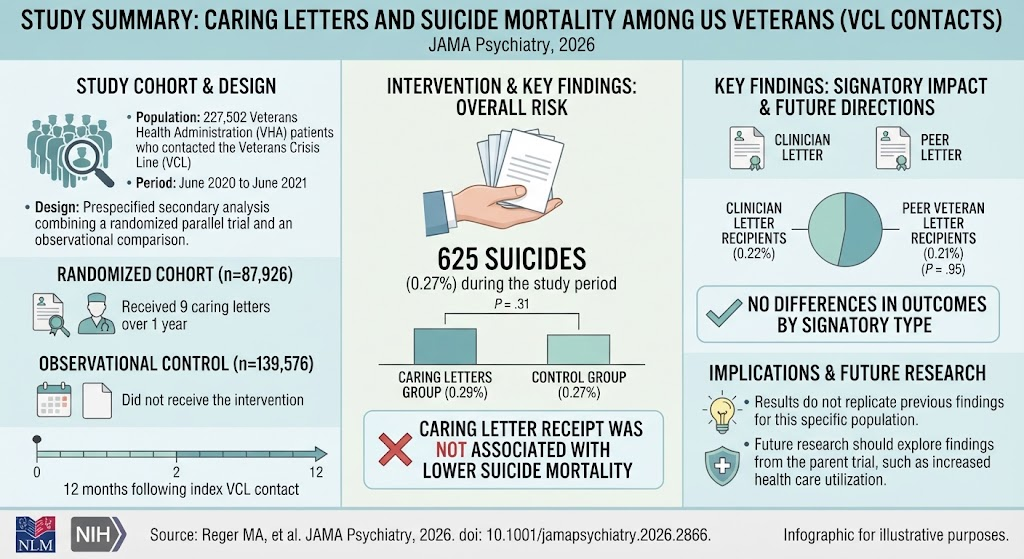
The study analyzed suicide mortality outcomes related to the Caring Letters (CL) intervention among US veterans contacting the Veterans Crisis Line (VCL).
No significant difference in suicide mortality was observed between veterans who received CL and a historical control group not receiving CL.
No difference in suicide mortality was found between recipients of letters signed by VA clinicians versus peer veterans.
Findings suggest that CL may not reduce suicide death in this population, but increased healthcare utilization remains a potential benefit to investigate.
Study Background
Suicide remains a critical public health concern, especially among US veterans who experience higher suicide rates compared to the general population. Interventions targeting suicide prevention in this high-risk group are urgently needed. Caring Letters (CL) is one of the few interventions that previously demonstrated a reduction in suicide mortality in a randomized clinical trial, through periodic, non-demanding, supportive communications aimed at sustaining contact and conveying care. However, replication studies have yielded mixed results, and its effectiveness in the veteran population specifically contacting crisis resources required further evaluation.
Study Design
This prespecified secondary analysis examined suicide mortality outcomes within a large cohort of US veterans who contacted the Veterans Crisis Line (VCL) during 2018–2021. The study combined two methods:
– A randomized parallel trial where veterans contacting the VCL between June 11, 2020 and June 10, 2021 were randomly assigned to receive nine caring letters over 12 months, signed either by a VA clinician or a peer veteran.
– An observational historical control group including veterans contacting the VCL from June 11, 2018 to June 10, 2021 who did not receive CL.
The participant population consisted of 227,502 Veterans Health Administration (VHA) patients aged 18 years or older. The main outcome was suicide mortality within one year following the initial VCL contact. Statistical comparisons utilized chi-square tests and time-to-event models between intervention groups and the control.
Key Findings
Among the large veteran cohort, 87,926 individuals received the CL intervention and 139,576 comprised the historical control group. Over the study duration, 625 suicides (0.27% overall) were documented.
– Suicide mortality rates were 0.29% in the CL group and 0.27% in the historical control group, with no statistically significant difference (P = 0.31).
– Within the intervention group, receiving letters signed by peer veterans versus VA clinicians showed no difference in suicide mortality (0.21% vs 0.22%, respectively; P = 0.95).
These findings indicate that the CL intervention did not reduce suicide deaths among veterans who contacted the VCL relative to historical controls.
Expert Commentary
While Caring Letters have demonstrated promise in prior studies, this large, rigorous analysis suggests their impact on suicide mortality may be limited in this veteran crisis line population, or that contextual factors unique to this group and setting influence effectiveness. The lack of difference by signatory type (peer vs clinician) suggests that the mode of sender may not be a critical component in mortality reduction.
Potential reasons for the null findings include the possibility that the intervention dose or the nature of the veteran crisis population requires modification. Moreover, suicide prevention requires multifaceted approaches, and letters alone may be insufficient to reduce mortality.
The authors note that the parent trial showed increased healthcare utilization associated with CL receipt, highlighting that indirect benefits beyond mortality reduction may still be clinically meaningful. Thus, future research focusing on engagement strategies, timing, and integration with broader interventions is warranted.
Conclusion
This prespecified secondary analysis of a large cohort of US veterans contacting the Veterans Crisis Line found that the Caring Letters intervention was not associated with reduced suicide mortality over 12 months, irrespective of whether letters were signed by peer veterans or clinicians. While these results challenge prior positive findings, the potential role of CL in enhancing healthcare engagement merits further exploration. Comprehensive, multifaceted strategies remain essential to effectively reduce veteran suicide.
Funding and Trial Registration
This study was funded by the US Department of Veterans Affairs. The trial was registered at ISRCTN (Identifier: ISRCTN27551361). Suicide mortality analyses were conducted between March and September 2025.
References
– Reger MA, Garrido MM, Lauver M, et al. Caring Letters and Suicide Mortality Among US Veterans Who Contacted the Veterans Crisis Line: A Prespecified Secondary Analysis. JAMA Psychiatry. 2026 Oct 14;PMID: 42873518.
– Motto JA, Bostrom AG. A Randomized Controlled Trial of Postcrisis Suicide Prevention. Psychiatr Serv. 2001 Jun;52(6):828-33.
– Jobes DA. Managing Suicidal Risk: A Collaborative Approach. 2nd ed. Guilford Press; 2016.
– US Department of Veterans Affairs. National Strategy for Preventing Veteran Suicide FY 2018–2028. VA Office of Mental Health and Suicide Prevention; 2018.
This article was created using several editorial tools, including AI, as part of the process. Human editors reviewed this content before publication.