Characteristics of Higher-Education Students in England Who Died by Suspected Suicide: A National Retrospective Case Series Study
Highlights
- National case series identified 107 suspected student suicides in England’s higher education sector during 2023-24, predominantly males aged around 24.
- Common risk factors included mental health difficulties, neurodivergence, academic and financial challenges, and social isolation.
- Nearly 70% had prior contact with university support services, yet systemic issues in access, coordination, and monitoring were evident.
- Family involvement in serious incident investigations was low despite national guidance, underscoring the need for transparency and openness.
Background
Suicide among young people remains a critical global public health concern. Within England, strengthening mental health support in educational settings is a cornerstone of the national suicide prevention strategy. Higher-education students may face unique stressors including academic pressures, relocation, financial insecurity, and social isolation, which may elevate suicide risk. However, detailed, nationally representative data characterizing this population’s suicide profiles and institutional responses have been limited. This impedes tailored interventions in this demographic which is generally considered at transitional life stage vulnerable to mental health challenges. Understanding individual characteristics, institutional context, and service interactions is vital for effective prevention and timely support.
Key Content
National Retrospective Case Series Methodology
Rodway et al. conducted a nationwide retrospective case series across England examining suspected suicides among higher-education students during the 2023-24 academic year. Anonymized serious incident reports (SIRs) were solicited from providers, alongside structured data extraction collaboratively developed with bereaved families and sector stakeholders, ensuring sensitivity to lived experience and practical relevance. The study operationalized adherence to national investigation guidance, enabling assessment of institutional compliance.
Demographics and Student Characteristics
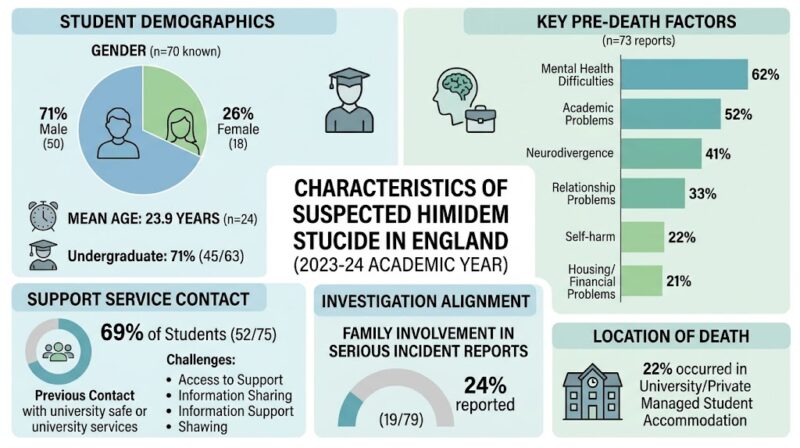
Among 107 notified suspected suicide deaths, 79 serious incident reports were analyzed from 50 providers. Men represented approximately 71% of known sex data, with a mean age near 24 years, predominately undergraduates living away from home. Ethnicity data were insufficiently recorded, limiting demographic granularity.
Precipitating and Associated Factors
Mental health difficulties were reported in 62% of cases, corroborating existing evidence that psychiatric conditions are a strong suicide risk factor in young adults. Neurodivergence (defined broadly including autism spectrum conditions and ADHD) was indicated in 41%, highlighting an emerging recognition of neurodevelopmental vulnerability in suicidality epidemiology. Academic and financial stressors featured prominently—academic problems were identified in over half, and housing or financial difficulties in one-fifth of cases. Relationship problems, self-harm history, social isolation, and exposure to violence further compounded risk profiles. Potential suicide clusters, indicated in six reports, suggest contagion phenomena warranting further investigation.
Contact with Support Services and Institutional Challenges
Most students (69% of 75 with data) had prior contact with university support services. Despite this, reports consistently revealed challenges such as difficulties accessing timely mental health care, poor information sharing between academic and pastoral staff, inadequate mechanisms to monitor engagement or response to support interventions, and fragmented coordination. This fragmented support milieu underscores systemic barriers that could limit prevention efficacy.
Institutional Responses and Guidance Compliance
Only 24% of serious incident reports documented family involvement in investigation processes, a key recommendation of national guidance for transparency and trust building. Moreover, safety concerns arose relating to student accommodation, with over a fifth of deaths occurring in university-managed or private student housing, calling attention to the need for robust safety protocols and environmental risk mitigation.
Comparative and Supplementary Evidence
While this study is among the first to provide detailed national data, prior smaller studies and surveillance data echo many findings. Systematic reviews of student suicide emphasize overlapping risk domains: mental illness, social isolation, academic stress, and life transitions. Neurodivergent populations have been underrepresented historically but recent literature indicates elevated risk, consistent with the current findings. Additionally, meta-analyses indicate that previous contact with mental health services is common among young people who die by suicide, highlighting the critical need to evaluate service effectiveness and accessibility.
Expert Commentary
The case series represents a landmark in delineating the multifaceted profile of student suicide within an English academic context, combining rich qualitative and quantitative data. The predominance of men and undergraduates aligns with prior epidemiological patterns but underscores the persisting gender disparities in suicidality and help-seeking. The considerable prevalence of neurodivergence as a clinical feature demands heightened awareness and tailored interventions within university mental health services. Approaches must integrate academic accommodations, inclusive communication, and proactive outreach.
Systemic barriers spanning service access, information flow, and engagement monitoring suggest urgent institutional reforms are necessary. Integrated care pathways combining academic, pastoral, and clinical supports could enhance responsiveness and continuity. Furthermore, family involvement in serious incident investigations is not merely procedural but therapeutic—engendering transparency, accountability, and healing. Greater adherence to national guidance and deployment of independent investigations are recommended.
Environmental modifications targeting accommodation safety, enhanced detection of potential clusters, and destigmatizing mental health on campuses are crucial complementary strategies. Future research should explore efficacies of specific interventions designed for neurodivergent and socioeconomically disadvantaged students.
Conclusion
Suspected suicide among higher-education students in England is characterized by complex, multifactorial risk involving mental health disorders, neurodivergence, academic pressures, and socioeconomic challenges. Despite frequent prior support engagement, structural shortcomings hinder optimal prevention. Universities must prioritize mental health strategically, provide targeted support for at-risk subgroups, improve interdisciplinary collaboration, ensure the safety of student housing, and uphold transparent investigative processes involving families. Implementing these recommendations could meaningfully reduce student suicide rates and improve overall wellbeing.
References
- Rodway C, Tham SG, Turnbull P, Kapur N, Appleby L. Characteristics of higher-education students in England who died by suspected suicide in a single academic year: a national retrospective case series study. Lancet Psychiatry. 2026 Aug;13(8):678-687. PMID: 42456705.
- Hawton K, Saunders KEA, O’Connor RC. Self-harm and suicide in adolescents. Lancet. 2012 Jun 23;379(9834):2373-82. PMID: 22683122.
- Luoma JB, Martin CE, Pearson JL. Contact with mental health and primary care providers before suicide: a review of the evidence. Am J Psychiatry. 2002 Jun;159(6):909-16. PMID: 12042113.
- Cassidy S. Understanding and supporting the needs of students on the autism spectrum in UK higher education: Implications for practice. J Autism Dev Disord. 2012 Feb;42(4):674-685. PMID: 21909807.
- Wilkinson P, Catan T, Taylor K, et al. Addressing suicide and self-harm clusters in young people: A rapid systematic review. J Affect Disord. 2023;323:142-156. PMID: 36910469.
This article was created using several editorial tools, including AI, as part of the process. Human editors reviewed this content before publication.