Ethics and Professionalism in AI and Medical Practice: Key Guidance from the American College of Physicians (2026 Position Paper)
Introduction and Context
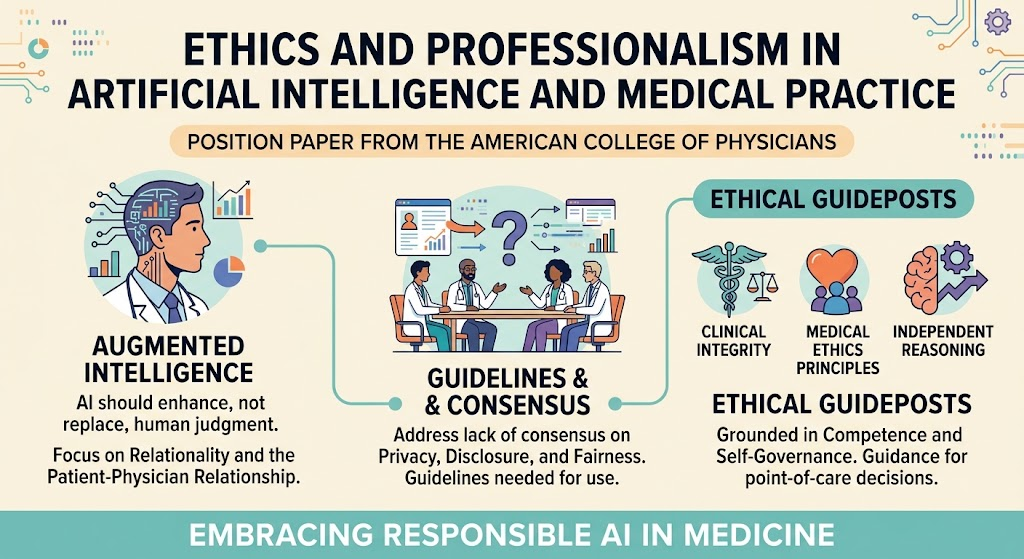
Artificial intelligence (AI) — more precisely described in clinical settings as augmented intelligence — has rapidly moved from research to routine clinical tools for diagnosis, risk prediction, imaging interpretation, triage, and administrative tasks. The American College of Physicians (ACP) Ethics, Professionalism and Human Rights Committee published a position paper in September 2026 that confronts the ethical and professional challenges of AI at the point of care (DeCamp et al., 2026). Rather than offering technical regulatory rules, the ACP centers the patient–physician relationship and professional obligations as the foundation for ethically deploying AI in clinical practice.
Why this paper matters now
– Rapid adoption of AI tools across care settings has outpaced consensus on how clinicians should integrate them ethically and professionally.
– Prior frameworks (WHO, AMA, FDA) provide governance and implementation guidance, but clinicians still need actionable principles for bedside decisions, disclosure, and maintaining clinical integrity.
– The ACP paper responds to gaps in patient-centered guidance: when to disclose AI use, how to preserve professional judgment, how to manage fairness and privacy concerns, and how clinicians should steward AI for equitable care.
Sign in free to continue reading
Create or use your MedXY account to unlock the complete article.
This article was created using several editorial tools, including AI, as part of the process. Human editors reviewed this content before publication.