Highlight
This study provides robust randomized evidence that sustained transthyretin suppression with eplontersen leads to significant myocardial amyloid regression, reduced extracellular volume, and enhanced biventricular systolic function in transthyretin amyloid cardiomyopathy (ATTR-CM). It highlights the use of serial multiparametric cardiovascular magnetic resonance (CMR) to quantify treatment response and myocardial remodeling over nearly three years.
Key findings include a marked decrease in myocardial extracellular volume, improved left and right ventricular ejection fractions, and better myocardial deformation indices compared with placebo, underscoring eplontersen’s disease-modifying potential.
Study Background
Transthyretin amyloid cardiomyopathy (ATTR-CM) is a progressive infiltrative cardiomyopathy caused by misfolded transthyretin protein depositing as amyloid fibrils in myocardial tissue. This results in myocardial stiffening, impaired cardiac function, and ultimately heart failure. ATTR-CM is increasingly recognized in older adults and is associated with significant morbidity and mortality.
Transthyretin-lowering therapies, such as antisense oligonucleotides or small interfering RNA agents, aim to reduce circulating transthyretin and thus slow or reverse amyloid deposition. However, the extent to which such therapies modify myocardial amyloid burden and cardiac structure has been incompletely characterized, particularly by objective imaging biomarkers over prolonged periods.
Cardiovascular magnetic resonance (CMR) with multiparametric tissue characterization, including native T1 mapping and extracellular volume (ECV), offers a noninvasive, quantitative approach to assess myocardial amyloid infiltration and remodeling in ATTR-CM.
Study Design
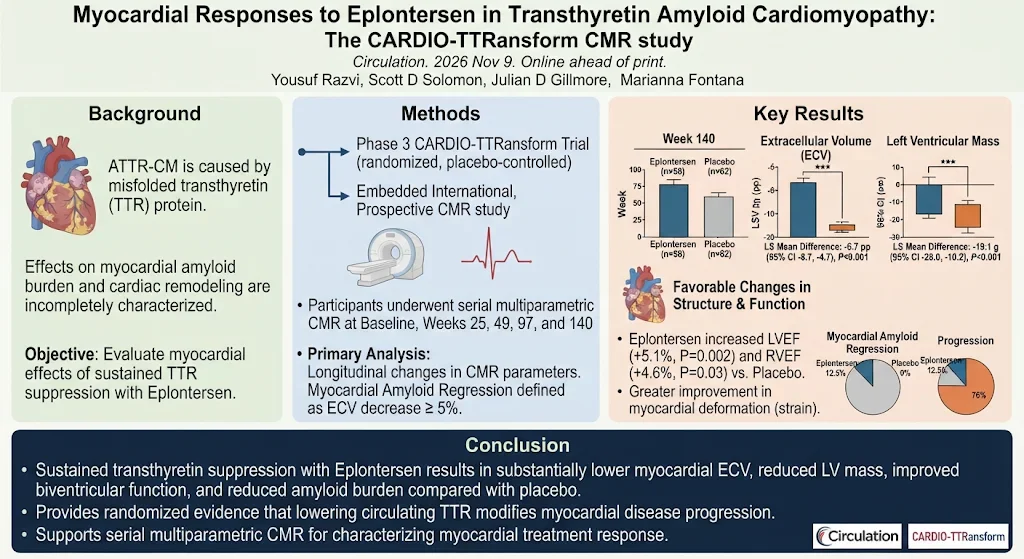
The CARDIO-TTRansform CMR study was a pre-specified, international, prospective sub-study embedded within a larger randomized, placebo-controlled phase 3 clinical trial evaluating eplontersen, a transthyretin-lowering agent, in patients with ATTR-CM.
A total of 120 participants, predominantly elderly males (mean age 76.7 years, 95% male), were randomized to receive eplontersen (n=58) or placebo (n=62). Approximately 12.5% were on background transthyretin stabilizer therapy at baseline.
Serial multiparametric CMR assessments were performed at baseline and at weeks 25, 49, 97, and 140. The primary imaging endpoint was longitudinal change in myocardial parameters, including extracellular volume (ECV), native T1, left ventricular (LV) mass, and biventricular systolic function.
Myocardial amyloid regression was defined as at least a 5 percentage-point decrease in ECV, while progression was defined as a 5 percentage-point or greater increase.
Key Findings
After 140 weeks of treatment, eplontersen produced significant myocardial changes compared with placebo. The mean difference in myocardial ECV was -6.7 percentage points (95% CI: -8.7 to -4.7; P<0.001), indicating a substantial reduction in myocardial amyloid burden.
Native T1 values, reflective of myocardial tissue characteristics, decreased by 25.9 milliseconds (95% CI: -41.7 to -10.2; P=0.002), and left ventricular mass was reduced by 19.1 grams (95% CI: -28.0 to -10.2; P<0.001), consistent with reverse remodeling.
Eplontersen significantly improved biventricular systolic function: left ventricular ejection fraction increased by 5.1% (95% CI: 1.8 to 8.3; P=0.002) and right ventricular ejection fraction by 4.6% (95% CI: 0.6 to 8.7; P=0.03). Moreover, improvements were observed in LV global longitudinal, circumferential, and radial strain, as well as right ventricular longitudinal strain (all P<0.05), indicating enhanced myocardial deformation and contractile performance.
In terms of myocardial amyloid status at week 140, 12.5% of patients treated with eplontersen exhibited amyloid regression (≥5 percentage-point ECV reduction) compared to 0% in the placebo group. Conversely, amyloid progression occurred in only 12.5% of eplontersen recipients versus 76% in placebo recipients.
Expert Commentary
The CARDIO-TTRansform CMR study importantly advances our understanding of transthyretin-lowering therapy effects on the myocardium in ATTR-CM. The significant reductions in ECV and native T1 alongside reverse remodeling and functional improvements provide compelling evidence that eplontersen modifies the underlying disease process rather than merely ameliorating symptoms.
The use of multiparametric CMR imaging underscores the value of advanced noninvasive biomarkers for monitoring therapeutic response and guiding management decisions. Notably, the study cohort mostly comprised patients not on background stabilizer therapy, allowing the isolated effect of transthyretin suppression to be delineated.
Study limitations include a predominantly male population and relatively small sample size, which may limit generalizability. Nonetheless, these data provide a critical foundation for incorporating transthyretin-lowering agents such as eplontersen into treatment protocols for ATTR-CM with objective imaging endpoints.
Conclusion
Eplontersen therapy for transthyretin amyloid cardiomyopathy produces significant myocardial amyloid regression, decreases extracellular volume, reverses left ventricular hypertrophy, and improves biventricular systolic function and myocardial mechanics over nearly three years. These findings demonstrate the disease-modifying potential of transthyretin suppression and validate the application of serial multiparametric CMR as a powerful tool for characterization of treatment response in ATTR-CM.
Future studies should explore longer-term clinical outcomes, detailed mechanistic pathways, and the impact of combined approaches including transthyretin stabilizers. Personalized treatment strategies guided by imaging biomarkers may optimize prognosis in this increasingly recognized cardiomyopathy.
Funding and ClinicalTrials.gov
The CARDIO-TTRansform study was supported by Ionis Pharmaceuticals and Akcea Therapeutics, developers of eplontersen. Clinical trial registration: NCT04791839.
References
Razvi Y, Solomon SD, Cuddy SAM, et al. Myocardial Responses to Eplontersen in Transthyretin Amyloid Cardiomyopathy: The CARDIO-TTRansform CMR study. Circulation. 2026 Nov 9. PMID: 43002382.
Fontana M, et al. Cardiovascular magnetic resonance for amyloid assessment. JACC Cardiovasc Imaging. 2021;14(2):278-288.
Maurer MS, et al. Tafamidis in transthyretin amyloid cardiomyopathy. N Engl J Med. 2018;379:1007-1016.
Gillmore JD, et al. Noninvasive diagnosis of cardiac transthyretin amyloidosis. Circulation. 2016;133:2404-2412.