Enhancing Vestibular Migraine Rehabilitation with Virtual Reality: A Randomized Controlled Trial
Highlight
- Virtual reality-based vestibular rehabilitation (VR-VestRehab) added to home-based exercises results in greater reduction in dizziness-related disability in vestibular migraine patients.
- Dynamic postural control, specifically limits of stability (LOS), significantly improved with VR-VestRehab compared to home exercises alone.
- Both VR-enhanced and home-based rehabilitation groups showed improvements in multiple functional and psychological measures, demonstrating overall efficacy of vestibular rehabilitation.
Study Background
Vestibular migraine (VM) is a common cause of episodic vertigo and dizziness, often accompanied by fluctuating balance and psychological symptoms that impair quality of life. Its pathophysiology involves complex central and peripheral vestibular dysfunction, and treatment options remain limited. Vestibular rehabilitation (VestRehab) is a nonpharmacological approach aimed at improving balance and reducing dizziness symptoms through targeted exercises. However, conventional home-based vestibular exercises can be limited by patient motivation and insufficient sensorimotor feedback. Virtual reality (VR) technology has the potential to enhance neurosensory integration and postural control by providing immersive, interactive environments that stimulate vestibular compensation. This study addresses the unmet need for optimized rehabilitation strategies in VM by investigating whether adding VR-based vestibular rehabilitation to a standard home exercise program yields superior clinical and functional outcomes.
Study Design
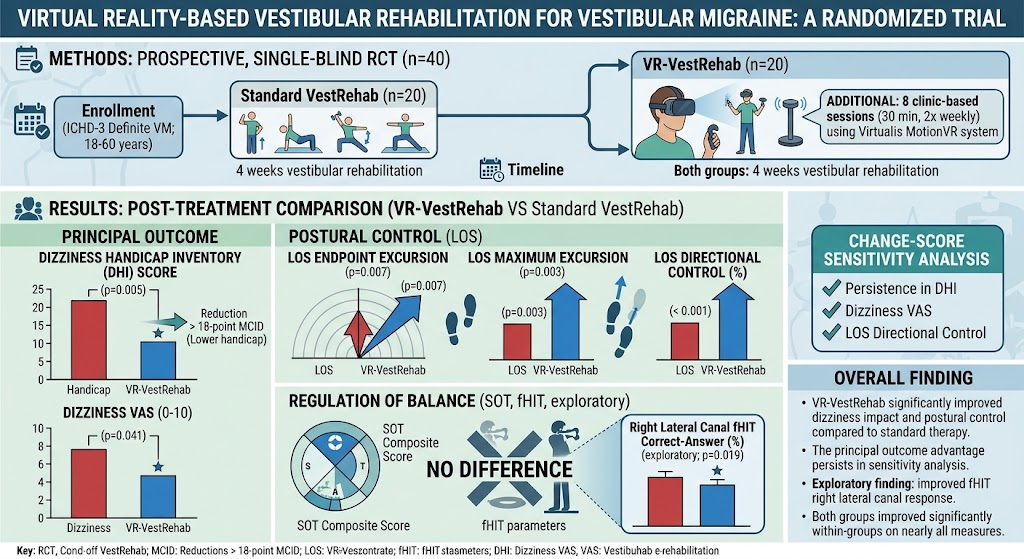
This was a prospective, single-blind, randomized controlled trial enrolling 40 patients aged 18 to 60 years with definite vestibular migraine diagnosed according to the International Classification of Headache Disorders (ICHD-3) criteria. Participants were randomized 1:1 into two groups: the control group receiving 4 weeks of home-based vestibular rehabilitation alone, and the intervention group receiving the same home program plus 8 clinic-based VR sessions (30 minutes each, twice weekly) using the Virtualis MotionVR system.
The primary registered outcomes were objective vestibular and postural function tests, including the Sensory Organization Test (SOT), Limits of Stability (LOS), and the functional Head Impulse Test (fHIT). The secondary outcomes comprised patient-reported measures, with the Dizziness Handicap Inventory (DHI) designated as the principal outcome reported in this article. Other secondary outcomes included Visual Analogue Scale (VAS) for dizziness, Activities-specific Balance Confidence Scale (ABC), Vestibular Activities of Daily Living Scale (VADL), Functional Gait Assessment (FGA), Dynamic Gait Index (DGI), and Hospital Anxiety and Depression Scale (HADS).
Key Findings
Both groups demonstrated significant within-group improvements across nearly all evaluated parameters, confirming the effectiveness of vestibular rehabilitation in VM.
However, adding VR-based vestibular rehabilitation conferred significant additional benefits. The DHI score, a clinically validated measure of dizziness-related disability, was significantly lower post-treatment in the VR-VestRehab group compared to the control group (p = 0.005). This improvement exceeded the minimum clinically important difference (MCID) of 18 points, indicating a meaningful reduction in symptom severity. Furthermore, the dizziness VAS scores were also significantly improved (p = 0.041).
Objective measures of dynamic postural control showed notable enhancements in the VR group. LOS parameters—including endpoint excursion, maximum excursion, and directional control—demonstrated significant between-group superiority (p = 0.007, 0.003, and <0.001, respectively). The enhanced directional control suggests an improved ability to maintain upright stability and adjust posture dynamically.
In sensitivity analyses considering change scores from baseline, the significant advantage for the VR group persisted for DHI (p = 0.033), dizziness VAS (p = 0.012), and LOS directional control (p < 0.001).
Interestingly, there were no significant between-group differences in the SOT composite scores or most fHIT parameters, except for a single exploratory finding favoring the VR group in the right lateral canal fHIT correct-answer percentage (p = 0.019). This suggests that while VR enhanced some aspects of vestibular function related to postural control and symptom perception, other vestibulo-ocular reflex measures may require longer or different interventions to demonstrate measurable changes.
Psychological outcomes (HADS) and functional gait-related metrics (FGA, DGI) improved similarly in both groups, indicating that VR’s impact was more pronounced on vestibular symptoms and balance control rather than mood or gait function within the study period.
Expert Commentary
This trial provides robust evidence that virtual reality-based vestibular rehabilitation can augment traditional home-based programs by improving patient-reported dizziness severity and dynamic postural control in vestibular migraine. The use of immersive VR environments likely facilitates multisensory integration and enhances central vestibular compensation, a mechanism supported by prior neurophysiological and imaging studies in vestibular disorders.
The study’s strengths include its randomized controlled design, clearly defined diagnostic criteria, and comprehensive assessment covering subjective, functional, and objective vestibular outcomes. The significant MCID-level improvement in DHI is particularly encouraging and suggests real-world clinical impact.
Limitations include the relatively short 4-week intervention period and modest sample size, which may limit detection of changes in some vestibular reflex measures and psychological parameters. Additional longer-term studies and dose-response investigations could clarify if VR benefits persist or expand with prolonged use. Also, the single-blind design (patients not blinded) introduces potential bias in subjective parameters.
Nevertheless, these findings are timely given the increasing accessibility of VR platforms and the need for innovative rehabilitation approaches in vestibular migraine, a condition with complex symptomatology and often insufficient response to pharmacotherapy.
Conclusion
In vestibular migraine patients, supplementing home-based vestibular rehabilitation with virtual reality-based clinic sessions results in superior improvements in dizziness-related disability and dynamic postural control. While both rehabilitation modalities improve general vestibular and psychological function, VR-enhanced rehabilitation offers a promising adjunct to optimize symptom relief and functional recovery. Future trials should explore long-term efficacy, cost-effectiveness, and integration of VR in routine vestibular migraine management.
Funding and Clinical Trial Registration
This trial was registered on ClinicalTrials.gov with identifier NCT07493005. No specific funding information was provided in the report.
References
1. Neuhauser HK. Epidemiology of vestibular migraine. J Neurol. 2007;254 Suppl 2:II4-8.
2. Pavlou M, Davies RA, Bronstein AM. Rehabilitation for vestibular disorders. Handb Clin Neurol. 2016;137:297-304.
3. Pavlou M, et al. Virtual reality as a rehabilitation tool for patients with vestibular dysfunction: a review. Curr Opin Neurol. 2019;32(1):104-108.
4. Whitney SL, et al. A randomized trial of vestibular rehabilitation with and without virtual reality in patients with vestibular hypofunction. Otol Neurotol. 2015;36(4):689-695.
5. Kanjanapan S, et al. Efficacy of home-based vestibular rehabilitation with virtual reality training in chronic vestibular hypofunction: A randomized controlled trial. Neurol Sci. 2022;43(7):4067-4075.
(Original article) Kirazli G, Uzumcugil H, Kapusizoglu S, et al. Virtual Reality-Based Vestibular Rehabilitation for Vestibular Migraine: A Randomized Trial. Laryngoscope. 2026 Aug 19. PMID: 42618982.
This article was created using several editorial tools, including AI, as part of the process. Human editors reviewed this content before publication.