Highlight
This study presents an innovative modified individualized and convenient tongue model (ICTM) applied to profunda artery perforator flaps (PAPFs) for total tongue reconstruction, yielding superior functional and cosmetic outcomes compared to conventional flap designs. Improved speech intelligibility, swallowing function, and aesthetic appearance were statistically significant benefits observed with the ICTM technique.
Study Background
Total tongue reconstruction represents one of the most challenging procedures within head and neck surgery due to the complex anatomy and critical functional roles of the tongue in speech, swallowing, and airway protection. Success hinges on creating a neotongue with appropriate volume, shape, and mobility that closely mimics normal anatomy. Traditional free flap techniques often struggle to balance functional restoration with aesthetic considerations.
The profunda artery perforator flap (PAPF) is gaining favor as a versatile tissue source for total tongue reconstruction because of its reliable vascularity, pliability, and sufficient bulk. However, conventional flap designs may inadequately replicate the tongue’s protuberance and contour, leading to suboptimal functional outcomes.
The modified individualized and convenient tongue model (ICTM) technique aims to customize the flap design based on patient-specific anatomy and desired tongue geometry, optimizing flap volume and shape for better functional and aesthetic restoration.
Study Design
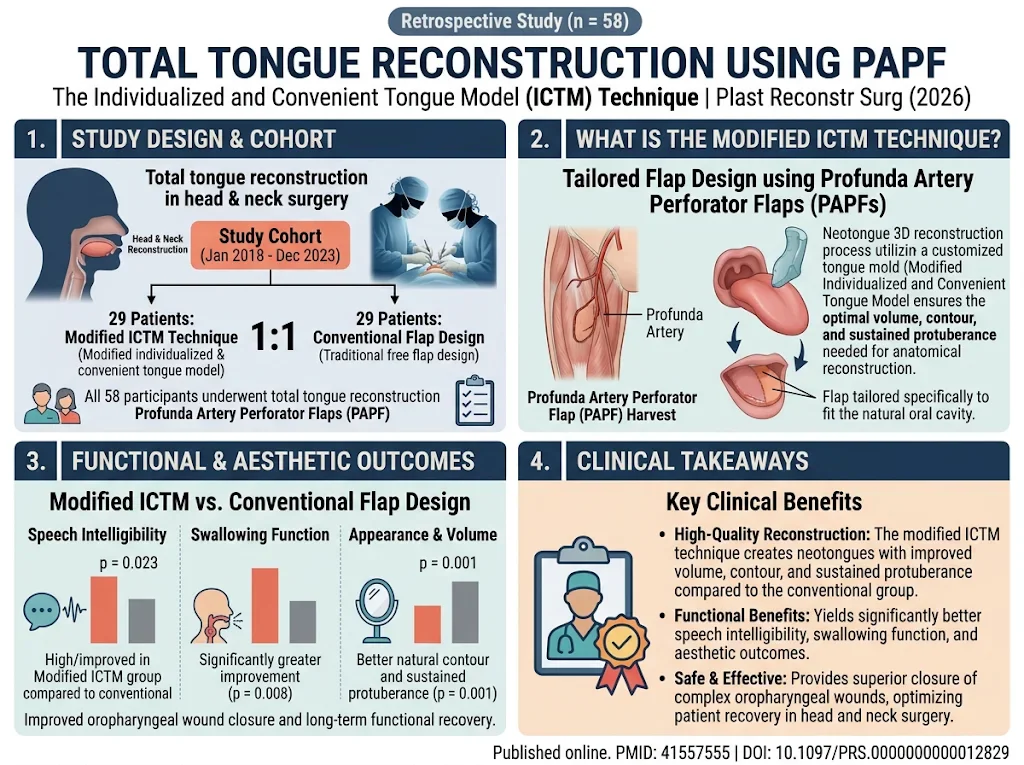
This retrospective cohort study included 58 patients undergoing total tongue reconstruction with PAPFs from January 2018 to December 2023. The cohort was divided equally: 29 patients reconstructed using the modified ICTM technique and 29 patients receiving conventional flap designs.
Functional outcomes assessed included speech intelligibility and swallowing function, measured by standardized evaluation scales validated in head and neck reconstructive surgery. Aesthetic outcomes were appraised using appearance scoring systems by clinicians and patient self-assessments.
Statistical analyses were performed to compare groups, with significance defined as P < 0.05.
Key Findings
The PAPFs constructed via the modified ICTM technique resulted in neotongues that better preserved volume, contour, and sustained protuberance compared to those created using conventional flap designs. This anatomical mimicry directly correlated with enhanced functional outcomes:
Speech Intelligibility: The ICTM group showed statistically significant improvements (P = 0.023) in speech clarity measured by standardized speech evaluation protocols, likely due to improved neotongue mobility and volume.
Swallowing Function: Patients reconstructed with the ICTM approach experienced better swallowing mechanics (P = 0.008), reflecting improved oral bolus control and reduced aspiration risk.
Aesthetic Outcomes: Both patient-reported and clinician-assessed appearance scores significantly favored the modified ICTM method (P = 0.001), suggesting greater satisfaction with tongue shape and oral cavity closure.
No major complications directly attributable to the flap design were reported, indicating the modified ICTM technique maintains safety profiles comparable to conventional methods.
Expert Commentary
The integration of patient-specific modeling in head and neck reconstruction exemplifies the evolving paradigm in personalized surgical care. This study’s demonstration of the modified ICTM technique’s enhanced restoration of tongue functions highlights the critical role of anatomical precision in flap design.
While retrospective and single-center, the findings suggest compelling avenues for prospective evaluation. Limitations include potential selection biases and the challenge of standardizing functional assessments across patients. The modified ICTM approach could benefit from incorporation of three-dimensional imaging and preoperative virtual surgical planning to further refine flap customization.
Given the profound impact of tongue reconstruction quality on patient quality of life, this study supports the wider adoption of individualized flap design to improve postoperative outcomes in extensive tongue resections.
Conclusion
The modified individualized and convenient tongue model for profunda artery perforator flap design offers significant advantages over conventional methods in total tongue reconstruction. This technique enhances neotongue volume, contour, and protuberance, which translates into improved speech intelligibility, swallowing function, and aesthetic outcomes.
Future research incorporating larger, prospective cohorts and objective functional metrics will further substantiate its clinical value. Surgeons should consider individualized flap modeling as a standard for optimizing total tongue reconstruction results.
Funding and Clinical Trials
The study documentation did not specify funding sources or clinical trial registration. Further inquiries into trial registries could clarify ongoing validation efforts.
References
Lei YM, Sun WX, Zhang XD, Xue XM, Xiong JJ, Zhang AH, Dai W, Liu FY, Liu MD. Modified Individualized and Convenient Tongue Model for Total Tongue Reconstruction Using Profunda Artery Perforator Flap. Plastic and reconstructive surgery. 2026 Jan 21;158(5):787-796. PMID: 41557555.
Other relevant literature to support clinical context and flap techniques can be sourced from PubMed indexed journals on head and neck reconstruction and microsurgery.