Enfortumab Vedotin-Induced Cutaneous Toxicity: A Marker of Improved Survival in Advanced Urothelial Carcinoma
Highlight
This multi-institutional retrospective study identifies that cutaneous adverse events (cAEs) specifically induced by enfortumab vedotin (EV) in locally advanced or metastatic urothelial carcinoma patients are common and independently associated with significantly improved progression-free survival (PFS) and overall survival (OS). Notably, early-onset and even high-grade EV-related skin toxicities correlate with favorable clinical outcomes. Distinguishing EV-induced cAEs from other causes is crucial for optimal management and prognostication.
Study Background
Urothelial carcinoma, especially in its locally advanced or metastatic form, remains a therapeutic challenge with limited durable treatment options. Enfortumab vedotin (EV), an antibody-drug conjugate targeting Nectin-4 on urothelial cancer cells, has emerged as an effective therapy post platinum chemotherapy and immune checkpoint inhibitors (ICIs). Despite its therapeutic efficacy, EV is associated with diverse cutaneous adverse events (cAEs), including pruritus, dermatitis, and morbilliform eruptions, occurring in nearly half of treated patients. Previous data have suggested a link between cAEs and improved survival, but the confounding influence of concomitant ICI therapy has obscured clear interpretation. Precise characterization of EV-induced skin toxicities and their prognostic significance is needed to guide clinical decision-making and supportive care.
Study Design
This retrospective cohort study evaluated 449 patients with locally advanced or metastatic urothelial carcinoma treated with EV between 2020 and 2025 across multiple institutions. Patient demographic and clinical data were manually extracted. A likelihood scoring system was employed to attribute observed cutaneous events to EV therapy versus other etiologies. Key outcomes included progression-free survival (PFS) and overall survival (OS) analyzed via Kaplan-Meier methodology and Cox proportional hazards models that accounted for time-varying covariates and landmark analyses at intervals ranging from 15 to 105 days post EV initiation. This methodological approach minimized immortal time bias and separated effects of EV-induced cAEs from concurrent ICI treatment.
Key Findings
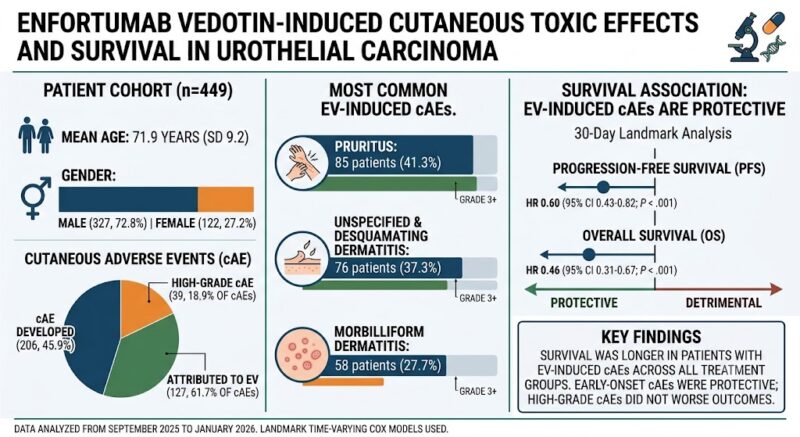
Of 449 patients studied (mean age 71.9 years, predominantly male), 206 (45.9%) experienced cAEs, with 18.9% being high-grade. Among these, 127 cases (61.7%) were attributed directly to EV. The most frequent manifestations included pruritus (41.3%), desquamating and unspecified dermatitis (37.3%), and morbilliform dermatitis (27.7%). Survival analysis revealed significantly longer PFS and OS in patients developing EV-induced cAEs across all treatment subgroups. Specifically, the landmark analysis at 30 days post-treatment, the primary time point, found a hazard ratio (HR) for progression of 0.60 (95% CI, 0.43-0.82; P < .001) and for death of 0.46 (95% CI, 0.31-0.67; P < .001) when comparing patients with EV-induced cAEs to those without.
Crucially, early-onset EV-induced cAEs showed consistent protective associations across all landmark times analyzed. Moreover, high-grade skin toxicities did not correlate with worse survival outcomes, alleviating concerns that severe cutaneous toxicity may portend poor prognosis or necessitate treatment cessation. Adjustments for concurrent ICI exposure confirmed that the observed survival benefit was independently tied to EV-induced cAEs rather than immune-related effects alone.
Expert Commentary
This study adds robust clarity to the prognostic implications of EV-induced cutaneous toxicities in urothelial carcinoma management. The use of a rigorous time-dependent analytical framework and meticulous causality attribution strengthens the conclusion that skin toxicities serve as an on-treatment biomarker for therapeutic efficacy. This may reflect underlying pharmacodynamics or host immune responses interacting with EV’s mechanism targeting Nectin-4.
Limitations include its retrospective design and potential for residual confounding, although the large patient cohort and multi-institutional involvement enhance generalizability. Future prospective studies could elucidate mechanistic pathways linking skin toxicity and tumor response, possibly informing personalized dosing strategies or early intervention guidelines.
Conclusion
Enfortumab vedotin-induced cutaneous adverse events are not only common but also independently linked to improved survival outcomes in patients with advanced urothelial carcinoma. Identification and differentiation of these skin toxicities from other causes are vital for appropriate management without prematurely discontinuing potentially life-prolonging therapy. Early recognition and supportive dermatologic care should be integrated into oncologic practice to optimize patient outcomes and quality of life. Further research into mechanistic underpinnings may enable better prediction and modulation of treatment responses.
Funding and Trial Registration
Funding sources and clinical trial registration details were not specified in the source publication.
References
Lee E, Karagenova R, Lu C, et al. Enfortumab Vedotin-Induced Cutaneous Toxic Effects and Survival in Urothelial Carcinoma. JAMA Dermatology. 2026 Jul 29. PMID: 42525402. Available at: https://pubmed.ncbi.nlm.nih.gov/42525402/
This article was created using several editorial tools, including AI, as part of the process. Human editors reviewed this content before publication.
