Highlight
– Myocardial external efficiency (MEE) significantly improves from 1-3 weeks to 6 months after heart transplantation but remains lower than in controls.
– MEE and mitochondrial oxidative capacity correlate with left-ventricular contractile performance as measured by global longitudinal strain.
– Lower MEE is associated with elevated cardiac injury and strain biomarkers such as troponin I and NT-proBNP.
– Findings underline the role of myocardial energetics and mitochondrial function in graft recovery and performance.
Study Background
Heart transplantation (HTX) remains the definitive treatment for end-stage heart failure. Despite advances in surgical techniques and immunosuppression, graft dysfunction continues to impede long-term outcomes. Emerging evidence implicates mitochondrial dysfunction and impaired myocardial energetics as contributing factors to graft failure and suboptimal myocardial performance post-transplant. The heart’s energy metabolism and efficiency are essential to maintaining contractile function; thus, understanding these parameters early after HTX may shed light on mechanisms of graft adaptation and failure.
Myocardial external efficiency (MEE), defined as the ratio of mechanical work to myocardial oxygen consumption, serves as a robust metric to evaluate cardiac energetic performance. Studies exploring MEE and mitochondrial respiratory capacity in heart transplant recipients remain sparse, especially during the critical early recovery phase.
Study Design
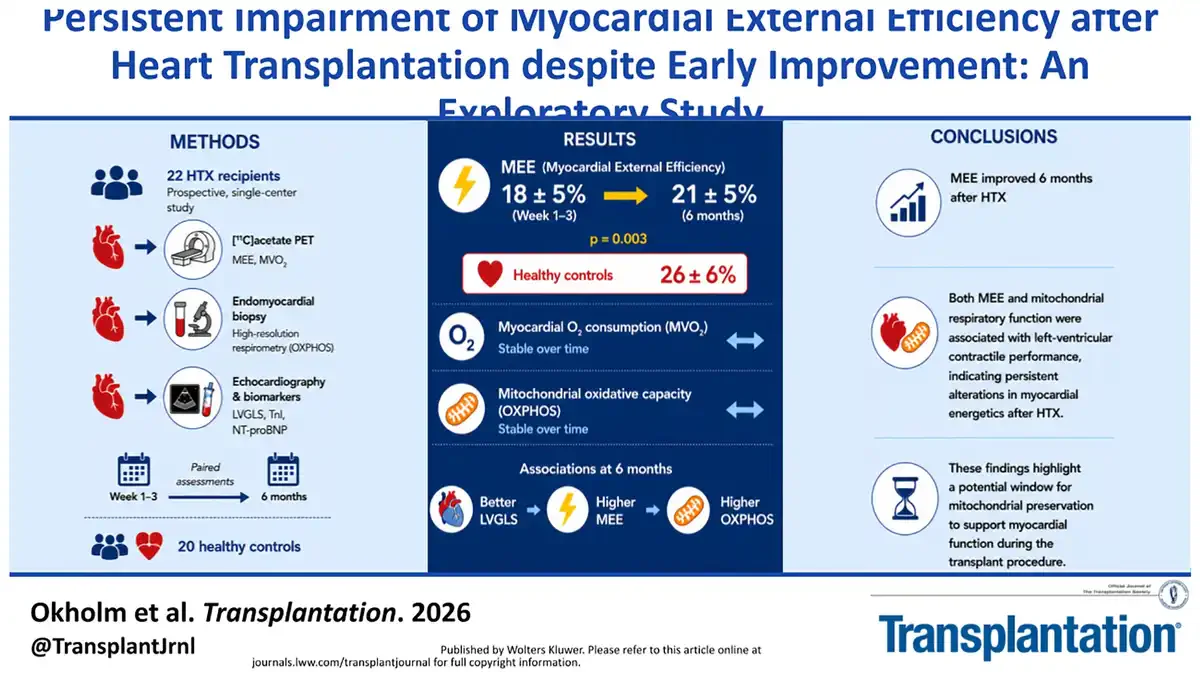
This prospective, single-center exploratory study enrolled 22 heart transplant recipients. Participants underwent integrated assessment at two timepoints: once during the early post-transplant period (week 1 to 3) and again at 6 months post-HTX. Evaluations included [11C]acetate positron emission tomography (PET) to quantify MEE, echocardiography for cardiac mechanical function including left-ventricular global longitudinal strain (GLS), and biomarker testing (troponin I and N-terminal pro-brain natriuretic peptide [NT-proBNP]) to assess myocardial injury and stress.
Additionally, mitochondrial capacity was examined via high-resolution respirometry performed on endomyocardial biopsies obtained from HTX recipients. Twenty age- and sex-matched control participants without heart disease underwent PET and echocardiography for comparative analyses. The study focused on intraindividual temporal changes in MEE and related parameters, as well as correlations between mitochondrial function and functional markers of myocardial performance.
Key Findings
Myocardial External Efficiency Improvement Over Time: MEE increased significantly from 18 ± 5% during week 1–3 to 21 ± 5% at 6 months post-transplant (P = 0.003), indicating partial energetic recovery during graft adaptation. However, MEE remained significantly lower than in control participants (26 ± 6%, P < 0.0001), suggesting persistent energetic inefficiency relative to healthy myocardium.
Cardiac Output and Oxygen Consumption: Measures of cardiac output and myocardial oxygen consumption showed no significant change over time, signifying that improvements in MEE resulted mainly from increased efficiency rather than altered oxygen delivery or consumption rates.
Mitochondrial Oxidative Capacity and Its Relation to Function: Mitochondrial respiratory capacity did not significantly change across timepoints but correlated with left-ventricular GLS at 6 months (r = −0.58, P = 0.010), indicating a biological link between mitochondrial function and myocardial contractility.
Associations with Cardiac Biomarkers: MEE inversely correlated with circulating markers of myocardial injury and stress. Specifically, lower MEE associated with higher troponin I (r = −0.49, P = 0.030) and NT-proBNP (r = −0.35, P = 0.029), suggesting that reduced energetic efficiency accompanies greater graft injury and dysfunction.
Expert Commentary
This exploratory study provides valuable insights into myocardial energy dynamics during early and intermediate phases after heart transplantation. The observed improvement in MEE indicates a degree of energetic remodeling and adaptation within the graft. The persistent deficit compared to controls underscores ongoing myocardial energetic challenges despite clinical recovery.
The association of MEE and mitochondrial capacity with left-ventricular GLS and injury biomarkers highlights the centrality of energy metabolism in determining graft performance and possibly prognosis. GLS, a sensitive strain-based measure of myocardial contractility, strengthens the link between cellular energetics and mechanical function.
These findings align with mechanistic concepts that mitochondrial dysfunction contributes to graft vulnerability post-HTX. The lack of change in mitochondrial capacity over time may reflect either a slow recovery process or the need for longer follow-up. Further, high-resolution respirometry on myocardial biopsies offers direct assessment of oxidative metabolism, supporting the translational relevance of metabolic imaging with PET.
Limitations include a relatively small sample size, single-center design, and lack of long-term outcome data. Additionally, control comparison was limited to imaging and functional assessments without biopsy, which is ethically justified but precludes direct mitochondrial comparisons in controls. Future studies should incorporate larger cohorts with longitudinal clinical correlation to graft outcomes and assess potential therapeutic strategies to enhance myocardial energetics.
Conclusion
Myocardial external efficiency improves significantly from early post-transplant period to 6 months but remains reduced relative to healthy controls. Both MEE and mitochondrial respiratory function are closely associated with left-ventricular mechanical performance and biomarkers of myocardial injury, suggesting that energetic adaptation is a key component of graft recovery. These results reinforce the importance of myocardial energetics and oxidative metabolism in heart transplantation outcomes, warranting further research to optimize graft function and longevity through metabolic modulation.
Funding and Clinical Trials
The original study funding sources were not disclosed in the summary. The trial registration details were not provided.
References
Berg Okholm K, et al. Myocardial External Efficiency and Energetic Adaptation After Heart Transplantation: An Exploratory Study. Transplantation. 2026 Oct 23. PMID: 42925569.
Neubauer S. The failing heart—an engine out of fuel. N Engl J Med. 2007;356(11):1140-1151.
Murashige D, et al. Myocardial energetics in heart failure: New insights from nuclear medicine. J Nucl Med. 2018;59(2):196-202.
Poelzl G, et al. Left ventricular global longitudinal strain predicts outcome in patients undergoing heart transplantation. Eur Heart J Cardiovasc Imaging. 2016;17(10):1133-1139.