Highlight
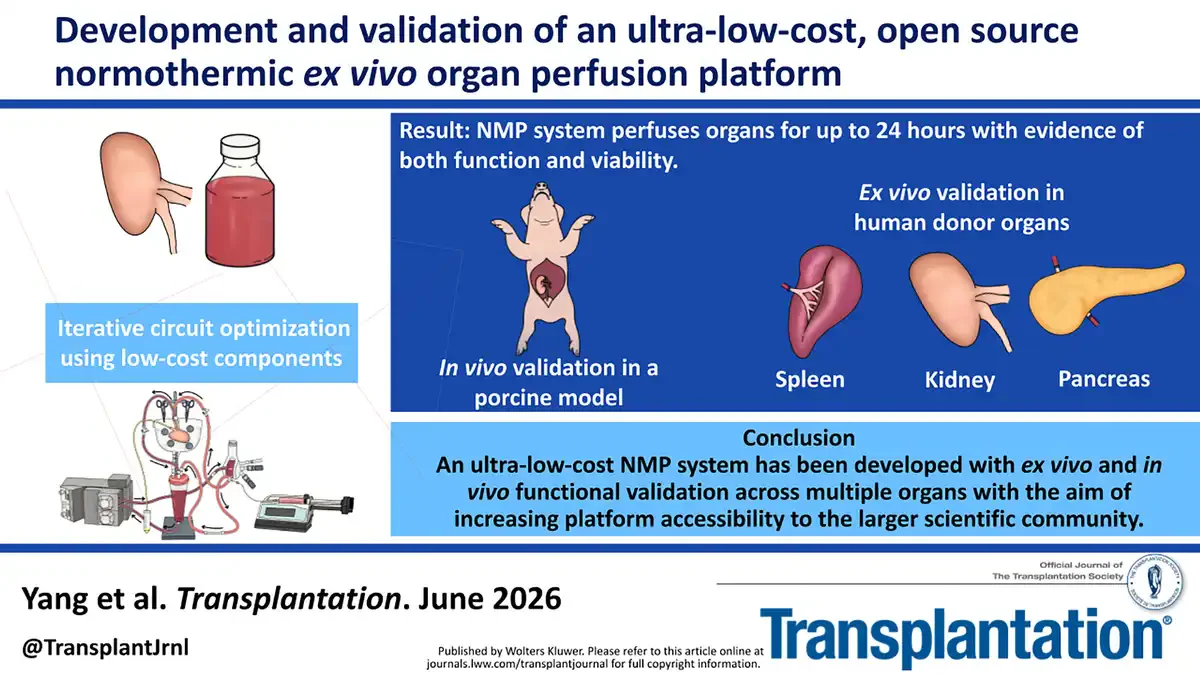
This article reports the development of an ultra-low-cost (~$2000), open-source normothermic machine perfusion (NMP) system constructed from recycled and readily available components. The platform demonstrated the capability to sustain functional perfusion of porcine kidneys and nontransplantable human organs (kidney, pancreas, spleen) up to 24 hours. Porcine kidneys perfused on the system were successfully autotransplanted with survival beyond 30 days, confirming in vivo viability. Key innovations include a novel low-flow perfusion mechanism for nonheparinized organs and a stabilization containment bag using adjustable magnets.
Study Background
Normothermic machine perfusion represents a promising frontier in organ preservation by maintaining organs at near-physiologic temperatures with oxygenated perfusate, facilitating viability assessment, therapeutic interventions, and disease modeling outside the body. Traditionally, commercial NMP devices are prohibitively expensive and technically complex, limiting their widespread adoption in research and clinical settings especially in resource-constrained environments. This cost and accessibility barrier poses significant challenges for advancing organ preservation science and increasing the utility of extended criteria and marginal donor organs.
Study Design
The research team designed an NMP circuit using low-cost, recycled, and repurposed materials to build a financially accessible perfusion system. The device was iteratively optimized using porcine kidneys perfused with autologous porcine blood, facilitating device refinement and functionality testing. To assess the biological relevance of ex vivo perfusion, a porcine kidney autotransplantation protocol was adapted to evaluate post-perfusion in vivo kidney function and survival. Nontransplantable human kidneys, along with spleen and pancreas specimens, were also perfused with human blood products to test cross-species applicability and device versatility.
Key Findings
The final ultra-low-cost NMP platform, costing approximately $2000, proved effective in maintaining organ function and viability ex vivo. Porcine kidneys perfused for up to 24 hours exhibited preserved renal function after autotransplantation, with recipients surviving for at least 30 days, which demonstrates sustained organ integrity and functionality post-NMP.
Application to human donor organs showed that kidneys, pancreas, and spleen could be perfused successfully, suggesting the platform’s broad utility for a range of solid organs. The adjustable containment bag using magnets provided stable organ positioning, mitigating mechanical injury during perfusion. The low-flow perfusion mechanism for nonheparinized organs addressed clotting challenges inherent in blood-based perfusion, improving system reliability and reducing need for anticoagulation.
Notably, the device markedly differed from commercially available NMP systems by leveraging affordable and recyclable components without sacrificing functional perfusion times. The open-source nature of the design encourages adoption and iterative improvements within the research and clinical communities.
Expert Commentary
This work represents a significant step towards democratizing NMP technology, making high-fidelity organ preservation accessible for diverse research applications and eventually clinical use. By addressing critical hurdles of cost, complexity, and availability, the study supports broader research into therapeutic interventions during ex vivo perfusion, potentially improving graft quality and transplant outcomes.
However, the system’s performance in longer-term perfusion beyond 24 hours and its application in transplantable human organs require further validation. Potential limitations include variability in recycled component performance and challenges in standardizing protocols across different centers. Subsequent studies should evaluate the device’s compatibility with various organ types and perfusate compositions, as well as long-term post-transplant outcomes in large animal models and clinical trials.
Conclusion
The study successfully demonstrates the feasibility of constructing a cost-effective, open-source NMP platform from commonly available materials that can sustain organ perfusion and function ex vivo. This scalable and financially sustainable model may catalyze advancements in organ preservation research, therapeutic development during perfusion, and improved utilization of marginal donor organs. Widespread implementation could ultimately enhance transplant quality and accessibility by overcoming entrenched financial and technological barriers associated with current commercial devices.
Funding and ClinicalTrials.gov
The article abstract and citation did not specify funding sources or clinical trial registrations. Readers are encouraged to consult the original publication for disclosures.
References
Yang H, Higgins N, Chu S, Lee J, Meyer N, Hansen K, et al. Development and Validation of an Ultra-low-cost, Open-source Normothermic Ex Vivo Organ Perfusion Platform. Transplantation. 2026 Sep 25;110(11):e2239-e2250. PMID: 42789778.
Akoh JA, Patel SK. Organ preservation in transplantation: A review of current and emerging technologies. Ann Transplant. 2018;23:700-713. doi:10.12659/AOT.907356.
Hosgood SA, Nicholson ML. The currently available organ preservation devices for kidney transplantation. Ann Transplant. 2017;22:605-612. doi:10.12659/AOT.902348.