Efficacy of Antifungal Therapies in Tinea Capitis: Insights from a Multicenter Study in China
Highlight
- Tinea capitis remains prevalent in China with Microsporum canis as the leading pathogen.
- Itraconazole and terbinafine are the most commonly prescribed systemic antifungals, with itraconazole showing higher success rates in treating gray patch tinea capitis and M. canis infections.
- All four studied antifungal agents—itraconazole, terbinafine, griseofulvin, and fluconazole—demonstrated good efficacy and tolerability.
- Lower efficacy of oral terbinafine in certain clinical types underscores the need for tailored antifungal regimens.
Study Background
Tinea capitis, a fungal infection of the scalp primarily affecting children but also seen across age groups, continues to pose a public health challenge in China. Despite advances in antifungal therapies, variability in clinical presentations, causative species, and drug responses necessitates region-specific epidemiological and treatment data. The standard of care involves systemic antifungal agents, yet comparative real-world effectiveness and optimal agents for specific fungal pathogens require further elucidation. This study addresses these knowledge gaps by prospectively examining epidemiological patterns and therapeutic outcomes across multiple tertiary centers in China.
Study Design
This was a multicenter, prospective real-world study conducted from August 2020 to December 2021, involving 20 tertiary hospitals across China. A total of 819 patients diagnosed clinically and mycologically with tinea capitis were enrolled. Patients underwent demographic data collection, clinical classification of tinea capitis types (notably gray patch), and fungal identification, primarily via cultures or microscopy. Treatment regimens included oral antifungal agents: itraconazole, terbinafine, griseofulvin, and fluconazole, administered per local protocols. Primary endpoints were clinical cure rates assessed after initial systemic therapy, with secondary analyses stratified by fungal species and clinical subtype.
Key Findings
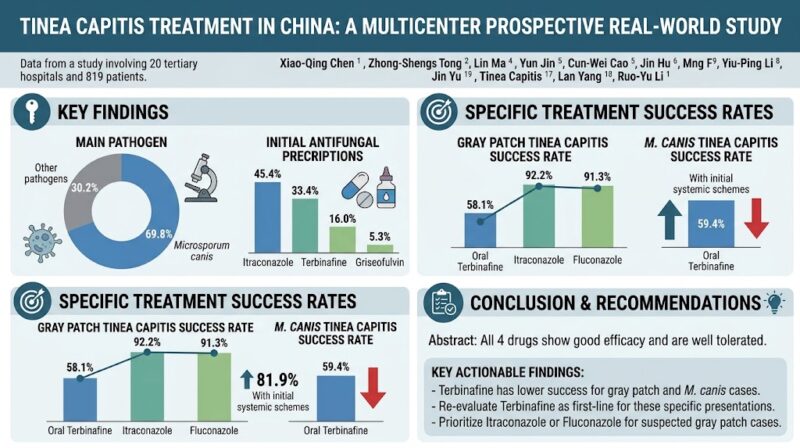
The predominant causative pathogen was Microsporum canis, accounting for approximately 69.8% of cases, consistent with prior regional data highlighting zoonotic sources. Oral itraconazole was the most frequently utilized antifungal (45.4%), followed by terbinafine (33.4%), with griseofulvin (16%) and fluconazole (5.3%) less commonly prescribed.
Overall, a high clinical cure rate of 81.9% was achieved after initial systemic therapy, affirming the effectiveness of oral antifungals in routine clinical practice in China. Specific subgroup findings included:
– In gray patch tinea capitis, the treatment success rate was substantially higher with itraconazole (92.2%) and fluconazole (91.3%) compared to terbinafine (58.1%), indicating variable drug efficacy relevant to clinical subtype.
– Terbinafine’s efficacy for M. canis infections was relatively limited, with a success rate of 59.4%, suggesting lower in vivo activity against this species.
– All four antifungal agents were generally well tolerated, with no significant adverse event signals reported.
The analysis underscores itraconazole’s superior clinical performance for the common M. canis pathogen and gray patch clinical type, challenging the assumption of terbinafine as a first-line agent in these cases.
Expert Commentary
The study’s prospective and multicenter real-world design enhances the reliability and generalizability of its findings within tertiary hospital settings in China. However, the limitation of including only tertiary centers might introduce referral bias toward more complex or refractory cases. Missing data may also affect the robustness of some subgroup analyses.
Nonetheless, these results align with biological plausibility; itraconazole’s broad-spectrum activity and pharmacokinetic properties facilitate better penetration into hair follicles and keratinized tissues, potentially explaining its clinical advantage over terbinafine, particularly for Microsporum species.
Current treatment guidelines often include griseofulvin as the historical gold standard and terbinafine as a favored alternative, but this study highlights the need to revisit antifungal selection strategies, particularly considering local epidemiology. Tailoring antifungal therapy according to species identification and clinical subtype can optimize outcomes and reduce treatment failures.
Conclusion
This comprehensive real-world investigation of tinea capitis treatment in China reveals Microsporum canis as the dominant pathogen and confirms that systemic antifungal therapies remain effective and safe. Itraconazole demonstrated superiority over terbinafine, especially in gray patch disease and M. canis infections, suggesting clinicians should consider species-level diagnosis and clinical presentation for optimal agent selection. Future studies should extend to primary care settings and explore long-term outcomes to enhance generalizability and inform national treatment guidelines.
Funding and Trial Registration
Details on funding sources and clinical trials registration were not specified in the publication.
References
Chen XQ, Tong ZS, Ma L, et al. Treatment of tinea capitis in China: a multicenter prospective real-world study. J Am Acad Dermatol. 2026 Aug 1; PMID: 42542189. Available from: https://pubmed.ncbi.nlm.nih.gov/42542189/
Other relevant literature supporting antifungal efficacy and tinea capitis epidemiology can be consulted for further reading.
This article was created using several editorial tools, including AI, as part of the process. Human editors reviewed this content before publication.