Highlight
First-in-human phase 1 study evaluating low-dose intralesional cemiplimab for early-stage cutaneous squamous cell carcinoma (CSCC).
Intralesional administration demonstrated acceptable safety with no grade 3 or higher adverse events.
High visual and pathologic complete response rates observed at week 13, especially with weekly 5 mg dosing.
Findings suggest a promising non-surgical therapeutic option warranting further clinical trials.
Study Background
Cutaneous squamous cell carcinoma (CSCC) is one of the most common non-melanoma skin cancers, with increasing incidence worldwide due to ultraviolet exposure and aging populations. Early-stage CSCCs, defined as lesions with diameters between 1 and 2 cm, typically undergo surgical excision as the standard of care. However, surgery carries risks including functional or cosmetic impairments and is not always feasible for all patients due to comorbidities or lesion location.
Currently, there is an unmet need for effective non-surgical treatments for early-stage CSCC that are both efficacious and have a favorable safety profile. Immunotherapy with programmed death-1 (PD-1) inhibitors like cemiplimab has proven effective for advanced or metastatic CSCC when administered systemically. Intralesional administration of such agents aims to deliver local immune activation with potential for fewer systemic side effects.
Study Design
This open-label, phase 1 pilot study (NCT03889912) investigated the safety and efficacy of low-dose intralesional cemiplimab in patients with early-stage CSCC. The study employed a dose-escalation design followed by expansion cohorts to refine dosing and administration frequency.
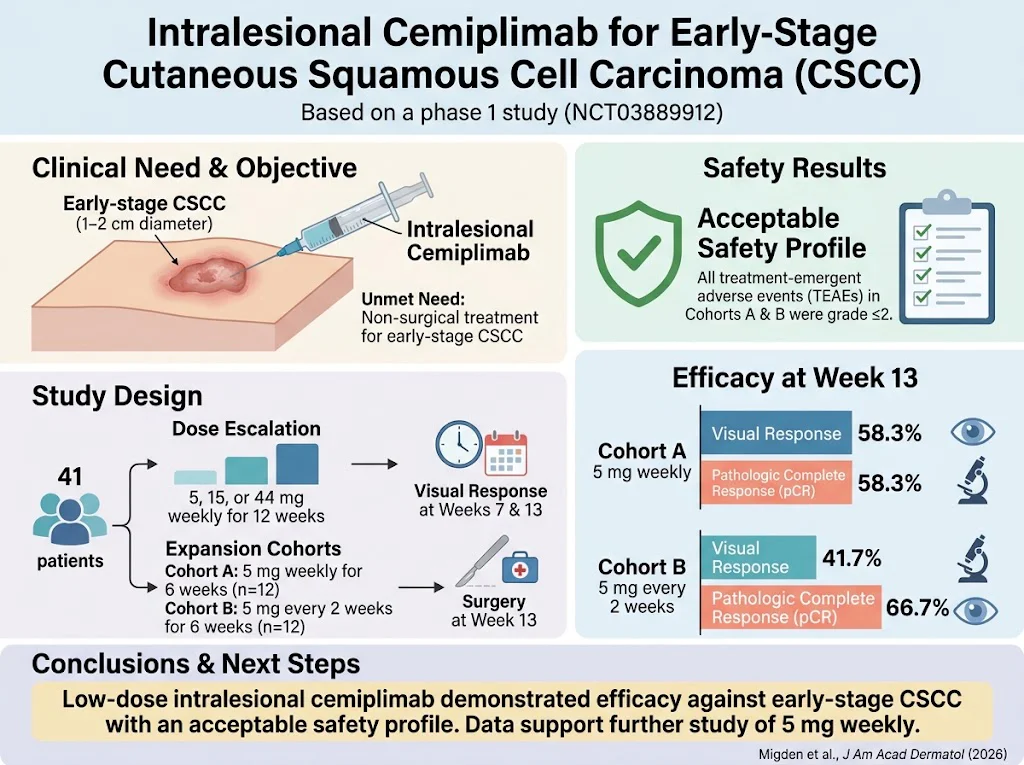
Eligible patients had a single CSCC lesion measuring 1–2 cm in diameter. One lesion per patient was injected with cemiplimab. Initial dose escalation cohorts received weekly injections of 5 mg, 15 mg, or 44 mg for 12 weeks. Subsequently, two expansion cohorts received 5 mg intralesional cemiplimab either weekly (Cohort A) or every two weeks (Cohort B) over 6 weeks.
Visual response assessments were conducted at weeks 7 and 13, with surgical excision performed at week 13 post-treatment to obtain pathological response data. Safety was the primary endpoint, while efficacy measures included visual and pathologic complete response rates.
Key Findings
A total of 41 patients were enrolled across dose escalation and expansion cohorts. The treatment was generally well tolerated with no grade ≥3 treatment-emergent adverse events reported, especially in the expansion cohorts where all adverse events were grade ≤2.
In Expansion Cohort A (5 mg weekly), 58.3% of patients achieved both visual and pathologic complete responses at week 13. Cohort B (5 mg every 2 weeks) showed visual and pathologic complete response rates of 41.7% and 66.7%, respectively. These findings suggest that weekly dosing may provide a more consistent clinical benefit, although pathologic complete responses in every 2-week dosing were notably high.
The variability in intralesional administration technique and the modest sample size were acknowledged as study limitations, which may affect generalizability. Nonetheless, the safety profile and efficacy outcomes encourage further exploration of this localized immunotherapeutic approach.
Expert Commentary
The results of this phase 1 study are encouraging, demonstrating that low-dose intralesional cemiplimab can elicit significant anti-tumor responses in early-stage CSCC with minimal toxicity. This novel approach leverages local immune activation, potentially reducing systemic exposure and associated risks compared to intravenous anti-PD-1 therapy.
From a mechanistic perspective, intralesional PD-1 blockade may enhance resident T-cell activation within the tumor microenvironment, promoting tumor regression. Given the dermatologic accessibility of CSCC lesions, intralesional delivery is feasible and may improve patient convenience and adherence.
However, larger, randomized controlled trials are essential to validate these preliminary efficacy signals, optimize dosing schedules, and compare outcomes with standard surgical excision and other non-surgical treatments such as topical chemotherapy or photodynamic therapy.
Current clinical guidelines for CSCC do not yet include intralesional immunotherapy, underscoring the need for robust clinical data to inform practice changes.
Conclusion
This phase 1 pilot study presents low-dose intralesional cemiplimab as a promising, safe, and effective therapeutic approach for patients with early-stage CSCC. The favorable safety profile and promising complete response rates suggest it could become an important non-surgical option in the future. Further studies with larger cohorts and long-term follow-up are warranted to establish its role in clinical practice.
Funding and ClinicalTrials.gov
The study was funded by the respective sponsoring institutions and companies involved in cemiplimab development. It is registered under ClinicalTrials.gov Identifier NCT03889912.
References
Migden M, Ibrahim SF, Strasswimmer J, Zeitouni N, Rogers GS, DeSimone J, Kheterpal M, Visich JE, Han H, Yoo SY, Seebach F, Lowy I, Cristea M, Fury M. Intralesional cemiplimab for patients with early-stage cutaneous squamous cell carcinoma: Results from a dose-escalation study with expansion cohorts. J Am Acad Dermatol. 2026 Oct 30:S0190-9622(26)03838-7. doi: 10.1016/j.jaad.2026.10.075. Epub ahead of print. PMID: 42962928.