Highlight
Long-term, low-dose capecitabine reduces the incidence of keratinocyte carcinomas in patients with refractory cutaneous field cancerization.
The treatment is generally well tolerated, with a low discontinuation rate due to toxicity.
Patient-reported satisfaction is high, with most preferring capecitabine over alternative therapies.
Statistical analysis showed significant reduction in skin cancer surgeries at 2 years, emphasizing sustained clinical benefit.
Study Background
Cutaneous field cancerization describes a chronic condition characterized by widespread precancerous and cancerous lesions—commonly actinic keratoses and keratinocyte carcinomas—due to cumulative ultraviolet damage. Management proves challenging because lesions are multifocal and often refractory to topical therapies like 5-fluorouracil or imiquimod. Patients suffer morbidity from frequent surgeries and lesions, as well as psychological distress. Thus, alternative systemic treatments with manageable toxicity profiles are needed.
Study Design
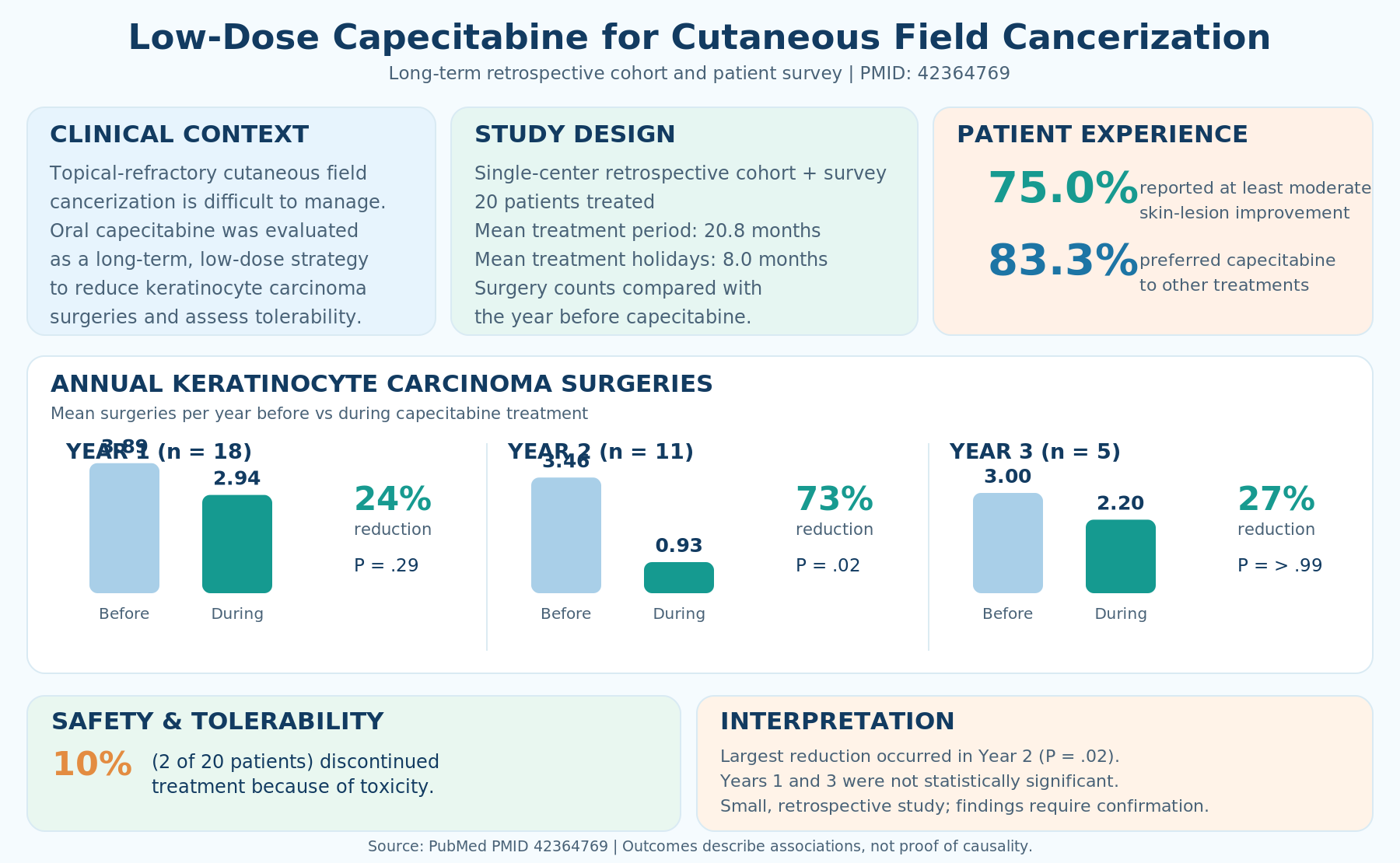
This retrospective cohort and survey study was conducted at a single institution to evaluate the efficacy, safety, and patient satisfaction associated with long-term, low-dose capecitabine in adults with topical-refractory cutaneous field cancerization. Twenty patients who received capecitabine over a mean duration of 20.8 months were included. Keratinocyte carcinoma surgeries performed annually before and after capecitabine initiation were assessed at one, two, and three years using the Wilcoxon matched-pairs signed-rank test to determine treatment impact.
Key Findings
The primary finding was a significant reduction in mean annual keratinocyte carcinoma surgeries at the two-year mark: a 73% reduction from 3.46 to 0.93 surgeries per year (P = .02). Although reductions were also observed at one year (24% reduction, P = .29) and three years (27% reduction, P > .99), these did not reach statistical significance, potentially due to smaller sample sizes (18 patients at one year, 5 at three years).
Among the 20 patients, 10% discontinued therapy due to toxicity, indicating acceptable tolerability of prolonged low-dose administration. The survey of patients (12 respondents from 17 invited, 70.6% response rate) revealed that 75% perceived at least moderate improvement in their skin lesions and 83.3% expressed preference for capecitabine over alternative treatments, underscoring patient satisfaction with the regimen.
Expert Commentary
Capecitabine, an oral prodrug of 5-fluorouracil, offers a systemic mechanism to suppress dysplastic epithelial proliferation across the field cancerization area, which may explain the observed decrease in keratinocyte carcinoma formation. The low-dose, long-term approach balances efficacy and toxicity, potentially improving adherence. The retrospective design and small sample size limit generalizability, and the possibility of confounding factors remains. However, these real-world data provide encouraging evidence supporting capecitabine as a therapeutic option in difficult-to-manage field cancerization cases.
Further prospective randomized studies are warranted to establish optimal dosing, duration, and long-term safety. Incorporation into treatment guidelines should be considered once more robust evidence is available. Attention to patient-reported outcomes strengthens the translational relevance of these findings.
Conclusion
Low-dose, long-term capecitabine represents a promising systemic treatment modality for patients with refractory cutaneous field cancerization. It significantly reduces keratinocyte carcinoma incidence over two years, achieves high patient satisfaction, and is generally well tolerated. This approach might reduce the burden of repeated surgeries and improve quality of life for affected patients. However, larger prospective studies are needed to confirm these findings and clarify its role in clinical practice.
Funding and Clinical Trials Registration
No funding information or clinical trial registration was reported for this study.
References
Neff H, Mortelliti C, Solomon B, Karn E, Stump M, Ran NA, Silk AW, Ruiz ES. Low-dose long-term capecitabine for refractory field cancerization: A retrospective cohort study. J Am Acad Dermatol. 2026 Jun 27;95(4):1053-1060. doi: 10.1016/j.jaad.2026.04.015. PMID: 42364769.
Sidhu S, Griffiths CE. Cutaneous field cancerization: Implications for immunosuppressive therapy in transplantation. Br J Dermatol. 2005;153(3):414-421.
Lock-Andersen J, Olsen J, Skovgaard LT, Heje M. Oral low-dose 5-fluorouracil treatment of patients with actinic keratoses: A prospective double-blind placebo-controlled study. Photodermatol Photoimmunol Photomed. 1997;13(6):209-213.