We use cookies

Our website uses essential cookies and, with your consent, additional cookies to measure performance and improve our services. Cookie Policy.

You can change your choice at any time.

MMedXYNews
HomeVideos
MedXY AI/MedXY News/Section: news

Effective Retinal Detachment Prevention in Type 2 Stickler Syndrome Using Cambridge Prophylactic Cryotherapy
MedXY Editorial Team•Sep 29, 2026•news
ophthalmologyretinal detachmentStickler syndromeprophylactic cryotherapy

Highlight

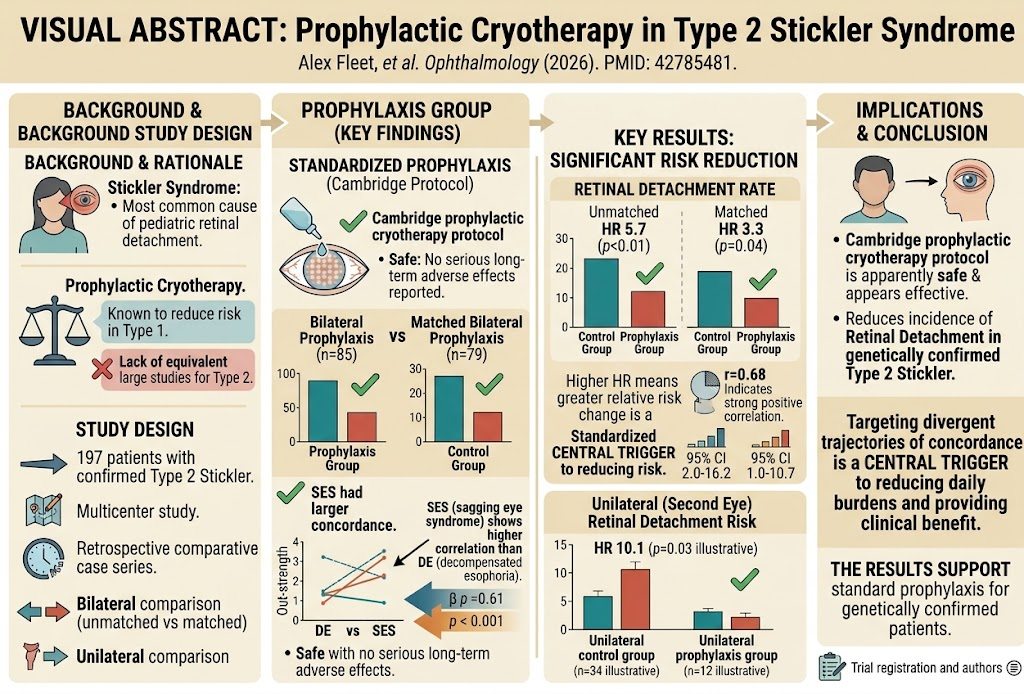
  • Prophylactic cryotherapy markedly reduces retinal detachment risk in genetically confirmed Type 2 Stickler syndrome patients.
  • The Cambridge protocol demonstrated a 3- to 10-fold reduction in detachment risk compared to untreated controls.
  • No serious long-term adverse effects were observed, supporting the safety of the intervention.
  • This study extends prophylactic efficacy evidence from Type 1 to Type 2 Stickler syndrome, suggesting broader applicability.

Study Background and Disease Burden

MedXY registered readers

Sign in free to continue reading

Create or use your MedXY account to unlock the complete article.

This article was created using several editorial tools, including AI, as part of the process. Human editors reviewed this content before publication.

Related articles

Open language-specific specialty feeds and department pages.

When Is High-Level Disinfection Needed for Reusable Ophthalmic Devices? A Multisociety Position Paper ExplainedA multisociety task force finds routine high-level disinfection (HLD) of reusable ophthalmic devices unnecessary in most clinics, recommends targeted HLD only for higher-risk encounters, and urges alignment of regulations with evidence.Oct 17, 2026Advancing Gender Equity in Ophthalmology: The Impact of Virtual Oral Board Exams on Workforce RepresentationThis study reveals a significant increase in female representation among American Board of Ophthalmology oral board examiners following the transition to virtual exams, while the proportion of female examinees remained stable from 2011 to 2Oct 11, 2026Individualized High-Fluence Corneal Cross-Linking for Ultrathin Keratoconus: Insights from the ELZA-sub400 ProtocolThe ELZA-sub400 protocol demonstrates safe and effective high-fluence corneal cross-linking tailored for ultrathin keratoconus corneas, halting ectasia progression in most treated eyes at 12 months with no endothelial damage.Oct 11, 2026
Loading comments...
MedXY briefing

Get the free newsletter

Evidence-led clinical news, trends, and analysis—delivered to your inbox.

Ask MedXY AI

Most popular

Intimate Health
Five Benefits for Women Continuing Sexual Activity After Menopause
Intimate Health
Why Some Women Have a Strong Sex Drive—And Why Men Shouldn't Worry About It
Nursing & care
How often should a couple have sex?
Cardiology
Precision Medicine for Long QT Syndrome Type 2: Lumacaftor Corrects Trafficking Defects and Shortens QT Interval
General Surgery
Optimizing Postoperative Opioid Prescriptions After Intra-Abdominal Cancer Surgery: Comparing the 5x-Multiplier and 3-Tier Models
© 2026 MedXY
Contact usAbout usPrivacy PolicyMedXY story
Evaluating Aflibercept With Reduced-Fluence Photodynamic Therapy in Polypoidal Choroidal Vasculopathy: Insights from Longitudinal OCT Angiography
This randomized trial compares aflibercept monotherapy versus combined with reduced-fluence photodynamic therapy for PCV, highlighting OCTA metrics that predict polypoidal lesion closure and treatment response over 52 weeks.
Oct 9, 2026
LYNX-1 Phase 3 Trial: Phentolamine Ophthalmic Solution for Dim Light Vision DisturbancesThe Phase 3 LYNX-1 trial demonstrates that 0.75% phentolamine ophthalmic solution improves mesopic low-contrast visual acuity and reduces photic symptoms in patients with dim light vision disturbances, including those post-keratorefractiveSep 20, 2026
Distinct Molecular and Clinical Profiles of USH2A-Associated Retinitis Pigmentosa in Korean Patients: Implications for Targeted TherapyThis study elucidates the unique East Asian-specific genetic variants and clinical progression of USH2A-associated retinitis pigmentosa in Koreans, highlighting the potential for exon 13-targeted treatments.Sep 19, 2026