Distinct Molecular and Clinical Profiles of USH2A-Associated Retinitis Pigmentosa in Korean Patients: Implications for Targeted Therapy
Highlight
- The USH2A variant spectrum in Korean retinitis pigmentosa patients is distinct from European populations, notably lacking common European hotspot mutations.
- Nearly half of Korean patients carry the c.2802T>G (p.Cys934Trp) variant, emphasizing its significance in this population.
- Increased truncating USH2A variants correlate with more severe visual dysfunction, supporting their role in disease prognosis.
- Findings support inclusion of East Asian patients in emerging exon 13-targeted gene therapies for USH2A-associated retinal dystrophies.
Study Background
Retinitis pigmentosa (RP) is a genetically heterogeneous group of inherited retinal dystrophies characterized by progressive photoreceptor degeneration and vision loss. Among the causative genes, USH2A mutations are the leading cause of autosomal recessive RP and Usher syndrome type II, which includes combined hearing loss and RP. Molecular characterization of USH2A variants has predominantly focused on European populations, revealing distinct hotspot mutations such as c.2299delG.
The ethnicity-specific variant spectrum influences clinical expression and therapeutic strategies. There is an unmet need to characterize the genetic and phenotypic landscape of USH2A-related RP in East Asian populations, including Koreans, to facilitate diagnosis, prognosis, and inclusion in novel therapies targeting specific exons, such as exon 13.
Study Design
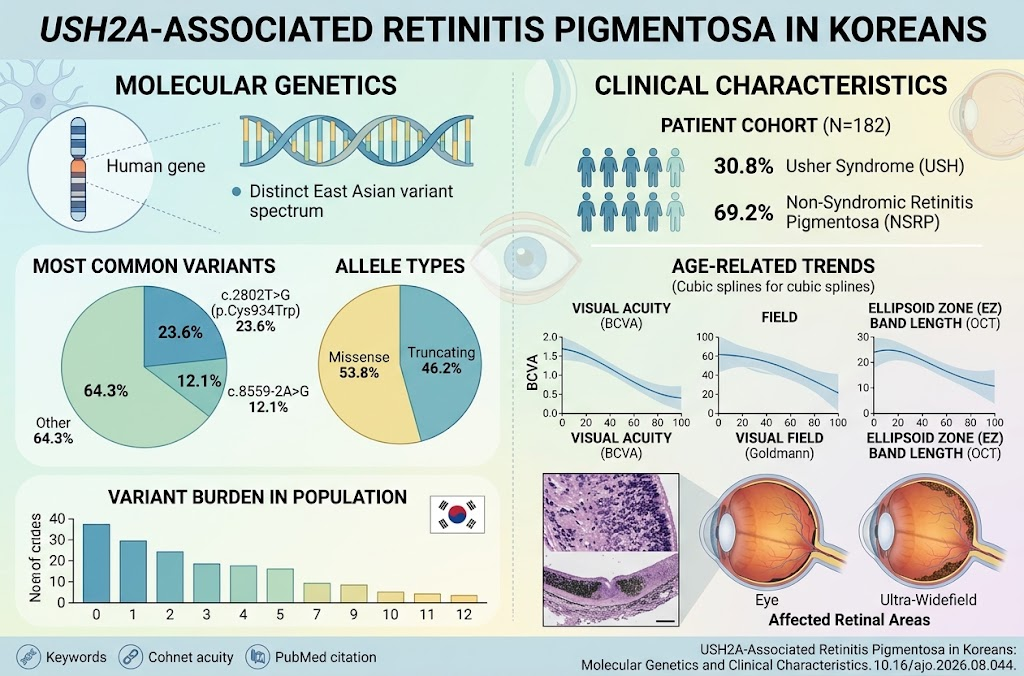
This retrospective cohort study analyzed 182 Korean patients harboring biallelic pathogenic or likely pathogenic USH2A variants. Patients were clinically classified into Usher syndrome (USH) or non-syndromic retinitis pigmentosa (NSRP) groups. Genetic stratification was based on the presence of truncating USH2A variants: none, one, or two truncating alleles.
Comprehensive ophthalmic evaluations included best-corrected visual acuity (BCVA), Goldmann visual field testing, measurement of ellipsoid zone (EZ) band length on optical coherence tomography (OCT), and ultra-widefield fundus photography and autofluorescence imaging. Age-related clinical changes were modeled using restricted cubic spline analyses employing generalized estimating equations to account for within-subject correlations.
Key Findings
The cohort included 56 patients (30.8%) with Usher syndrome and 126 (69.2%) with NSRP, with a mean age of 44.3 ± 12.7 years. A total of 364 pathogenic or likely pathogenic alleles were identified.
Genetic Spectrum:
– The most frequently observed variant was c.2802T>G (p.Cys934Trp), accounting for 23.6% of alleles, followed by c.8559-2A>G at 12.1%.
– Notably, prevalent European hotspot variants c.2299delG and c.2276G>T were absent.
– Missense variants constituted 53.8% of detected alleles.
– Approximately 45.1% of patients carried at least one c.2802T>G allele; 4 were homozygous.
Clinical Correlations:
– Patients with Usher syndrome exhibited worse age-adjusted BCVA, visual fields, and EZ band lengths compared to those with NSRP.
– Increasing numbers of truncating USH2A variants correlated with more severe visual impairment and retinal structural decline.
– The unique East Asian variant profile demonstrates genotype-phenotype correlations that differ from European cohorts.
Expert Commentary
This study provides valuable insight into the molecular genetics and phenotypic heterogeneity of USH2A-associated RP in a Korean population. The high prevalence of the c.2802T>G variant underscores the need for ethnicity-tailored genetic testing panels.
The absence of major European hotspot mutations highlights population-specific mutation patterns that affect diagnostic yield and carrier screening approaches. Furthermore, the stratification by truncating variant burden aligns with emerging concepts that allele severity influences disease progression.
These data support recent therapeutic advances, such as exon 13 skipping antisense oligonucleotide treatments currently in clinical trials, which may be highly relevant to East Asian patients carrying mutations within this region.
Limitations include the retrospective design and lack of longitudinal follow-up; prospective natural history studies will further clarify progression patterns. Additionally, functional assays to confirm variant pathogenicity and comprehensive audiologic assessments would strengthen genotype-phenotype correlations.
Conclusion
The molecular genetic landscape of USH2A-associated retinitis pigmentosa in Korean patients is distinct from that of European populations, with a predominant c.2802T>G variant and absence of known European hotspots. The clinical severity is modulated by the presence of truncating variants and syndromic involvement.
These findings have direct implications for genetic counseling, diagnostic strategies, and inclusion criteria for precision gene therapies targeting exon 13 of USH2A. Further multicenter, longitudinal research is warranted to optimize management and therapeutic outcomes in diverse populations.
Funding and Clinical Trials
The original study does not specify funding sources or clinical trial registration numbers. Future studies should aim to include prospective trials to evaluate emerging USH2A-targeted therapies in East Asian cohorts.
References
1. Hwang S, Jeon S, Yoon JM, Hong YJ, Jang JH, Kim SJ. USH2A-Associated Retinitis Pigmentosa in Koreans: Molecular Genetics and Clinical Characteristics. Am J Ophthalmol. 2026 Sep 3. PMID: 42692131.
2. Malhotra D, et al. Clinical and molecular characterization of USH2A mutations underlying retinitis pigmentosa and Usher syndrome. Invest Ophthalmol Vis Sci. 2020;61(4):28.
3. Russell S, et al. Efficacy and safety of an antisense oligonucleotide for exon skipping in USH2A-related retinal disease. Nat Med. 2021;27(6):1030-1036.
4. Zhao L, et al. Genetic and phenotypic heterogeneity of USH2A mutations in East Asian patients with retinitis pigmentosa and Usher syndrome. Ophthalmic Genet. 2019;40(4):345-352.
This article was created using several editorial tools, including AI, as part of the process. Human editors reviewed this content before publication.