East Asia-Specific Mycobacterium massiliense ST120: Phylogenomics, Clinical Impact, and Challenges in Pulmonary Disease Management
Highlight
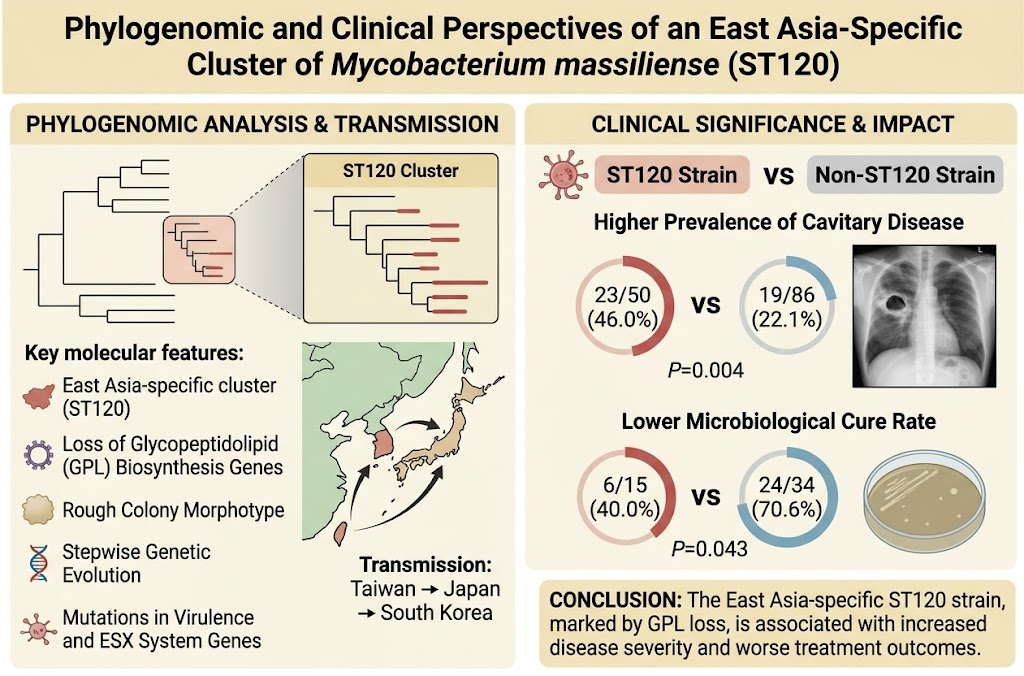
- Mycobacterium abscessus subspecies massiliense (MAM) ST120 is an East Asia-specific cluster predominantly found in South Korea, Japan, and Taiwan.
- ST120 isolates uniformly show a rough colony morphotype and deletion of glycopeptidolipid biosynthesis genes, linked to enhanced virulence.
- Phylogenomic analysis suggests ST120 evolved stepwise with transmission between Taiwan, Japan, and South Korea.
- Patients infected with ST120 have higher rates of cavitary lung disease and poorer microbiological cure following treatment compared to non-ST120 infections.
Background
Mycobacterium abscessus complex, including the subspecies massiliense (MAM), is a notable cause of non-tuberculous mycobacterial pulmonary infections, often presenting challenges in treatment due to intrinsic drug resistance and diverse clinical manifestations. Within-host adaptation can drive the emergence of genetically related clusters with distinct phenotypes affecting disease severity and outcomes. The ST120 strain of MAM has recently been identified as a genotype primarily circulating in East Asia, particularly in South Korea, Japan, and Taiwan. Understanding its epidemiology, genomic characteristics, and clinical impact is critical given the increasing global burden of pulmonary non-tuberculous mycobacterial disease and the need for effective targeted management strategies.
Study Design and Methods
This longitudinal observational study collected MAM isolates from 136 patients diagnosed with pulmonary MAM disease at Seoul National University Hospital between October 1, 2019, and December 31, 2023. Isolates underwent multilocus sequence typing (MLST) and colony morphotyping to classify strain types and morphotypes. Genetic deletions involving glycopeptidolipid (GPL) biosynthesis-related genes were assessed due to their known roles in bacterial surface phenotype and pathogenicity. Whole-genome sequencing (WGS) facilitated detailed phylogenomic and pangenome analyses, integrating additional MAM genomic data retrieved from public databases comprising 796 global strains. Transmission dynamics were inferred using phylogenetic methods. Clinical data including disease radiological presentations, cavitary involvement, treatment regimens, and microbiological cure outcomes were systematically evaluated and correlated with strain types.
Key Findings
Prevalence and Geographic Distribution: Of the 136 clinical isolates analyzed, 50 (36.8%) were classified as ST120. Utilizing a global strain database, ST120 was highly localized: 37.1% of South Korean isolates, 5.7% of Japanese isolates, and 3.8% of Taiwanese isolates belonged to this lineage. No ST120 strains were identified outside East Asia, indicating a geographically restricted dissemination pattern.
Genotypic and Phenotypic Characteristics: All ST120 isolates exhibited a rough colony morphotype—commonly associated with increased virulence in Mycobacterium abscessus. These isolates uniformly demonstrated deletions in genes related to GPL biosynthesis, affecting the bacterial outer surface and potentially contributing to enhanced pathogenicity and immune evasion. Phylogenomic trees depicted a stepwise evolutionary pattern suggesting ST120 strains originated in Taiwan, followed by spread to Japan and subsequently South Korea. Notably, these ST120 strains harbored mutations affecting virulence factors and displayed structural variations within the ESX secretion system, a key determinant in mycobacterial pathogenicity.
Clinical Impact: Patients infected with ST120 strains had a significantly higher prevalence of cavitary pulmonary lesions (46%) compared to those with non-ST120 strains (22.1%; P = .004). Cavitary disease is an established marker of severe pulmonary involvement and poorer prognosis. Regarding treatment response, among individuals who initiated therapy, only 40% of ST120-infected patients achieved microbiological cure versus 70.6% for those with non-ST120 infections (P = .043). These data underscore the clinical challenge posed by ST120, including greater disease severity and resistance to standard treatment approaches.
Expert Commentary
This study provides compelling evidence linking a genetically and geographically distinct MAM cluster to poor clinical outcomes, emphasizing the need for regional surveillance and individualized therapeutic strategies. The deletion of GPL biosynthesis genes coupled with ESX system alterations likely underpins increased virulence and treatment resistance, consistent with prior knowledge of rough morphotypes correlating with pathogenicity. The findings highlight the complexity of treating NTM pulmonary infections, where strain-specific characteristics substantially influence disease course. However, the relatively small patient subset undergoing treatment and the observational design limit definitive causal inferences on treatment response. Further prospective studies and mechanistic investigations are warranted to elucidate the molecular basis of ST120’s virulence and to optimize antimicrobial regimens.
Conclusion
The ST120 cluster of Mycobacterium massiliense represents a distinct East Asia-specific lineage characterized by extensive loss of glycopeptidolipid biosynthesis genes and increased virulence-associated mutations. Its presence correlates with more severe pulmonary disease manifestations, such as cavitary lesions, and lower rates of microbiological cure in clinical practice. These insights necessitate enhanced molecular epidemiological surveillance in endemic regions and may guide the development of strain-targeted therapeutic interventions to improve patient outcomes in non-tuberculous mycobacterial pulmonary disease.
Funding and Clinical Trials
The original study was conducted at Seoul National University Hospital. Details on funding sources or clinical trial registration were not provided in the source article.
References
- Kim DH, Jung S, Jung S, et al. Phylogenomic and Clinical Perspectives of an East Asia-Specific Cluster of Mycobacterium massiliense. Chest. 2026 Apr 22;170(3):701-713. PMID: 42031023.
- Griffith DE, Aksamit T, Brown-Elliott BA, et al. An Official ATS/IDSA Statement: Diagnosis, Treatment, and Prevention of Nontuberculous Mycobacterial Diseases. Am J Respir Crit Care Med. 2007 Feb 15;175(4):367-416.
- Howard ST, Rhoades E, Recht J, et al. Spontaneous reversion of Mycobacterium abscessus from a smooth to a rough morphotype is associated with reduced expression of glycopeptidolipid and acquisition of an invasive phenotype. Microbiology. 2006 Jun;152(Pt 6):1583-90.
- Wayne LG, Kubica GP. The Mycobacteria. In: Koch’s Postulates and the Mycobacteria. ASM Press; 2016.
This article was created using several editorial tools, including AI, as part of the process. Human editors reviewed this content before publication.