Highlight
This longitudinal study demonstrates that non-surgical periodontal therapy (NSPT) in patients with advanced periodontitis results in significant reductions in pathogenic bacterial extracellular vesicles (EVs) in saliva and plaque, alongside increased host cytokines associated with healing. Notably, shifts in fungal EV populations were also observed, suggesting microbial ecosystem modulation. These findings position salivary EVs as promising non-invasive biomarkers for monitoring therapeutic efficacy in periodontitis.
Study Background
Periodontitis is a prevalent chronic inflammatory disease characterized by destruction of the supporting structures of teeth, leading to tooth loss and systemic inflammation. It is driven primarily by dysbiotic biofilms comprising pathogenic bacteria and fungi interacting with host immune responses. Current clinical monitoring requires periodontal probing and radiographs, which, while informative, are invasive and do not capture dynamic molecular changes. Extracellular vesicles (EVs), small membrane-bound particles released by both host and microbial cells, carry proteins, nucleic acids, and lipids reflective of cellular states and interactions. Salivary EVs represent a minimally invasive source to assess host-microbe crosstalk and treatment response, but their longitudinal changes post therapy remain underexplored.
Study Design
This exploratory longitudinal cohort study enlisted 25 patients diagnosed with Stage III/IV periodontitis. Samples of unstimulated saliva and dental plaque from deep periodontal pockets were collected at baseline, 3 months, and 6 months post non-surgical periodontal therapy (NSPT). EVs were segregated into host-derived and microbial (bacterial and fungal) populations via immunoaffinity and size-exclusion chromatography techniques. Host salivary EV-associated cytokines were quantified using multiplex flow cytometry. Microbial communities from EVs, saliva, and plaque samples were profiled using 16S rRNA sequencing for bacteria and internal transcribed spacer (ITS) sequencing for fungi.
Key Findings
Clinically, all patients exhibited significant improvement in periodontal parameters at 3 and 6 months following NSPT, confirming therapeutic efficacy.
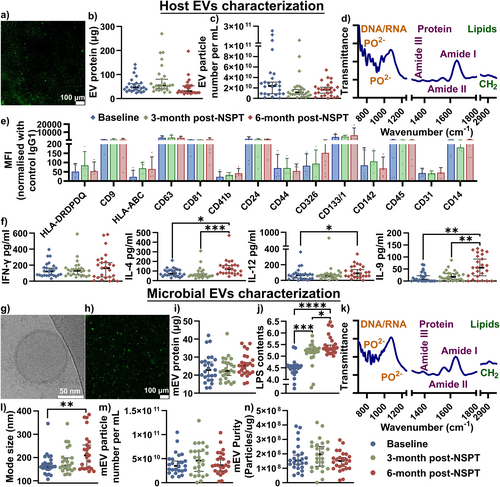
Host EVs and Cytokines: Post-therapy, salivary host EVs showed elevated levels of interleukin (IL)-4, IL-9, and IL-12 compared to baseline. These cytokines are known to contribute to modulation of immune responses, favoring resolution of inflammation and tissue repair. Importantly, these changes were detected in EV cargo rather than whole saliva, underlining the specificity of EV analysis for monitoring subtle immunological shifts.
Bacterial EVs and Microbial Taxa: NSPT led to a statistically significant reduction in bacterial EVs corresponding to key periodontal pathogens and associated taxa. Genus-level decreases were observed in Filifactor, Parvimonas, and Lentimicrobium. At the species level, major pathogens implicated in periodontitis, including Fusobacterium nucleatum, Filifactor alocis, Tannerella forsythia, Treponema denticola, Porphyromonas gingivalis, P. endodontalis, P. micra, and Lachnospiraceae bacterium, declined in bacterial EV content. These microbial shifts paralleled reductions in viable bacterial populations detected in both plaque and whole saliva samples, indicating a comprehensive ecological impact of therapy that is detectable at the EV level.
Fungal EV Dynamics: The fungal community within EVs also changed post-treatment. EVs derived from Malassezia arunalokei decreased significantly by 6 months, whereas those from Candida parapsilosis increased. This suggests that periodontal therapy not only modulates bacterial populations but also alters the oral fungal mycobiome, which may have implications on local immunity and disease progression.
Expert Commentary
This study advances the understanding of periodontitis pathobiology by integrating host immune and microbial vesicular components dynamically tracked over treatment. The elevation of regulatory and pro-resolving cytokines such as IL-4, IL-9, and IL-12 within host EVs aligns with restored immune homeostasis. Concurrent depletion of bacterial EVs from classic periopathogens validates NSPT’s role in biofilm disruption and microbial reduction.
Interestingly, the distinct changes in fungal EV populations raise new questions about the mycobiome’s role in periodontal health and recovery, a field warranting further mechanistic research. While the study’s sample size limits statistical power and generalizability, the multiplex methodology exemplifies a robust analytical approach combining immunological and microbial signatures.
Future investigations should expand cohort sizes, include control populations, and correlate EV profiles with clinical outcomes longitudinally to validate utility as biomarkers. Integration with host genetic and systemic parameters might further refine personalized treatment strategies.
Conclusion
This exploratory longitudinal analysis conclusively shows that non-surgical periodontal therapy induces significant, measurable shifts in the cargoes of salivary extracellular vesicles derived from both host and microbial origins. The findings bolster the concept of EVs as minimally invasive biomarkers capable of reflecting immunological and microbiological landscape remodeling during periodontitis treatment. Such markers have promising application potential for real-time disease activity monitoring and individualized therapeutic assessment.
Implementing EV-based diagnostics in clinical practice may enhance treatment decision-making and patient outcomes by providing molecular-level insights inaccessible through conventional means.
Funding and ClinicalTrials.gov
The article does not specify funding sources or clinical trial registration details. Future publications should include these for transparency and replication facilitation.
References
1. Liu C, Wang J, Lai A, Salomon C, Seneviratne CJ, Ivanovski S, Han P. An Exploratory Longitudinal Analysis of Salivary Host, Bacterial and Fungal Extracellular Vesicles Following 6-Month Non-Surgical Periodontal Therapy in Periodontitis. J Clin Periodontol. 2026 Oct 23; PMID: 42919615.
2. Hajishengallis G. Periodontitis: from microbial immune subversion to systemic inflammation. Nat Rev Immunol. 2015 Jan;15(1):30-44.
3. Tawakoli PN, et al. Salivary cytokines as biomarkers for periodontitis – a systematic review and meta-analysis. J Clin Periodontol. 2019;46:494-505.
4. Lässer C, et al. Extracellular vesicles – new players in viral infection and pathogenesis. Int J Mol Sci. 2018;19(3): 577.
5. Abusleme L, et al. The subgingival microbiome in health and periodontitis and its relationship with community biomass and inflammation. ISME J. 2013;7(5):1016-1025.
6. Zheng Y, et al. The Oral Mycobiome and Periodontal Disease. Int J Mol Sci. 2021;22(9): 4623.