Highlight
1. The ENCIRCLE trial demonstrates that percutaneous transseptal TMVR with the SAPIEN M3 system provides sustained near-complete mitral regurgitation reduction at 2 years in patients unsuitable for surgery or edge-to-edge repair.
2. Significant improvements in patients’ functional status and health-related quality of life were maintained, with 87% in NYHA class I/II at 2 years.
3. The composite rate of all-cause mortality or heart failure hospitalization at 2 years was 35.6%, with manageable rates of stroke, valve thrombosis, and hemolysis.
4. No clinically significant left ventricular outflow tract obstruction was observed, underscoring the safety of the fully percutaneous transseptal approach.
Study Background
Mitral regurgitation (MR) is a common valvular heart disease causing significant morbidity and mortality due to progressive heart failure and functional decline. Surgical mitral valve replacement or repair remains the definitive treatment; however, many patients are high risk or ineligible for surgery due to comorbidities or frailty. Transcatheter mitral valve interventions have emerged as less invasive alternatives, especially for symptomatic patients who cannot undergo surgery. While transcatheter edge-to-edge repair is established, anatomical constraints limit its applicability. The transcatheter mitral valve replacement (TMVR) via a fully percutaneous transseptal approach with devices like the SAPIEN M3 system offers an innovative solution. The ENCIRCLE trial was designed to evaluate the safety and effectiveness of this procedure over extended follow-up in a carefully selected high-risk population.
Study Design
The ENCIRCLE trial is a prospective, multi-center clinical study enrolling symptomatic patients with severe (≥3+) mitral regurgitation who were deemed unsuitable for surgical intervention or transcatheter edge-to-edge repair. All patients underwent TMVR using the fully percutaneous transseptal SAPIEN M3 system. The trial included rigorous independent oversight, incorporating an echocardiographic core laboratory to validate imaging endpoints and a clinical events committee to adjudicate adverse events objectively. Key endpoints analyzed were a composite of all-cause mortality or heart failure hospitalization (HFH), echocardiographic MR severity, clinical functional status via NYHA classification, health-related quality of life assessed by the Kansas City Cardiomyopathy Questionnaire (KCCQ), and exercise tolerance measured by the 6-minute walk test. Safety endpoints included rates of stroke, valve thrombosis, hemolysis, and left ventricular outflow tract (LVOT) obstruction.
Key Findings
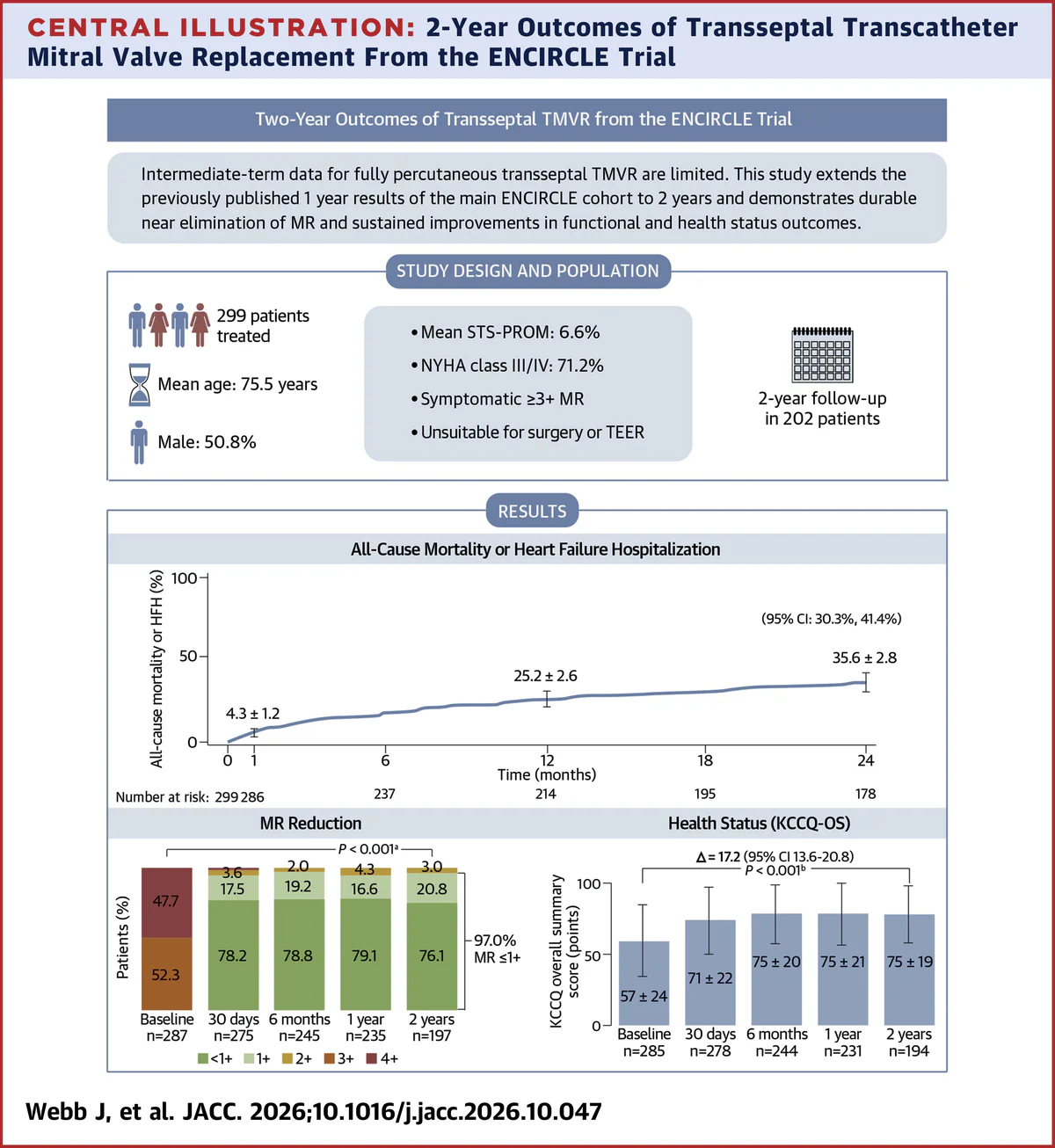
From January [start date] to [end date], 299 patients received transseptal TMVR with the SAPIEN M3 device. Two-year follow-up data were complete for 202 of 210 eligible patients (96.2%), reflecting high retention. Patients had a mean age of 75.5 ± 9.3 years, balanced gender distribution (50.8% male), and an elevated surgical risk profile with Society of Thoracic Surgeons Predicted Risk of Mortality of 6.6% ± 4.1%.
Mitral Regurgitation and Echocardiographic Outcomes: The remarkable efficacy of TMVR was demonstrated by sustained MR reduction. At 2 years, 97.0% of patients exhibited MR severity ≤1+ (P < 0.001 vs. baseline), confirming durable near elimination of regurgitation.
Mortality and Heart Failure Hospitalization: The composite endpoint of all-cause mortality or HFH occurred in 35.6% of patients at 2 years, with 25.1% mortality and 23.0% HFH. A landmark analysis from 1 to 2 years revealed reduced rates: 13.0% for all-cause mortality and 10.6% for first HFH, suggesting that clinical stability improves beyond the first post-procedural year.
Safety Outcomes: The incidence of disabling stroke was 6.6%, clinically significant valve thrombosis occurred in 7.1%, and hemolysis requiring intervention was documented in 7.6%. Notably, there were no cases of clinically significant LVOT obstruction, an important safety consideration in TMVR designs. These event rates are congruent with the high-risk profile and comorbidities in the study population and underscore the importance of vigilant post-procedural monitoring and anticoagulation management.
Functional and Quality of Life Improvement: Patient-centered outcomes were highly favorable. At 2 years, 87.0% of patients were classified as NYHA functional class I or II, a significant improvement from baseline (P < 0.001). Mean KCCQ overall summary score increased by 17.2 points (P < 0.001), demonstrating enhanced health-related quality of life. The 6-minute walk distance showed a nonsignificant mean increase of +9.0 ± 97.3 meters, indicating modest exercise capacity gains likely influenced by baseline functional status variability.
Expert Commentary
The 2-year data from the ENCIRCLE trial significantly advance the field of transcatheter mitral therapies by demonstrating the durable efficacy of a fully transseptal TMVR system in a challenging patient subgroup. The near-complete suppression of MR with sustained functional and quality-of-life benefits validates the SAPIEN M3 approach as a viable alternative for patients contraindicated for traditional surgery or edge-to-edge repair. The absence of clinically significant LVOT obstruction affirms the safety engineering of the device and procedural technique. However, the incidences of stroke, valve thrombosis, and hemolysis highlight persistent procedural risks requiring ongoing optimization of patient selection, procedural protocols, and post-implantation anticoagulant strategies. Limitations include lack of a control group and potential selection bias, but the trial’s robust follow-up and independent event adjudication enhance data reliability.
Conclusion
The ENCIRCLE trial provides compelling evidence that percutaneous transseptal TMVR with the SAPIEN M3 system offers durable mitral regurgitation reduction with meaningful improvements in symptom burden and health status over 2 years in high-risk symptomatic patients. Despite notable safety events, the balance of benefits supports TMVR as an important addition to the therapeutic armamentarium for mitral valve disease when conventional options are unsuitable. Future studies should focus on refining patient selection, reducing thromboembolic risks, and comparative evaluations against alternative transcatheter therapies.
Funding and ClinicalTrials.gov
The ENCIRCLE trial was conducted by an international collaborative investigator group with supported oversight. The trial is registered under NCT04153292.
References
1. Webb J, Guerrero ME, Muhammad KI, et al. Percutaneous Transcatheter Mitral Valve Replacement for Symptomatic Mitral Regurgitation: 2-Year Outcomes From the ENCIRCLE Trial. J Am Coll Cardiol. 2026 Nov 3; PMID: 42980633.
2. Leon MB, Mack MJ, Hahn RT, et al. Transcatheter Mitral Valve Repair and Replacement: Recent Advances and Future Directions. Circulation. 2022;145(4):303-316.
3. Nishimura RA, Otto CM, Bonow RO, et al. 2020 ACC/AHA Guideline for the Management of Patients With Valvular Heart Disease. Circulation. 2021;143:e72–e227.
4. Guerrero ME, Urena M, Himbert D, et al. Clinical Outcomes of Transcatheter Mitral Valve Replacement in High-Risk Patients. J Am Coll Cardiol. 2018;71(7): 761–770.