Highlight
This prospective SPRING study demonstrates that early pregnancy insulin resistance is linked to higher birthweight percentile while early insulin secretory dysfunction predicts increased postpartum glucose levels. The findings support a mechanistic distinction in how these two metabolic abnormalities differentially influence maternal and fetal outcomes.
Study Background
Gestational diabetes mellitus (GDM) and related hyperglycemia in pregnancy pose significant risks for both the mother and fetus, including macrosomia, perinatal complications, and future metabolic disease. Insulin resistance and beta-cell dysfunction are the principal pathophysiological processes underpinning these risks, yet their individual contributions during early pregnancy remain incompletely characterized. A better understanding of these mechanisms has implications for early risk stratification and individualized management approaches designed to optimize both neonatal outcomes and maternal long-term metabolic health.
Study Design
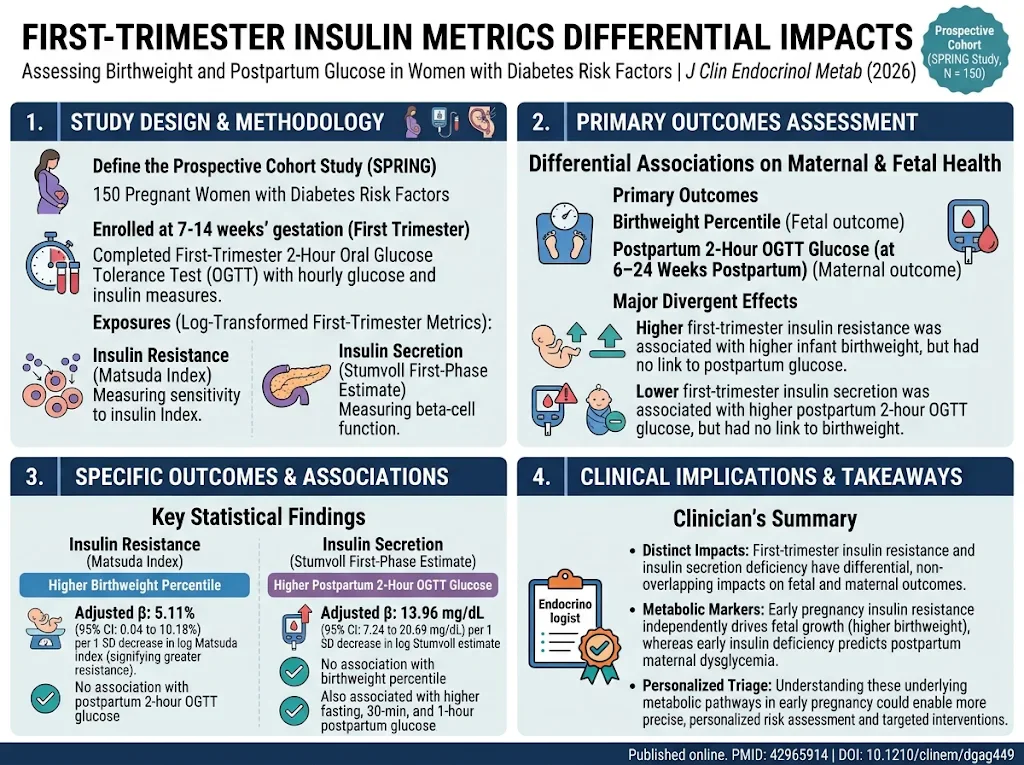
The Study of Pregnancy Regulation of Insulin and Glucose (SPRING) is a prospective cohort investigation enrolling 150 pregnant women at 7-14 weeks’ gestation who presented risk factors for diabetes. Participants underwent a comprehensive 2-hour oral glucose tolerance test (OGTT) with insulin and glucose measured hourly. Insulin resistance was quantified using the log-transformed Matsuda index, reflecting systemic insulin sensitivity, while first-phase insulin secretion was estimated by the log-transformed Stumvoll first-phase estimate, a validated surrogate for pancreatic beta-cell function. Primary endpoints included infant birthweight percentile and 2-hour OGTT glucose levels measured postpartum at 6-24 weeks. Secondary postpartum endpoints included fasting, 30-minute, and 1-hour OGTT glucose values. Multivariable linear regression models were adjusted for relevant covariates to test for associations between standardized insulin parameters and outcome measures.
Key Findings
The analysis revealed a statistically significant association between higher first-trimester insulin resistance and elevated birthweight percentile (adjusted β: 5.11%, 95% CI: 0.04 to 10.18 per 1 standard deviation decrease in log Matsuda index), indicating that lower insulin sensitivity early in pregnancy predisposes to fetal overgrowth. Contrarily, insulin resistance was not associated with postpartum glucose values, suggesting limited influence on maternal glycemic control after delivery.
Conversely, diminished insulin secretory capacity in early pregnancy was not related to birthweight percentile but was strongly associated with higher postpartum 2-hour OGTT glucose (adjusted β: 13.96 mg/dL, 95% CI: 7.24 to 20.69 per 1 SD decrease in log Stumvoll estimate). This relationship extended to fasting, 30-minute, and 1-hour OGTT glucose values postpartum, (all statistically significant), highlighting insulin secretory dysfunction as a critical determinant of postpartum glucose dysregulation. These findings underscore a mechanistic divergence in which insulin resistance primarily influences fetal growth, while insulin secretion deficits impact maternal glucose metabolism after pregnancy.
Expert Commentary
These differential associations between insulin resistance and secretion with distinct maternal and fetal outcomes reflect the complex interplay of gestational metabolic physiology. Early insulin resistance likely increases glucose availability to the fetus, promoting macrosomia, a known risk factor for neonatal complications and future obesity. On the other hand, impaired beta-cell function manifested as insulin secretory deficiency signals an intrinsic maternal metabolic vulnerability that may predispose to persistent postpartum hyperglycemia and type 2 diabetes development, consistent with prior evidence.
The study’s strengths include early gestational metabolic assessment and comprehensive postpartum glucose profiling. Limitations include a relatively modest sample size and the use of surrogate indices for insulin dynamics rather than direct clamp measurements. Nonetheless, these findings highlight the potential clinical utility of dissecting hyperglycemia pathophysiology early in pregnancy to refine risk prediction and personalized interventions.
Conclusion
This SPRING cohort secondary analysis importantly delineates how insulin resistance and secretory dysfunction in early pregnancy differentially affect birthweight and postpartum glucose homeostasis. These insights encourage clinicians to consider individualized metabolic evaluations beyond glucose levels alone. Future research should explore tailored therapeutic strategies targeting specific insulin defects to optimize maternal and offspring outcomes in diabetes risk pregnancies.
Funding and Registration
The study was supported by institutional research grants (details not provided in the source abstract). Public registry information was not specified.
References
Soria-Contreras DC, Rosenberg EA, Shames HE, et al. Insulin Sensitivity and Insulin Secretion Differentially Affect Birthweight and Postpartum Glucose. J Clin Endocrinol Metab. 2026;doi:10.1210/jc.2026-0000. PMID:42965914.
Buchanan, T.A., Xiang, A.H. Gestational diabetes mellitus. J Clin Invest. 2005 Mar;115(3):485-91.
Retnakaran, R., et al. Early metabolic predictors of glucose intolerance in pregnancy. Diabet Med. 2010;